Physical Address
304 North Cardinal St.
Dorchester Center, MA 02124
Physical Address
304 North Cardinal St.
Dorchester Center, MA 02124
Your Go-To for Digital Advice
Your Go-To for Digital Advice
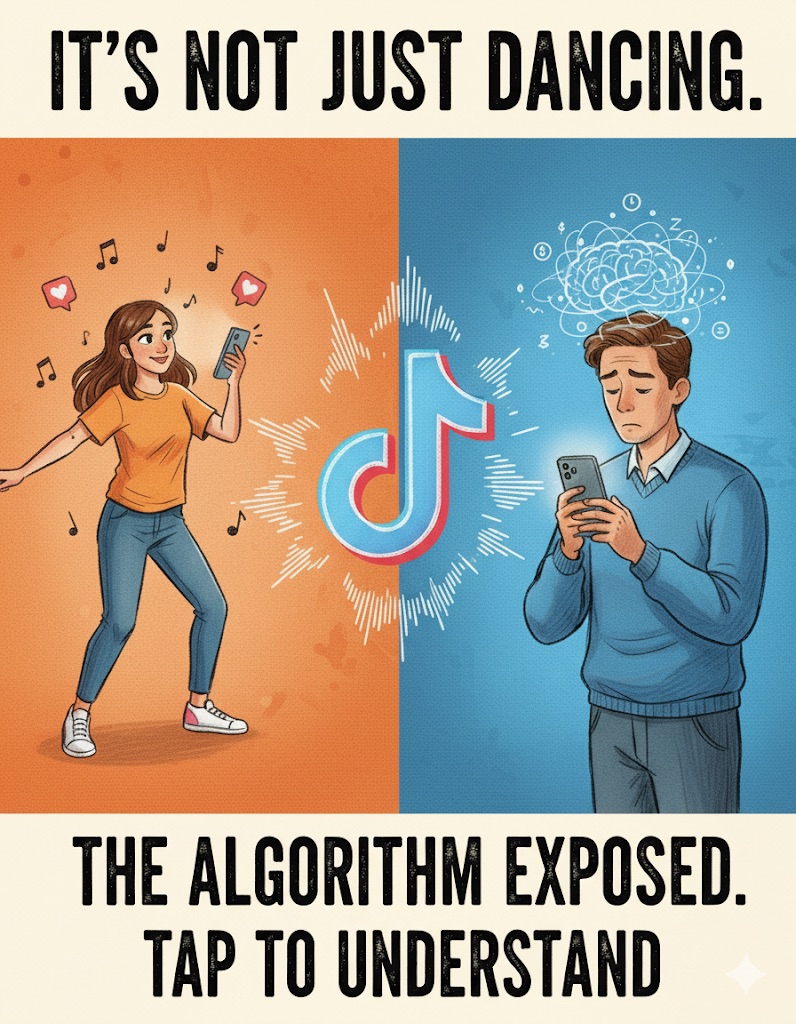
Discover TikTok's secrets: How its personalized algorithm tailors your experience, and learn essential tips to keep your family safe in this 2025 guide.
By Richard / December 2025. When most people hear “TikTok,” they picture teenagers dancing to loud music. It is easy to dismiss it as a waste of time. But if you look past the noise, you will discover that TikTok is actually a sophisticated tool for entertainment, learning, and connection—and also one of the most psychologically designed platforms on the internet. At Understand Tech, we want to break down exactly how it works, why it is so engaging, what the real risks are, and how you can keep your family safe while using it.
What this comprehensive guide covers:
The biggest mistake parents make is judging TikTok by its most visible content. Yes, there are dance videos. Yes, there are viral trends. But beneath the surface, TikTok is something far more sophisticated: a personalised content machine that learns your interests faster than any other social platform.
According to ByteDance (TikTok’s parent company), the algorithm is so effective that within just one hour of use, it has tailored your feed to match your interests with approximately 80% accuracy. By day three, it has essentially built a personal TV channel just for you.
This is not accidental. It is engineered.
To understand TikTok, you have to understand the For You Page (FYP). This is the primary feed—the endless stream of videos TikTok shows you when you open the app. Unlike Instagram or Facebook, where you see posts from people you follow, the FYP shows you videos from anyone on the platform, curated specifically for you.
TikTok collects data on:
Here is how it works in practice: You open TikTok and watch three videos about gardening. You stop scrolling on each one and rewatch them. You like one and share it with a friend. TikTok’s algorithm immediately registers this pattern: “This user has an interest in gardening.” Within the next 10 videos, approximately 6–7 of them will be gardening-related. Within 24 hours, gardening content will dominate your feed. Within 3 days, your TikTok looks completely different from your friend’s TikTok, even though you both started with the same default feed.
Instagram, Facebook, and YouTube all use algorithms, but TikTok’s is noticeably more effective. Here is why:
For a child or teen, this has a profound implication: the more they use TikTok, the more accurately it predicts and delivers what they want to see. This creates a powerful feedback loop that makes it genuinely hard to stop.
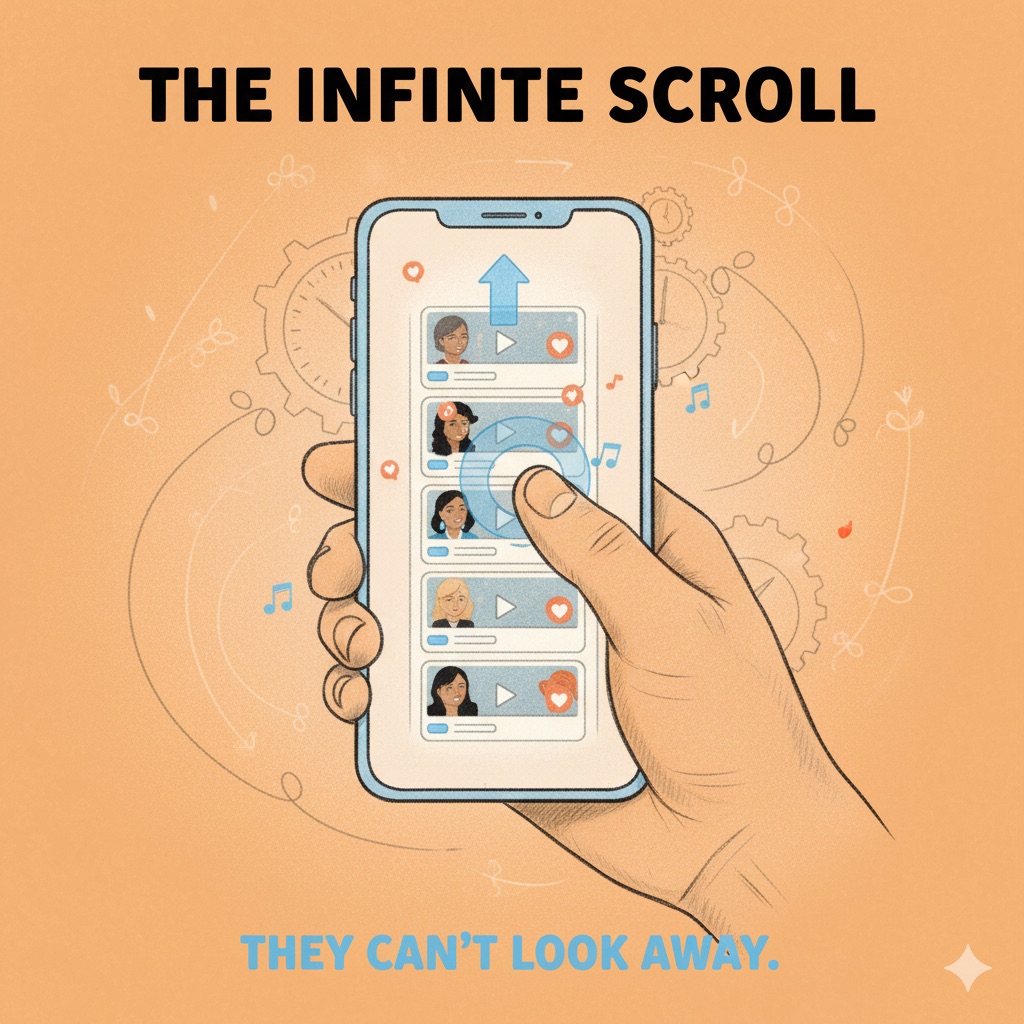
You sit down to watch TikTok for “five minutes” before dinner. You emerge 90 minutes later with no idea where the time went. This is not a personal weakness—it is by design.
TikTok uses a design pattern called the Infinite Scroll. As you swipe up, the next video plays instantly. There are no pages to turn, no “load more” buttons, no natural stopping points. The friction is removed entirely.
Compare this to traditional TV: if you want to watch the next episode, you have to make a conscious decision. You have to reach for the remote or navigate a menu. This friction creates a moment of reflection: “Do I really want to keep watching?”
On TikTok, there is no such moment. The next video just appears. Your brain does not have time to evaluate whether you want to continue.
Research from the University of Pennsylvania (2025) found that users consistently underestimate their TikTok use by an average of 48 minutes per session. If someone thinks they have been on TikTok for 20 minutes, they have actually been scrolling for about 68 minutes.
Why does this happen? Several factors:
Understand Tech Tip: Set a visible timer before opening TikTok. Use your phone’s alarm or a kitchen timer. It breaks the “trance” and gives your brain a conscious stopping point. Research shows this simple intervention reduces average TikTok sessions by 35–40%.
Beyond addiction and time loss, there is a growing body of research on the psychological impacts of heavy TikTok use on young people. The findings are concerning.
⚠️ Important note: These research findings do not mean TikTok is inherently harmful. Light to moderate use (under 2 hours daily) has not been shown to cause significant psychological damage. The problems emerge with heavy use—especially when combined with late-night scrolling or use in isolation.
Beyond the psychological design, there are specific content categories and trends on TikTok that pose safety and wellbeing risks for young people.
✓ What to do: Keep communication open. Ask your child to show you their FYP occasionally and ask questions: “What is this video about? Do you believe this information? Have you seen lots of videos like this?” This teaches critical consumption without being accusatory.
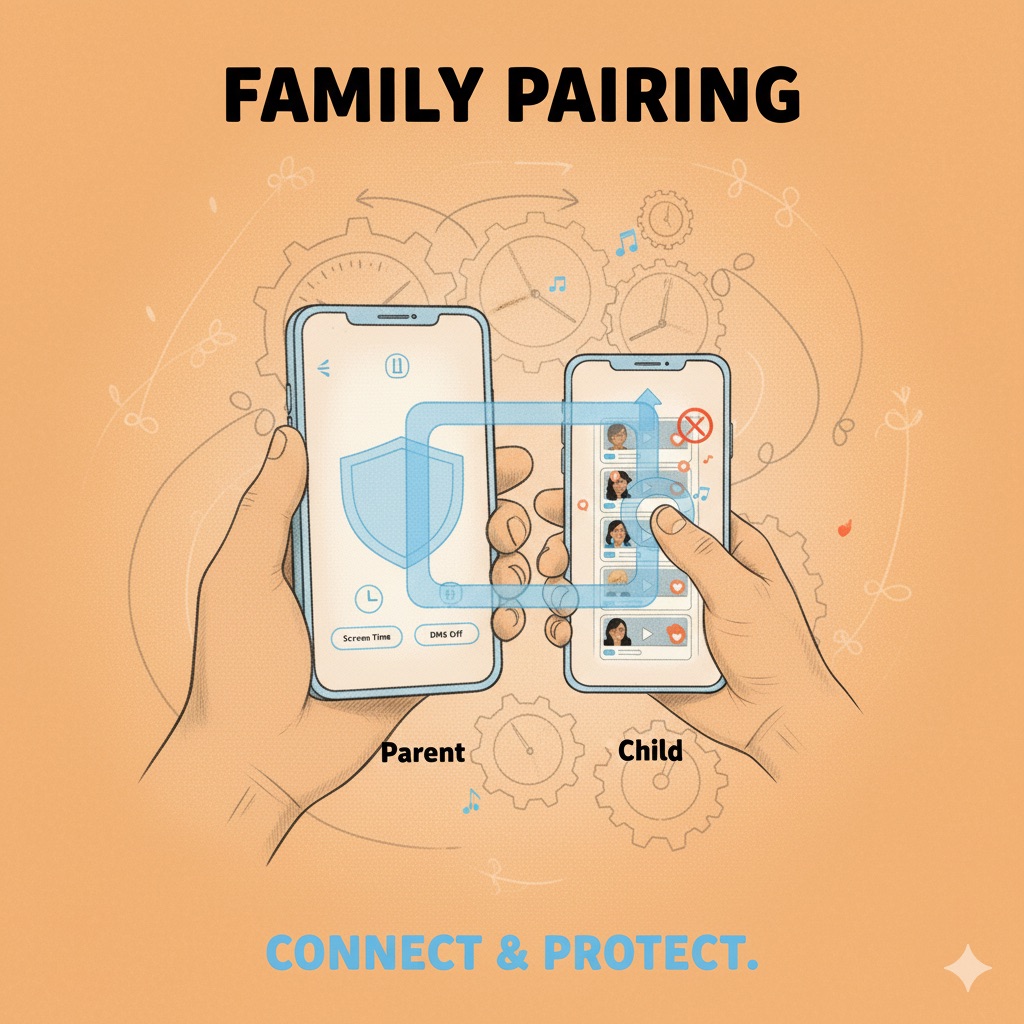
TikTok’s most powerful parental control is called Family Pairing. This feature allows a parent to link their device to a child’s device, giving you oversight and control without needing to know their password or check their phone.
On your device (parent):
On your child’s device:
Back on your device: You will now see a notification asking you to accept the link. Once confirmed, you can access all the controls listed above.
Important: Family Pairing works best when set up collaboratively. Sit down with your child and explain what you are doing and why. “I am setting this up not to spy on you, but to help you use TikTok in a way that feels good for you.” Transparency builds trust; hidden controls breed resentment and workarounds.
Even with Family Pairing enabled, watch for these warning signs of unhealthy TikTok use:
✓ If you spot red flags: Have a calm conversation first, not an accusation. “I have noticed [specific behaviour]. What is going on?” Listen before you judge. Many teens can self-correct if given the chance.
The Situation: Sophie asked for TikTok at age 12. Her parents agreed but set up Family Pairing immediately with a 45-minute daily limit.
What Happened: Within one week, Sophie had hit her 45-minute limit every single day. By week two, she was asking to extend the time limit. By week three, she admitted she was thinking about TikTok during school and checking it obsessively during breaks.
What They Did: Instead of increasing the limit, Sophie’s parents reduced it to 20 minutes and set it to be available only after homework was done. They also enabled time-blocking so TikTok closed at 8 PM. They checked her FYP together and Sophie realised most of her feed was dance and trend videos—not educational content. Together, they followed creators whose content felt more meaningful to her (science, art, music production). Within two weeks, Sophie’s interest in TikTok normalised significantly.
The Lesson: Early intervention is key. The first few weeks are critical in establishing healthy patterns.
The Situation: Marcus had been using TikTok unsupervised for over a year before his parents became concerned. His sleep was disrupted, his grades were slipping, and he was withdrawn.
What They Found: Marcus had approximately 4–5 hours of TikTok use daily. His FYP was 90% dance and trending content—algorithmically driven consumption with no intentionality. He had also been in DMs with people he did not know.
What They Did: They set up Family Pairing retroactively and had an honest conversation: “We messed up not managing this sooner. But we need to reset now.” They set a hard limit of 1 hour daily and enabled time blocking. Marcus was resistant initially, but after two weeks of enforced lower use, his sleep improved and his mood lifted noticeably.
The Lesson: It is never too late to implement boundaries. Yes, there will be resistance, but the health benefits kick in quickly.
The Situation: Aisha’s parents took a proactive approach from day one. They explained the algorithm, set up Family Pairing collaboratively, and intentionally guided her toward educational creators.
What Happened: Aisha followed creators in science, coding, and art. Her FYP became a personalised learning tool. She uses TikTok 45 minutes daily (mostly educational), and it has actually inspired her to pursue coding as a potential career path.
The Lesson: When you guide the algorithm from the start, TikTok can be genuinely educational and positive.
The Situation: Jordan was 16 with Family Pairing in place but had been pushing against the restrictions. He knew his parents could see his activity and felt watched.
What They Did: His parents renegotiated with him. “You are 16. We trust you. We are going to loosen Family Pairing, but we need to see that you can self-regulate.” They set a mutually agreed-upon 90-minute daily limit (weekdays), disabled time-blocking, but kept DM controls on. They also established a monthly check-in: “How is TikTok feeling for you? Is this amount of time working?”
The Result: Given more autonomy, Jordan actually self-regulated better. He averages about 60 minutes daily and has never exceeded the 90-minute limit. The key was involving him in the decision-making rather than imposing restrictions.
The Lesson: Autonomy and involvement matter. Teens respond better to negotiated boundaries than imposed ones.
| Feature | Teen Account (No Pairing) | Teen Account (With Family Pairing) |
|---|---|---|
| Screen time limits | No limits; unlimited use | Parent-set daily limits (customizable) |
| Time blocking | App accessible 24/7 | Parent can block during sleep/study hours |
| Restricted mode | Not enforced | Can be enabled to filter mature content |
| Direct messages | Anyone can message them | Parent can restrict to followers only or disable entirely |
| Comments | Public; visible to all | Parent can disable or restrict to followers |
| Parent visibility | No parental oversight | Parent can see screen time, who they follow, DM activity |
| Wellbeing reminders | Optional; rarely used | Parent can enable mandatory breaks after set time |
| Privacy | Teen controls all settings | Parent controls most settings; teen cannot override without permission |
Is TikTok safe for 13-year-olds?
TikTok’s age requirement is 13+. With Family Pairing and proper guardrails in place, it can be relatively safe. However, the algorithm is designed to be addictive, so close monitoring is essential. Light use (under 1 hour daily) with parental oversight is generally safe; heavy use (3+ hours) poses psychological risks. The key is intentional use, not passive scrolling.
Can my child bypass Family Pairing?
Determined teens can technically bypass Family Pairing by using a different device, accessing TikTok through a browser, or using a friend’s account. The goal is not to make it impossible, but to make it inconvenient enough that they think twice. Combine technical controls with open communication: “I trust you, but if I find out you are circumventing these controls, we will lose the privilege entirely.”
How much TikTok is too much for teens?
Research suggests: Under 1 hour daily = minimal risk. 1-2 hours daily = moderate risk (watch for sleep/academic impact). 2-3 hours = high risk (increased anxiety and depression correlations). 3+ hours = very high risk (likely significant psychological impact). For most teens, 45-90 minutes daily is a reasonable sweet spot if combined with other healthy habits.
What does TikTok’s algorithm actually track?
TikTok tracks: watch time (including the exact second you stop), likes/comments/shares, searches, sounds you engage with, videos you skip, your device type, language, location, and device settings. It also tracks metadata from videos (captions, hashtags, creators). All of this feeds into a machine learning model that predicts what you want to see next. It is remarkably effective.
Should I follow my child on TikTok?
Not necessarily. Following them can actually damage trust—they may feel surveilled and stop being authentic. Instead, use Family Pairing to see their screen time and follower list without following their account. Periodically ask them to show you their FYP and discuss what they are watching. This maintains oversight without invading privacy.
Is TikTok worse than Instagram or YouTube?
TikTok’s algorithm is more personalised and the infinite scroll is more aggressive, making it more addictive than Instagram or YouTube. However, all three platforms use similar psychological tactics. The difference is one of degree, not kind. TikTok is more immediately engaging, which is why time loss happens faster. This is not inherently bad, but it requires more vigilance.
Can I see my child’s passwords if they use TikTok?
No, and you should not try to. Family Pairing gives you the controls you need without invading privacy. Requesting passwords or secretly logging into accounts damages trust and may backfire. Family Pairing is designed specifically to give parents oversight without needing account access. Use it instead.
TikTok is a powerful platform. It can be genuinely educational, entertaining, and connective. It can also be addictive, psychologically designed, and sometimes expose young people to harmful content.
The difference is not the app. The difference is active, informed, collaborative parenting.
When you understand how the algorithm works, set up Family Pairing, establish boundaries, and stay involved, TikTok becomes a manageable part of your child’s digital life. When you ignore these steps and hope for the best, TikTok becomes a time sink that can damage sleep, academic performance, and mental health.
The choice is yours. And it starts with one conversation and one feature: Family Pairing.