Physical Address
304 North Cardinal St.
Dorchester Center, MA 02124

Your Go-To for Digital Advice
Your Go-To for Digital Advice
X Chat explained: Features, safety, pricing vs WhatsApp. Is it safe for families? Complete beginner's guide. Learn the key differences now.
Elon Musk has launched X Chat, a completely redesigned encrypted messaging system built into the X platform. It’s marketed as a privacy-forward alternative to WhatsApp, featuring end-to-end encryption, disappearing messages, file sharing, and video calling. But can it actually compete in the UK market, and should you consider switching from WhatsApp? This deep-dive explores what X Chat is, how it compares to WhatsApp, the security questions experts are raising, and what this means for the future of messaging in Britain.
Want a clear, jargon‑free answer right now? Ask our free AI tech chatbot for UK parents about Roblox, TikTok, screen time and more in seconds – try it here.
X Chat is not a new standalone app (yet). Instead, it’s a complete rebuild of X’s Direct Messaging (DM) system, integrated directly into the X platform. Think of it as upgrading from basic text messaging to a full-featured communication hub, similar to WhatsApp or Telegram, but existing inside X itself.
Elon Musk announced X Chat’s initial rollout in June 2025, describing it as built from the ground up using Rust programming language with what he calls “Bitcoin-style encryption.” The system gradually rolled out to X Premium subscribers throughout 2025, with broader availability expanding throughout the year.
X Chat bundles several communication tools into one interface. You can send text messages and share any file type (documents, videos, images, audio files). The app supports audio and video calling without requiring users to link a phone number. Messages can be set to disappear after being viewed—vanishing messages work similarly to Snapchat’s self-destructing feature. Users can delete messages for all recipients, not just themselves. The system includes typing indicators, emoji reactions to messages, and the ability to mark conversations as unread to revisit later. There’s also voice memo functionality, allowing users to record and send quick audio clips directly in chats.
The big selling point is that X Chat uses end-to-end encryption by default, meaning only the sender and recipient can read messages—theoretically not even X itself. This contrasts sharply with older X DMs, which had limited encryption and only for some premium users.
Musk’s statement that X Chat uses “Bitcoin-style encryption” created immediate confusion in the cryptography community. Bitcoin doesn’t actually use encryption; it uses public key cryptography and digital signatures for transaction verification. When experts asked what Musk meant, various theories emerged:
Some speculated he was referencing Elliptic Curve Cryptography (ECC), the mathematical method Bitcoin uses to generate and manage private keys. Others thought he might mean peer-to-peer communication design, essentially describing end-to-end encryption in Bitcoin terminology. BitMEX Research suggested he could be referencing BIP-151, a proposal to encrypt data exchanged between Bitcoin nodes.
The reality is that Musk’s terminology appears to be marketing language rather than a precise technical description. What matters is the actual implementation: X Chat uses a custom protocol called Juicebox, written in Rust and leveraging cryptographic libraries like Libsodium. This is a legitimate foundation for secure messaging, but the vague “Bitcoin-style” language undermines confidence in transparency.
Here’s where things get complicated. While X Chat advertises itself as a privacy-forward alternative to WhatsApp, independent security researchers have identified some significant concerns about how encryption is actually implemented.
 Security concerns have been raised about X Chat’s encryption methodology
In September 2025, security researcher Mysk revealed a critical design flaw in X Chat’s key management system. Instead of storing users’ encryption keys on their own devices (the standard practice for secure messengers like Signal), X stores private keys on X’s servers. Users protect these keys with a 4-digit PIN code.
This is the problem: a 4-digit PIN has only 10,000 possible combinations. A determined attacker—or X itself—could brute-force through all combinations in minutes. Once they have the PIN, they can decrypt all of a user’s messages, both old and new.
Matthew Green, a cryptography professor at Johns Hopkins University, explained the implications: “If we judge XChat as an end-to-end encryption scheme, this seems like a pretty game-over type of vulnerability.” In other words, by storing encryption keys on servers and protecting them with a weak PIN, X Chat trades actual security for convenience.
Forward secrecy is a principle in cryptography where compromising a current encryption key doesn’t expose past messages. X Chat doesn’t offer forward secrecy. This means if someone ever obtains your private key (through a brute-forced PIN, a server breach, or X employee access), they can retroactively decrypt every message you’ve ever sent.
WhatsApp uses Signal Protocol, which includes forward secrecy by default. Each message conversation gets a unique encryption key that expires after use. Even if one key is compromised, it only exposes that single message, not your entire history.
X Chat doesn’t support safety numbers or key fingerprinting. These are features that let users verify they’re actually talking to the person they think they’re talking to, not someone impersonating them or intercepting the conversation. WhatsApp and Signal both offer this verification; X Chat does not.
Unlike Signal, which collects virtually no data because it’s focused on privacy, X’s business model is built on advertising. This creates an inherent tension: truly strong encryption (where the platform sees nothing) conflicts with the need to harvest user data for ad targeting. Some analysts worry this tension will lead to compromises in actual security, even if X claims full encryption.
Let’s be direct: WhatsApp dominates the UK messaging market by an enormous margin. Understanding how X Chat compares is essential for making an informed decision.
| Feature | X Chat | |
|---|---|---|
| UK Market Penetration | <1% (in beta) | 90% of online adults |
| Daily Active Users (UK) | Unknown / minimal | 74% of users access daily |
| End-to-End Encryption | Yes (with concerns) | Yes (Signal Protocol) |
| Requires Phone Number | No (uses X account) | Yes |
| File Sharing | Any file type | Images, videos, documents |
| Voice/Video Calls | Yes | Yes |
| Disappearing Messages | Yes | Yes (View Once) |
| Availability | X Premium required | Free for all |
| Cost | £8–£16/month (X Premium) | Free |
| User Base | X’s 600M+ users (most don’t use for messaging) | 3 billion+ globally |
| Trust & Brand Perception | Low in UK due to Musk’s statements | High (despite Meta concerns) |
| Security Audits | No independent verification | Regularly audited |
As of May 2025, WhatsApp reaches 90% of UK online adults. For context, that means if you send a WhatsApp message to someone, you can be almost certain they have the app installed and will see it. Seventy-four percent of UK users access WhatsApp every single day, a figure that has grown consistently year-on-year.
In contrast, X Chat’s reach is negligible. It’s only available to X Premium subscribers, which represents a fraction of X’s already-declining user base in the UK.
Both messaging apps rely on network effects—the app’s value increases as more people use it. But WhatsApp has an insurmountable advantage: almost everyone in your life is already on it. Family groups, work chats, neighborhood watch groups, school parent groups—they’re all on WhatsApp. Switching to X Chat would require convincing an entire social network to move simultaneously, which is virtually impossible.
Even X users themselves don’t see X Chat as their primary messaging layer. Research shows that 77.5% of X users also use WhatsApp, meaning X Chat is an “add-on” for them, not a replacement. They use X for public debate and news consumption, but WhatsApp for their actual private lives.
Here’s the elephant in the room: messaging apps require extraordinary levels of trust, especially when they’re handling encrypted communications and (eventually) financial data. Users need to believe the company won’t spy on them, won’t sell their data, and won’t collapse overnight.
Elon Musk has significant brand challenges in the UK and Europe. A YouGov poll found that 57% of Britons have an unfavorable opinion of Musk, with only 20% viewing him positively. In Germany, 50% hold unfavorable views.
Much of this hostility stems from Musk’s intervention in UK politics. During the UK Southport riots in 2024, Musk attacked Prime Minister Keir Starmer and the British government, using strong language characterizing the UK as “tyrannical.” A YouGov poll found that 69% of UK respondents viewed his comments as “unacceptable.” A majority of British and German citizens believe Musk “knows little” about their countries and should not interfere in governance.
This matters enormously for X Chat’s financial ambitions. If X Money (X’s forthcoming payments service) ever launches in the UK, it will need approval from the Financial Conduct Authority (FCA). The FCA applies a “fit and proper person” test to directors of financial institutions. Musk’s public attacks on the UK government could provide grounds for the FCA to deny licensing.
X Chat aims to integrate messaging with financial services as part of Musk’s super app vision
There’s another trust issue: X under Musk’s leadership has dramatically reduced content moderation. This has led to a perceived explosion of hate speech, misinformation, and abuse on the platform. Sixty-seven percent of Britons have an unfavorable view of the X platform itself, separate from opinions about Musk. Fifty-six percent specifically deem Musk’s management of the platform “inappropriate.”
WhatsApp, by contrast, is owned by Meta, and while Meta faces its own privacy scandals, WhatsApp has successfully decoupled from Meta’s “creepy data-harvesting” reputation by promoting its end-to-end encryption as a private vault. Even users who dislike Mark Zuckerberg generally trust WhatsApp’s technology.
X Chat exists as part of a larger vision: transforming X into a “super app” like WeChat in China. The idea is that X should handle messaging, social media, payments, and financial services all in one place.
To support this vision, X has been building X Money—a financial wallet and peer-to-peer payment service. In partnership with Visa, X Money would allow users to connect debit cards, send funds instantly via Visa Direct, and conduct transactions without leaving the app. X has already secured money transmitter licenses in 38+ US states.
The encrypted messaging layer of X Chat is essential to this vision. Financial transactions require extremely high trust and security. If X Chat can be perceived as truly secure, it becomes the foundation for moving money through the app.
But here’s the reality: Western consumers don’t want super apps the way Asian consumers do. In China, WeChat works because it’s the dominant platform and became an all-in-one necessity. In the US and UK, consumers are accustomed to best-in-class standalone services: Uber for transport, Spotify for music, Monzo or Revolut for banking. There’s no pent-up consumer demand to bundle disparate services into a single app, especially one built by Elon Musk.
Furthermore, financial services require a significantly higher threshold of trust than social media. With nearly 60% of the UK population holding unfavorable views of Musk, the cost of customer acquisition for banking services will be astronomical. Users are unlikely to migrate their salary payments to a platform they fundamentally distrust.
Despite Musk’s ambitions, X Chat has experienced several problems during its rollout. The rollout coincided with significant platform outages in late May 2025, disrupting core X services including photo loading, timelines, and search. Some observers speculated that the XChat upgrade contributed to these technical instabilities, highlighting the operational challenges X faces as it becomes more complex.
Further, the broader messaging experience remains problematic. The 4-digit PIN security issue identified in September 2025 wasn’t fixed until much later, if at all. Initial beta testing revealed poor performance and service instability.
For a messaging app—where reliability and security are paramount—these issues are serious red flags. WhatsApp has built its reputation on simple, reliable message delivery. X Chat’s technical stumbles undermine confidence in the product.
Understanding the UK’s messaging landscape reveals why X Chat faces an uphill battle. The market is already saturated with entrenched players, and users have strong social and psychological reasons not to switch.
WhatsApp dominates across age groups and genders. It’s the only top 10 social media service where women are the predominant users. Seventy-four percent of women use WhatsApp daily, making it the primary platform for household decision-making and family coordination.
X, by contrast, is heavily male-dominated (65.8% male vs. 34.2% female). This gender skew creates a filter bubble: as X becomes less representative of the general population, the discourse drifts further from mainstream public opinion. This alienates advertisers who target household spending (often controlled by women) and limits X’s utility for the average person.
For X Chat to succeed as a mainstream messaging platform, it would need broad adoption across all demographics. The reality is that X has essentially ceded the female-majority market to WhatsApp, and that’s catastrophic for a messaging app’s future.
X Chat faces significant regulatory hurdles in the UK and Europe, particularly if integrated with X Money. The UK’s Financial Conduct Authority (FCA) and the EU’s Markets in Crypto Assets Regulation (MiCA) impose strict requirements on any platform handling payments or cryptocurrency.
WhatsApp, by contrast, operates as a pure messaging service, not a financial institution. It’s therefore subject to less stringent financial regulation.
If you’re concerned about privacy but want an alternative to WhatsApp, you should know about other options.
Signal remains the gold standard for privacy. It’s open-source, offers minimized metadata, and is used by journalists, politicians, and activists. The downside: Signal’s refusal to collect data limits its ability to offer “smart” features, keeping it a pure utility.
Threema has gained traction in Europe, particularly German-speaking regions. It allows users to sign up without a phone number or email, completely decoupling digital identity from biological identity.
World App (formerly Worldcoin), co-founded by Sam Altman, represents a high-tech alternative that verifies “personhood” via iris scanning (the Orb) to distinguish humans from AI bots. It offers “World Chat” with end-to-end encryption and crypto-payroll integration. While seemingly dystopian to some, it’s a serious attempt to solve the “bot problem” that plagues X.
For most UK users, WhatsApp’s balance of security, usability, and universal adoption remains the practical choice. Signal is available for those who prioritize privacy above convenience.
One differentiator X is pursuing is AI integration. X is integrating its “Grok” AI into X Chat to facilitate financial transactions and information retrieval. The vision is that X Chat becomes not just a communication tool but an interface for services negotiated by AI agents—booking flights, buying clothes, all within the chat window.
Meta is pursuing a similar strategy with WhatsApp, integrating AI customer service bots and personal assistants directly into the chat stream. However, WhatsApp’s advantage is that it has 3 billion users globally, giving Meta an enormous testing ground for AI features.
For X Chat, the challenge is that AI agent integration requires user trust. Users need to believe that Grok can handle their financial transactions securely. Given the PIN vulnerability and lack of forward secrecy, that trust is not currently justified.
Most analysts believe the “Super App” dream will not materialize in Western markets the way it has in Asia. Instead, the messaging landscape will bifurcate:
WhatsApp and iMessage will remain dominant for personal relationships and high-trust coordination. These apps will integrate payments and AI slowly, prioritizing retention over radical change.
X will persist as a high-velocity media network for specific demographics (crypto traders, news junkies, politically polarized groups). It will capture attention but likely fail to capture the transactional economy due to trust barriers.
By 2030, the research suggests we will not see a single “One App to Rule Them All” in the UK. Instead, we’ll navigate a constellation of specialized tools: WhatsApp for people we love, Signal for secrets we keep, and X for arguments we watch.
For most UK users, the answer is no.
If privacy is your primary concern and you want an alternative to WhatsApp, Signal is the better choice. It’s free, audited, and purpose-built for security without compromises.
The X Chat launch reveals fundamental truths about the UK’s digital ecosystem in 2025:
Network effects create immovable incumbents: Once a platform reaches critical mass (90% penetration for WhatsApp), displacement becomes nearly impossible because users are locked in by social coordination. You can’t unilaterally leave WhatsApp; your entire social graph would have to move simultaneously.
Trust is a tangible asset: For financial and security-critical applications, brand reputation matters as much as technology. Musk’s geopolitical statements and X’s safety problems have made the platform radioactive for mainstream financial adoption.
The “Super App” dream doesn’t fit Western culture: Consumers in the UK and US prefer best-in-class specialized apps over bundled everything-apps. This is a fundamental difference from Asian markets where all-in-one platforms have thrived.
Fragmentation is the likely future: Rather than a single dominant platform, we’ll likely have a fragmented ecosystem: WhatsApp for mass communication, Signal for privacy, X for media consumption, and various fintech apps for payments.
X Chat is a technically ambitious project that highlights Elon Musk’s continued vision for X as a multi-purpose platform. The features—disappearing messages, file sharing, video calling—are genuinely useful, and the attempt to build encrypted communications is commendable.
However, the execution has serious flaws. The PIN vulnerability, lack of forward secrecy, and absence of independent audits make it objectively less secure than WhatsApp or Signal. The trust problem—60% of Britons distrust Elon Musk—creates an insurmountable barrier for mainstream adoption. And the lack of interoperability with existing social networks means it will never achieve the network density that WhatsApp enjoys.
For UK users, WhatsApp remains the safe, practical choice for messaging. For those who prioritize privacy above convenience, Signal is available. X Chat may improve over time, but it currently occupies an uncomfortable middle ground: less secure than Signal, less trusted than WhatsApp, and more expensive than both.
The future of messaging in the UK will not be determined by X Chat. It will be shaped by how WhatsApp integrates AI, how regulators manage Meta’s dominance, and whether alternative privacy-focused platforms can achieve sufficient scale to matter.
Until those dynamics shift, WhatsApp’s hegemony is secure—not because it’s perfect, but because the social cost of leaving is simply too high.
Since X Chat is built directly into the X platform (formerly Twitter), you don’t download it as a separate app. Instead, you need to download the main X app, then access X Chat from within it. Here’s exactly how to do it on both iPhone and Android.
Step 1: Download the X App
Open the Apple App Store on your iPhone and search for “X” (formerly Twitter). Tap the blue download button or “Get” to install the app.
Direct App Store link for iPhone:
Download X App from Apple App Store (UK)
Step 2: Set Up Your Account or Log In
If you don’t have an X account, create one. If you do, simply log in with your existing username and password.
Step 3: Access X Chat
Once logged in, look for the speech bubble or chat icon in the bottom menu bar. Tap it to access X Chat. X Chat is available to all X users, but some advanced features require an X Premium subscription (£8–£16 per month).
iOS Requirements: iPhone or iPad running iOS 15.0 or later.
Step 1: Download the X App
Open Google Play Store on your Android phone and search for “X” (by X Corp.). Tap “Install” to download and install the app.
Direct Google Play Store link for Android:
Download X App from Google Play Store (UK)
Step 2: Create an Account or Log In
Launch the X app and either sign up for a new account or log in with an existing account.
Step 3: Open X Chat
Look for the message or chat icon in the navigation menu and tap it to access X Chat. The feature is rolling out to all users, but Premium subscribers get priority access to advanced chat features.
Android Requirements: Android 5.0 or later (most modern devices from the last 5+ years).
Not yet. X Chat is currently only available within the main X app. Elon Musk has announced plans to release X Chat as a standalone application for iOS and Android in the future, but as of December 2025, this has not happened. Many third-party developers have created unofficial “X Chat” apps on app stores, but these are not the official Elon Musk version and should be avoided due to security concerns.
Only download the official X app directly from the Apple App Store or Google Play Store.
The X app and X Chat are free to download. However, some advanced features like priority access to new features, ad reduction, and longer video uploads require an X Premium subscription, which costs:
Basic X Chat messaging features (text messages, voice notes, video calls) are available to free X users, though some advanced features are limited.
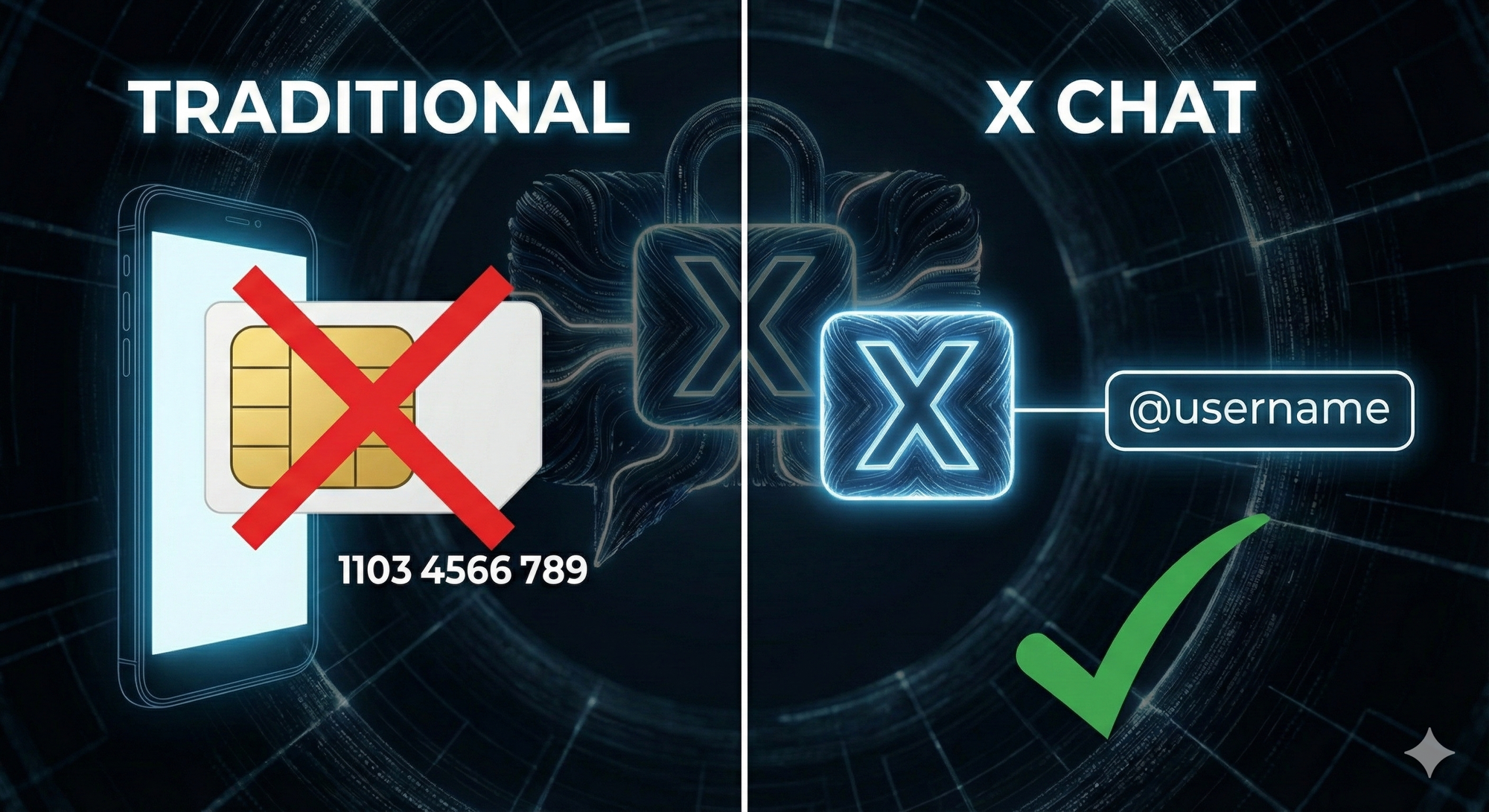
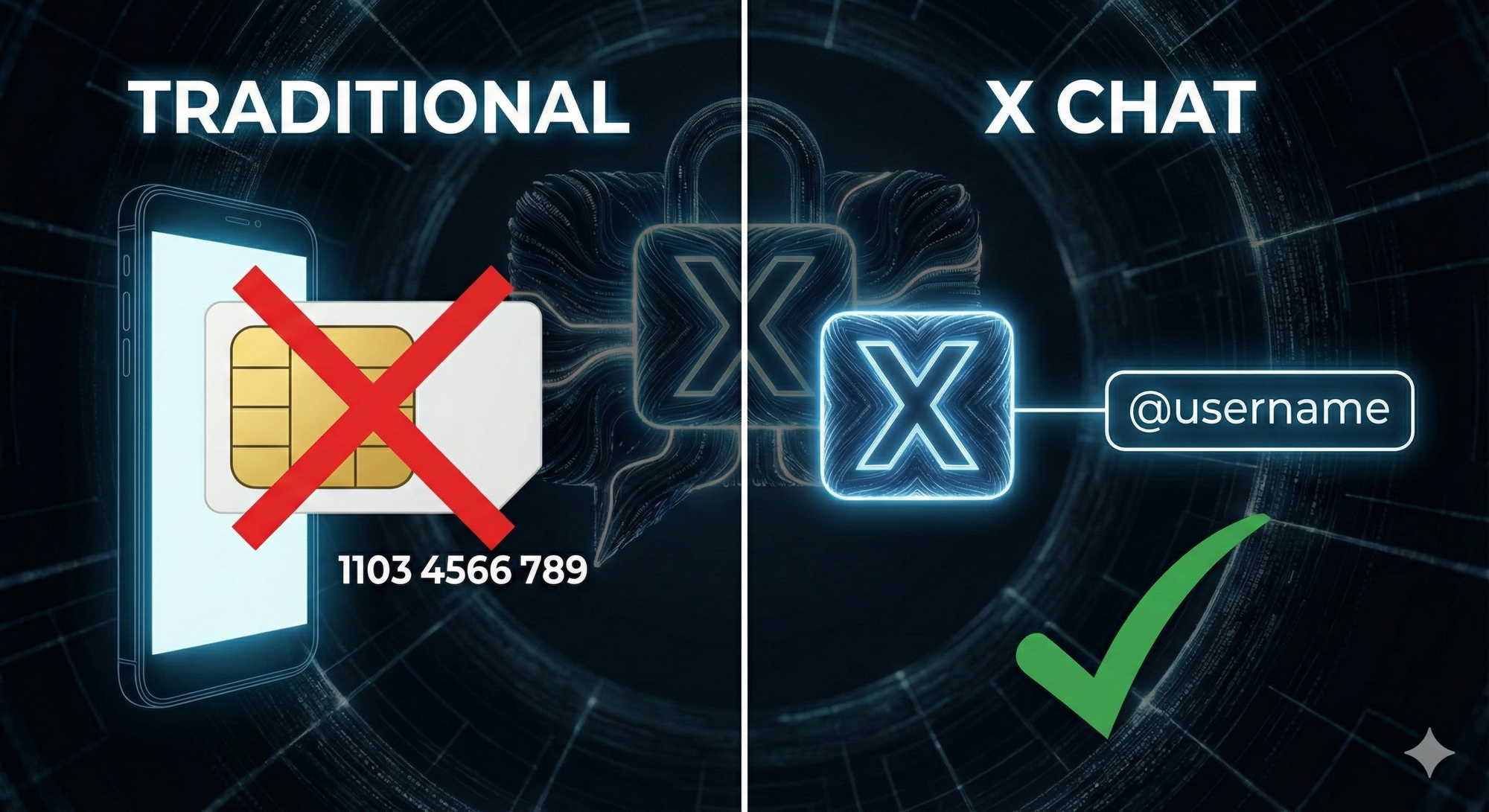
One of X Chat’s selling points is that you do not need a phone number to use it. Your X account (username and email) serves as your identity. This is different from WhatsApp, which requires a valid phone number.
Yes. X Chat is gradually rolling out to all X users worldwide, including the UK. If you don’t see the chat feature yet, it may still be rolling out to your account. Wait a few days or update the X app to the latest version.
Bottom line: X Chat is easy to access and free to try, but it’s worth understanding the security concerns outlined in the sections above before moving sensitive conversations or financial data to the platform.
Want a clear, jargon‑free answer right now? Ask our free AI tech chatbot for UK parents about Roblox, TikTok, screen time and more in seconds – try it here.