Physical Address
304 North Cardinal St.
Dorchester Center, MA 02124
Physical Address
304 North Cardinal St.
Dorchester Center, MA 02124

Your Go-To for Digital Advice
Your Go-To for Digital Advice
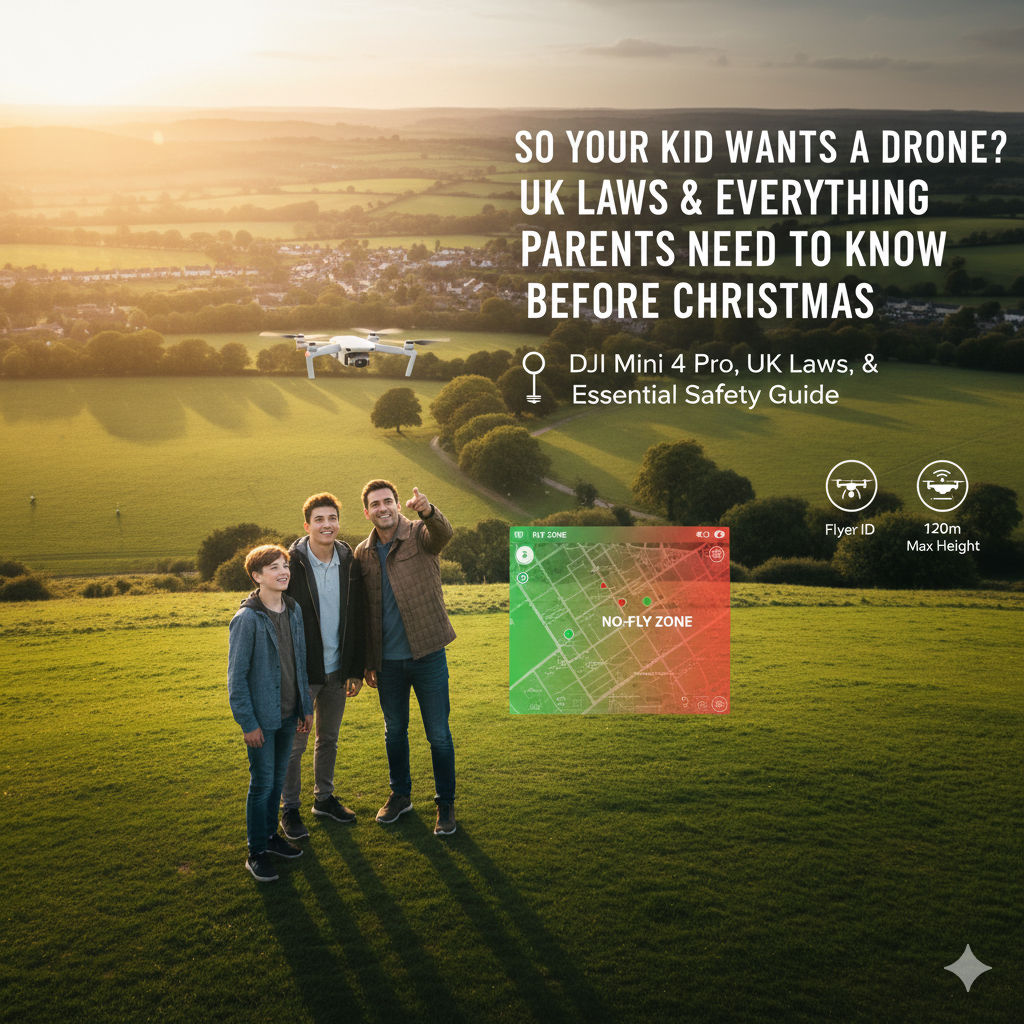
Discover the exciting world of drone flying with the DJI Mini 4 Pro and 5 Pro. Stay informed with the latest UK regulations and ensure your flying adventures are safe and legal. Dive deeper into the world of drones and model aircraft with expert insights.
Quick Links to Official CAA Resources:
When you hand a child a drone for the first time, the most terrifying moment is that first second when they let go of the control sticks. Will it fall? Will it spin uncontrollably? Will it fly into next door’s garden?
With a DJI Mini 4 Pro or Mini 5 Pro, none of that happens. You let go, and the drone just… hovers. Perfectly still. Rock solid. GPS-locked to the exact spot you released it.
That’s the magic ingredient. DJI has engineered these drones so that they make you feel like a professional pilot on day one, even if you’ve never flown anything in your life.
The Mini 4 Pro comes with a 1/1.3-inch CMOS sensor that shoots 4K video at up to 60 frames per second with HDR support, plus 48-megapixel stills. The Mini 5 Pro upgrades this to a larger 1-inch CMOS sensor, 50MP stills, and 4K at up to 120fps. For families, this means your teenager can actually make something worth watching. The video isn’t shaky, the colours aren’t blown out, and there’s enough detail that they won’t immediately outgrow the camera quality.
Both include professional colour profiles (D-Log M on the Mini 4 Pro; even more advanced on the Mini 5 Pro), which sounds like techno-babble but translates to this: if your child actually develops a passion for content creation, they won’t be limited by the camera. They can shoot log footage and color-grade it like a semi-pro.
The Fly More Combo is honestly the smarter investment. Extra batteries mean more flight time per session, and you won’t have the frustration of a child waiting hours for a single battery to charge.
Here’s the engineering that actually matters for a nervous parent:
Omnidirectional obstacle avoidance: The Mini 4 Pro has sensors pointing in all directions—forward, backward, left, right, up, down. If your child accidentally pilots it toward a tree, the drone detects it and either brakes or routes around it automatically. This saves countless crashes from beginner mistakes. The Mini 5 Pro adds LiDAR for even more precise forward detection, even in low light.
GPS + Visual Downward Sensors: Both drones use a combination of GPS and downward-pointing cameras to maintain altitude and position. When you let go of the sticks, they hold their exact position using satellite signals plus optical flow from the ground. Result: no drifting. No wind carrying it away. No “where did I leave the drone?” moments.
OcuSync 4 Video Transmission: The control signal reaches up to about 20 kilometers in ideal conditions, but you’ll hit UK legal limits long before the radio link gives up. In practical terms: you can fly from one end of a large park and still have a crystal-clear video feed on your phone or remote.
I’ll be candid: I’ve watched my own Mini 4 Pro be flown by an 11-year-old who had never touched a drone, and within five minutes—five minutes—they were flying smooth, intentional camera movements. That’s not luck. That’s engineering discipline.
Here’s the part that actually sets DJI apart from cheaper alternatives: geofencing. The drone has built-in maps of restricted airspace—airports, military bases, prisons, certain stadiums, protected wildlife areas. When you try to fly into one of these zones, the drone either warns you, limits your height, or outright refuses to take off.
For a parent, this is enormous. Your child doesn’t accidentally cross into Gatwick’s airspace. The drone won’t let them fly over a football stadium during a match. The technology is doing some of the heavy lifting of keeping them legal and safe.
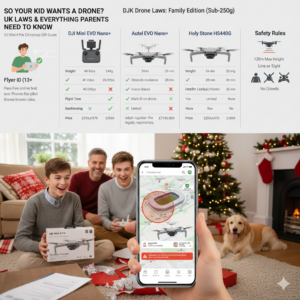
Parents often ask: “Is there a cheaper alternative that’s just as easy to fly?”
The short answer: not really. But there are some options worth considering.
Autel is the most credible competitor in the sub-250g space. The EVO Nano+ weighs 249 grams (same as the Mini 4 Pro), shoots 4K video, and includes obstacle avoidance.
But here’s what you lose:
If you want to test whether your child will actually use a drone before investing £700+ in a Mini 4 or 5 Pro, the Holy Stone HS440G is honest value for money.
Pros:
Cons:
My take: If your 14-year-old has expressed drone interest for three months, buy a Mini 4 or Mini 5 Pro. If they casually mentioned it once, start with the Holy Stone. It’s the smart testing ground.
Right. This is where I tell you the bits that actually matter.
The UK Civil Aviation Authority (CAA) runs a system that can feel intimidating at first, but it’s actually designed with beginners in mind. As of 1 January 2026, the registration threshold has dropped to 100g, and there are new class marks to understand. Here’s what actually applies to your Mini 4 Pro, Mini 5 Pro, or any other sub-250g family drone.
The UK Civil Aviation Authority (CAA) runs a system with two separate registrations:
Flyer ID (the pilot’s licence-ish thing):
Operator ID (the registered owner “plate”):
Here’s the family scenario (2026):
If your 14-year-old wants to fly your Mini 4 Pro (weighs ~249g with battery, has a camera):
From 1 January 2026, new drones sold in the UK carry a UK class mark (UK0 through UK6). This tells you exactly which flying categories the drone is approved for.
| Class Mark | Weight | What It Is | Flying Category | Mini 4/5 Pro? |
|---|---|---|---|---|
| UK0 | < 250g | Very light, minimal risk | Over People (A1) | Mini 4 Pro (C0) |
| UK1 | < 250g | Light, moderate safety features | Over People (A1) | Mini 5 Pro (C1) |
| UK2 | < 4 kg | Medium, higher safety standards | Near People (A2) | No |
| UK3–UK4 | < 25 kg | Heavy, advanced operations | Far From People (A3) | No |
| Weight of Drone | Class Mark | Flyer ID | Operator ID | Example |
|---|---|---|---|---|
| 250g to < 25kg | UK1, UK2, UK3, UK4 | Required | Required | Larger drones |
| 100g to < 250g with camera | UK0 with camera | Required | Required | Mini 4 Pro, Mini 5 Pro |
| 100g to < 250g without camera | UK0 without camera | Required | Optional | Light model aircraft |
| < 100g | Not applicable | Recommended | Optional | Tiny nano-drones |
Maximum Height: 120 meters (400 feet) above the ground directly below the drone. Not sea level. Not your altitude. This is universal in the UK. No exceptions for being in a field or a remote area.
Line of Sight (VLOS): You must be able to see your drone with your own eyes at all times. Not via the live video feed on the controller. Not on your phone screen. Your eyes. This typically means you can’t fly farther than about 250 meters away horizontally.
Distance from People (50m Rule – Updated for 2026):
The CAA rule is now more clearly expressed: Do not fly closer to people than 50m horizontally.
However, exceptions exist for sub-250g drones (UK0, UK1, C0, C1 class):
Night Flying – New Rule for 2026:
If you want to fly at night, your drone must have a green flashing light visible to others. This is a new requirement from 1 January 2026. Most modern DJI drones have built-in lights; if yours doesn’t, you can attach an external drone light module.
| Age | Flyer ID? | Can Fly Unsupervised? | Operator ID Needed? | Notes |
|---|---|---|---|---|
| Under 13 | No—adult holds it | Only under adult supervision | Yes, adult 18+ | Child can hold controller under supervision |
| 13–17 | Yes—pass free online test | Only under adult supervision (adult present) | Yes, adult 18+ | Teen pilot under adult’s legal responsibility |
| 18+ | Yes | Yes, if they have Operator ID | Yes, for themselves (£11.79/year) | Fully independent, legally responsible |
This is new for 2026, so let me explain it clearly.
Remote ID is essentially a digital “license plate” that a drone broadcasts during flight. It transmits your Operator ID, the drone’s serial number, location, altitude, and your location.
Good news for existing Mini 4 Pro and Mini 5 Pro owners: You don’t need to do anything yet.
Remote ID Deadlines:
Your Remote ID number is automatically generated when you register for your Operator ID. You’ll find it in your CAA account under “My Registration.”
Here’s something I’ve realized after three years of flying: DJI drones are almost deliberately engineered to make it difficult to break the rules accidentally.
You can’t fly higher than 120m automatically: Your child pushes the stick up, and at 120 meters, the drone simply won’t climb higher. It’s not a warning. It’s a hard limit.
You can’t fly into restricted airspace: The drone detects no-fly zones and either stops you or caps your altitude. I’ve watched a Mini 4 Pro automatically limit itself to 30 meters when entering a semi-restricted area near a hospital.
GPS return-to-home brings it back automatically: If your child loses control or the signal drops, the drone climbs to a safe altitude and flies back to the launch point automatically.
This is not true of cheaper drones. A £150 Holy Stone? If your kid flies it out of range, it keeps flying in that last direction. It doesn’t care about airspace.
⚠️ Important caveat: Guardrails don’t replace understanding. Your child still needs to know the rules, not just follow what the drone enforces.
As of January 2026, the DJI Mini 5 Pro has been out for a few months, and it’s bringing down Mini 4 Pro prices.
What Changed in the Mini 5 Pro:
Should You Buy the Mini 5 Pro Instead?
If you’re buying now (January 2026) and your budget is £800–£900:
For most families? The Mini 4 Pro remains the better entry point. The Mini 5 Pro’s improvements are real, but they’re not transformative for a 14-year-old’s first flight.
Let me be direct: recreational drone use is not legally required to be insured in the UK. Only commercial operators must have insurance.
But here’s the reality: if your Mini 4 Pro falls out of the sky and smashes through someone’s conservatory roof, you’re personally liable for all damages. We’re talking £10,000–£30,000 potentially.
| Option | Cost | Coverage | Best For |
|---|---|---|---|
| Basic Hobbyist | £25–£50/year | Public Liability only (£1M) | Casual flyers, tests |
| Comprehensive Hobbyist | £50–£100/year | Liability + Damage + Theft | Regular hobbyists |
| Drone Cover Club | £29.95/year | £12M Public Liability + £10k Personal Accident | Regular recreational flyers (best value) |
| BMFA Membership | £29.95/year | £12M Public Liability + extras | Model aircraft club members |
My personal take: I pay for Drone Cover Club at £29.95/year, and I think it’s a no-brainer. For less than £30, I have £12 million in public liability coverage. The peace of mind alone is worth it.
Most insurers won’t deny you coverage just because your child was flying (supervised with your Flyer ID). But read the fine print and choose one that explicitly covers supervised flying by minors.
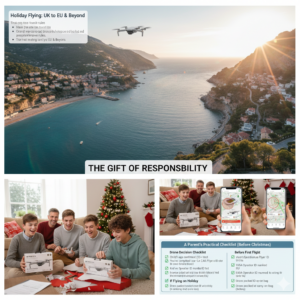
This is where post-Brexit gets messy. The UK is no longer part of EASA (European Aviation Safety Agency). The European Union still is. This means two separate regulatory systems.
You need a separate EASA Operator ID in addition to your UK ID. You’ll get this from the first EU country you visit and want to fly.
Steps:
Insurance: Check whether your UK policy covers flights in Europe. Call Drone Cover Club or your insurer before traveling and ask: “Are holiday flights in [country] covered?” It usually costs nothing extra, but confirm before you board the plane.
| Rule | UK (CAA) 2026 | EU (EASA) | Post-Brexit Change? |
|---|---|---|---|
| Maximum Height | 120m (400ft) | 120m (400ft) | No |
| Line of Sight Distance | Visual line of sight (~250m) | Visual line of sight (~250m) | No |
| Over People/Crowds | A1: Allowed if informed; A2: 50m minimum | A1: No restriction; A2: 30m | Slightly relaxed in EU |
| Minimum Age (Flyer) | 13 years (with Flyer ID) | 16+ or equivalent training | UK lower than EU pre-Brexit |
| Operator Age | 18+ (Operator ID) | 18+ (Operator registration) | No |
| Class Marks | UK0–UK6 (new 2026); C0–C1 recognized until Dec 2027 | C0–C6 (EU system) | Yes—different systems |
Before your child takes the drone out for its first flight, sit down and agree on the boundaries:
Write it down. Print it. Put it on the fridge. It sets expectations and avoids arguments later.
This has been a comprehensive read, I know. But handing your child a flying camera is a decision worth getting right. Do it properly, and you’ve given them a tool that teaches responsibility, creativity, and technical thinking. Do it carelessly, and you’ve handed them a liability.
The 2026 changes make registration more accessible (starting at 100g rather than 250g) but also slightly more complex. The good news: DJI’s built-in geofencing and your own understanding of the rules will keep both of you safe and legal.
The choice is yours. Now go make the right decision for your family.