Physical Address
304 North Cardinal St.
Dorchester Center, MA 02124
Physical Address
304 North Cardinal St.
Dorchester Center, MA 02124
Your Go-To for Digital Advice
Your Go-To for Digital Advice
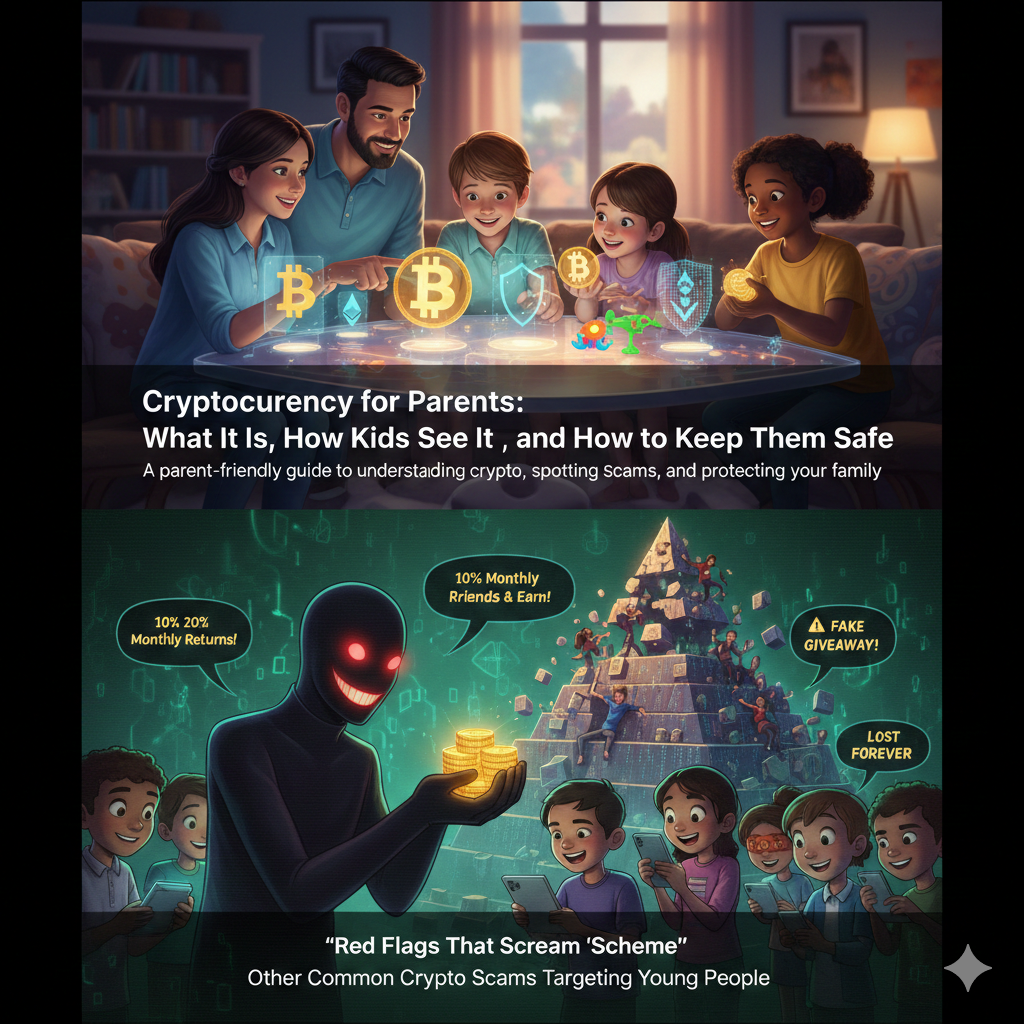
Parents, are you ready to navigate the crypto world with your kids? Discover how digital money, unlike traditional banking, operates without banks or government backing. Uncover the risks and rewards, and learn practical ways to guide your teens safely through this evolving landscape.
A parent-friendly guide to understanding crypto, spotting scams, and protecting your family
Cryptocurrency headlines have moved out of the financial pages and into your child’s social feeds, gaming chats, and school conversations. Terms like “Bitcoin,” “crypto wallet,” and “blockchain” pop up before you’ve had a chance to understand them yourself.
The real concern is that young people are actively being targeted. Influencers promise quick riches. Apps make trading feel like a game. Friends share “secret methods” that supposedly make money overnight. Meanwhile, actual scams disguise themselves as legitimate opportunities.
So let’s break this down—not to scare you, but so you actually understand what’s happening.
Cryptocurrency is digital money managed by computer networks instead of banks or governments. Instead of a bank holding your account, a system called a “blockchain” keeps a record of who owns what.
Think of it like this: Normal money (pounds, dollars) is printed by governments and managed by banks. Crypto is created by computers and managed by a network of computers worldwide. No single authority controls it.
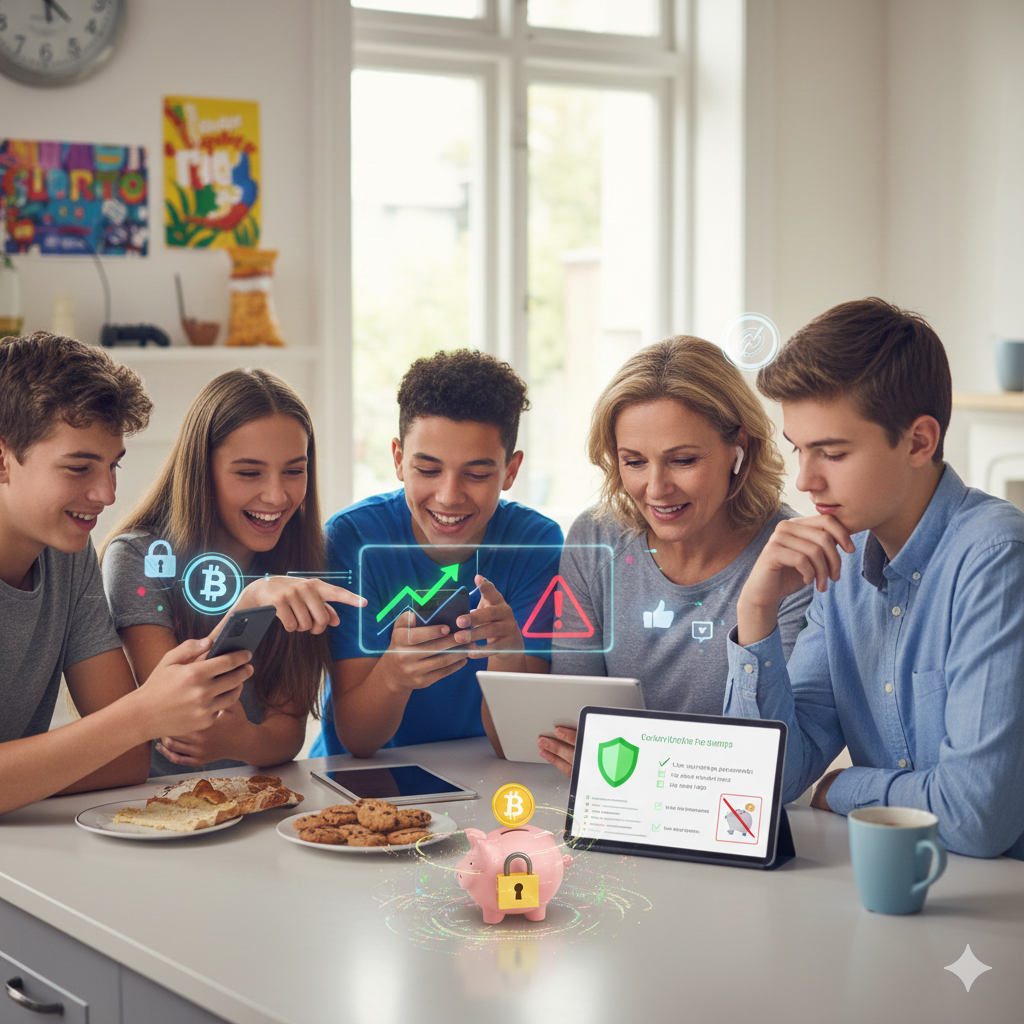
Here’s the core idea:
It’s clever technology. But it doesn’t change the fundamental risk: if you lose your password or send money to a scammer, you’re on your own.
There are currently over 10,000 cryptocurrencies in existence. Most will fail or disappear. Here’s what parents should know about the main ones:
| Cryptocurrency | Market Cap (Dec 2025) | What It Does | Parent Takeaway |
|---|---|---|---|
| Bitcoin (BTC) | $1.85 trillion | The original. Intended as digital money; acts like an investment asset. | Most recognizable. Still high-risk. Often promoted to teens by influencers. |
| Ethereum (ETH) | $353.37 billion | Runs “smart contracts”—programs that execute automatically. Powers many apps and NFTs. | More complex technology. Often seen in gaming and metaverse projects. |
| Tether (USDT) | $135 billion | “Stablecoin”—designed to stay at £1 value. Used for trading. | Less volatile, but has centralization and trust issues. Can be used as a scam vehicle. |
| XRP / Ripple | $113.67 billion | Designed for fast international bank transfers. | Less hype than Bitcoin. Lower volatility. Still high-risk. |
| Binance Coin (BNB) | $118.45 billion | Utility token for Binance exchange. Powers Binance Smart Chain apps. | Tied to a centralized exchange. If Binance has problems, BNB crashes. |
| Solana (SOL) | $70.91 billion | Fast blockchain for apps and NFTs. Popular in gaming communities. | Trendy with younger users. Known for NFT hype and broken promises. |
| Dogecoin (DOGE) | $19.61 billion | Started as a joke. Now treated like a real investment by some. | Very volatile. Heavily pushed by influencers. High scam risk. |
| Cardano (ADA) | $13.68 billion | Academic blockchain project. Aims to be more efficient than Ethereum. | Less hype than others. Still speculative. |
TikTok videos, YouTube shorts, and Instagram stories show people claiming they turned £500 into £5,000. It’s fast-paced, exciting, and—crucially—it focuses entirely on wins.
The loser’s story never gets told. The people who lost money don’t post videos. All your child sees is the highlight reel, and it creates a false sense of “everyone is making money except me.”
Some games use in-game currencies that look and feel like crypto. Some platforms now promote NFTs (digital collectibles) that can be bought, traded, and sold on external marketplaces. To a young person, the line between “fun game currency” and “real-world investment” gets very blurry.
Teenagers pass around tips: “This coin is going to the moon.” “This app gives you free crypto.” “This influencer has a method that actually works.” When a classmate claims to have doubled their money, fear of missing out kicks in hard—even if the story is exaggerated or won’t last.

Before we talk about scams, let’s clarify what these are:
How it works: Early investors are paid “returns” using money from new investors. As long as new money keeps flowing in, it looks legitimate. The moment it slows, the whole thing collapses.
In crypto: A platform promises 10–30% monthly returns. It shows fake dashboards with increasing profits. Behind the scenes, there’s no actual investment—just a pool of stolen money.
How it works: You’re recruited to join. You pay to join. You’re then incentivized (sometimes heavily) to recruit others. Money flows from recruits at the bottom to people at the top.
In crypto: A “community” offers you a token and promises you’ll earn by recruiting friends. The only income comes from new recruits, not from any actual product or service.
Marketed as a cryptocurrency by “Crypto Queen” Ruja Ignatova. The catch? OneCoin had no blockchain. It was a pyramid scheme selling fake educational packages and recruiting bonuses. Over 3 million people invested from 175 countries before it collapsed. Ruja disappeared and remains a fugitive.
A “wallet service” promising 10–30% monthly returns. Marketed heavily via WeChat to Chinese, South Korean, and Japanese investors. Operators disappeared with over 180,000 Bitcoin and 6 million Ethereum.
A platform promising daily returns via a fake “trading bot.” Users locked up Bitcoin and bought BitConnect Coin. Early investors were paid from new investor deposits. Regulatory action shut it down, but the damage was done.
A new crypto project launches. Creators hype it heavily. Everyone buys in. Suddenly, the developers disappear with all the money. The project website goes offline.
“Send 1 Bitcoin, get 2 back!” (Or 10 Ethereum, etc.) This never works. You send your crypto. They pocket it. You get nothing.
Someone contacts your teen on social media or a dating app. They build trust over weeks. Then they suggest a “sure-thing” crypto investment or ask for money to help with an “emergency.” The person doesn’t exist.
“Invest in our mining operation and earn passive income!” There’s often no actual mining. Your money gets pooled and slowly drained, or used to pay earlier “investors.”
A lookalike exchange or wallet app. You deposit money. It gets stolen. The site vanishes.
Crypto prices can move by 10–50% in a single day. For an inexperienced young person, that’s not investing—it’s a rollercoaster that encourages panic-selling when prices drop and gambling-like excitement when they rise.
Losing money early on can be genuinely traumatic for a teenager. It can damage their confidence around money for years.
Opening accounts, joining exchanges, and using new apps all mean sharing personal data. Teenagers often reuse passwords, skip security steps, or share screenshots that expose sensitive information. These habits create long-term risks far beyond the immediate crypto activity.
If your teenager mainly hears stories about overnight millionaires, education and steady work start looking pointless. They may chase high-risk opportunities constantly, believe luck matters more than effort, or undervalue savings and building actual skills.
Most crypto platforms require you to be 18. If your teen is trading, they might be using an adult’s ID, a prepaid card, or unregulated overseas services. Each route has weaker protections.
Limit who can add cards or payment apps to devices. Use parental controls to require your approval for any purchase. On shared devices, enable strong authentication.
Many trading apps are designed to feel like games. Disable in-app purchases where possible, or require a password for every transaction.
Unique passwords for every account. A password manager for older teens. Two-factor authentication on any financial account. Yes, it feels like overkill. It’s not.
For example:

Focus first on understanding what happened and making sure they’re safe. Then you can address the financial side. Don’t shame them. Ask questions. Learn together.
The honest answer: Probably not.
But here’s what you might consider instead:
No buying or holding any cryptocurrency. They don’t have the judgment to handle it.
If they’re genuinely interested in blockchain technology (not just making quick money), you might allow:
Cryptocurrency is technology, yes. But it’s high-risk, highly speculative, and heavily promoted by people who profit when young people invest.
Your job as a parent isn’t to become a crypto expert. It’s to:
For most households, the safest path is to treat crypto as a topic to study and understand, not a product to buy.