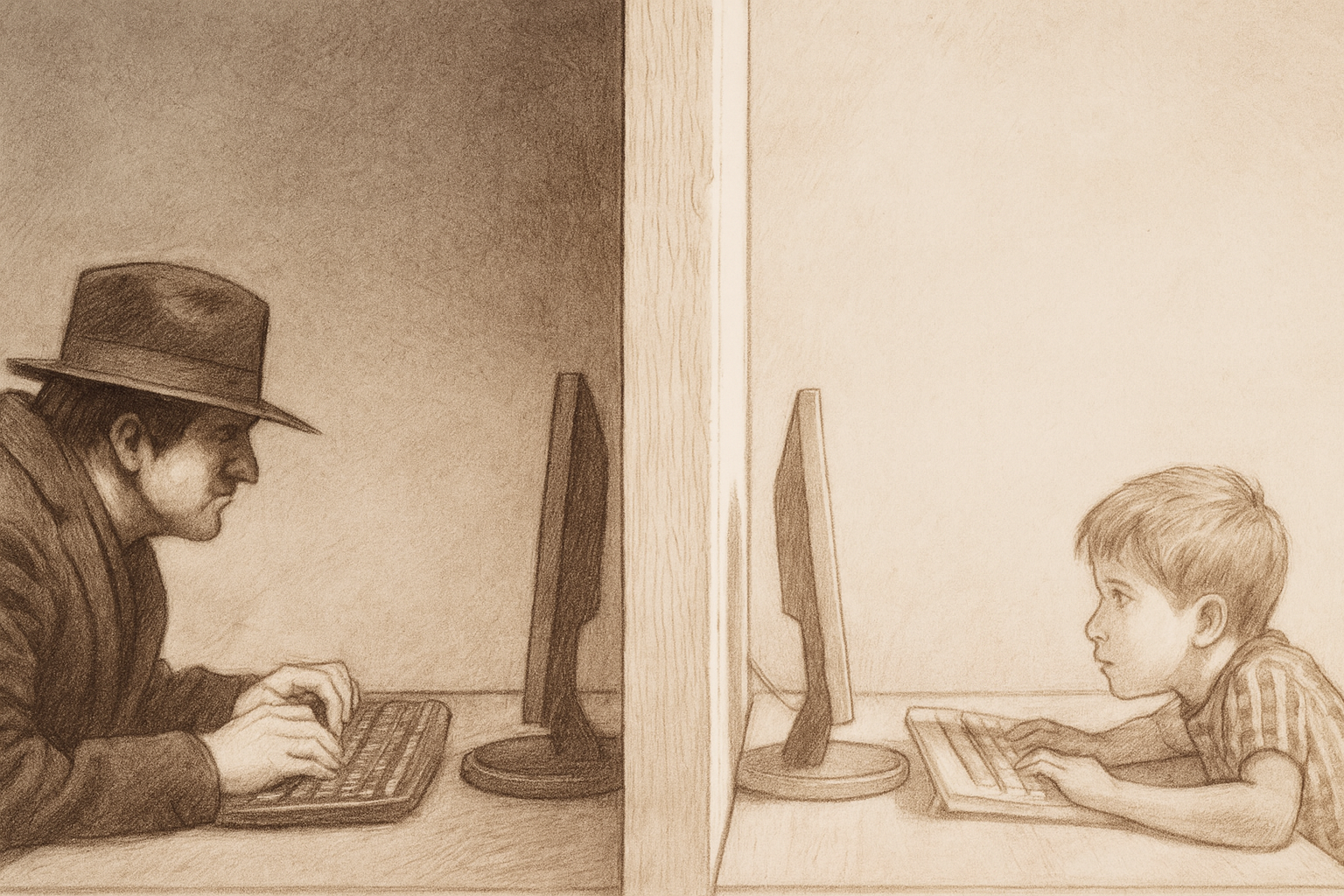
How to Talk to Kids About Online Strangers: A Calm Parent Guide
By Richard / November 2025. I’m not a child psychologist or an internet safety expert. I’m a parent who has sat down with his daughter and had these conversations—awkwardly at first, then naturally. I’ve also pulled apart how grooming actually works, talked to police who handle these cases, and learned what genuinely protects children online. This guide is everything I’ve learned, presented in a way that works for real families—without panic, without spying, without fear.
What you need to know:
- Most children meet “online strangers” in places that feel safe: games, group chats, school communities. They assume if other kids are there, the adults must be harmless too.
- Grooming doesn’t start with threats. It starts with compliments, gifts, understanding, and shared interests. That’s why your child won’t recognize danger immediately.
- Regular, calm conversations at home make the biggest difference. When children know you’ll listen without overreacting, they’ll come to you first.
- The goal is not to ban everything or spy constantly. The goal is to teach your child the same instincts they’d use in the park—translated to online.
- Red flags matter more than rules. Teaching your child to notice behavior (secrecy, isolation, boundary-pushing) works better than “never talk to strangers.”
- If something has gone wrong, it’s still better to tell. Early reporting gives platforms and police a real chance to help.
- You do not need to be a tech expert. Your calm presence and clear values matter infinitely more than knowing every app.
67%
Of children who encounter online predators never tell anyone initially
5 minutes
Average time for a groomer to move from public chat to private messages
3–6 months
How often you should refresh online safety conversations
Why These Conversations Matter More Than You Think
Children now meet people online long before they’re allowed out on their own in the real world. Games, group chats, and social platforms connect them with school friends, friends-of-friends, and people they’ve never met in person. That can be brilliant for social life and learning—but only if children know how to spot risk and what to do when something feels off.
Here’s what I learned: most children first encounter risk in places that feel genuinely safe to them. A Discord server for their favorite game. A group chat for homework. A Minecraft realm where lots of kids are playing. Because other children are around, they assume any new person must be harmless. That assumption is exactly what people with bad intentions rely on.
People who want to exploit children rarely start with obvious threats. They don’t open with “Send me a photo” or “Let’s keep this secret.” Instead, they:
- Send small gifts (game currency, cosmetics, in-game items)
- Give lots of compliments (“You’re so good at this game” or “You’re smarter than your friends”)
- Pretend to share the same hobbies, interests, or complaints about parents
- Slowly build trust over weeks or months before asking for anything personal
- Then gently push boundaries—asking for photos, requesting private chats, demanding secrecy
This process is called grooming. It’s deliberate. It’s designed specifically to confuse and manipulate children who don’t yet have the life experience to see the pattern.
But here’s the thing: regular, calm conversations at home make a massive difference. When children know that adults will listen without overreacting, they’re far more likely to speak up quickly if something feels weird or uncomfortable. That early report—that moment when your child says “Something’s off”—is when adults can actually help.
The Research is Clear: Children who talk openly with parents about online life are significantly less likely to be exploited. Not because parents are monitoring every message, but because the child knows what to look for, knows they can trust their parent, and knows exactly what to do if something crosses a line.
What Counts as an “Online Stranger”?
Many children think a “stranger” is only a complete unknown with a scary profile picture. Someone obviously threatening. In reality, risk often comes from people who feel familiar but are not part of your child’s real-world circle.
- People met in games or group chats who are fun to play with but have never been met offline
- Friends-of-friends in big class or community groups where nobody checks who’s really joining
- Adults pretending to be children using fake photos or stolen accounts
- “Tricky people”—those who break rules, push boundaries, or ask for secrecy, even if your child thinks they know them a little
Rather than teaching “never talk to any stranger,” I’ve found it more realistic to focus on behavior: noticing when someone is asking for too much, too soon, or ignoring clear boundaries. That advice works better in modern games and apps where completely avoiding contact is often impossible.
⚠️ Important Distinction: Most online interactions your child has are perfectly fine. The vast majority of people they’ll meet are exactly who they say they are. The goal isn’t paranoia—it’s teaching them to notice when something feels off and know what to do about it.
Start Simple, Stay Calm
You don’t need a big, serious “internet safety talk.” I learned this the hard way. When I sat my daughter down with a stern face and launched into a 20-minute lecture, she shut down completely. Short, regular chats tied to what she’s already doing online are far more effective—and far less intimidating for everyone.
How to Actually Have These Conversations
- Use their world. Ask about the games or apps they enjoy and who they chat with there: “Who do you usually play with?” or “Have you ever had a weird message?” Let them show you the features and language they use. It signals that you’re interested, not judging.
- Keep your tone curious, not fearful. Children quickly shut down if every conversation turns into a lecture. Phrases like “Help me understand…” or “What do your friends do when…?” invite honest answers.
- Make it clear: it is never their fault. Explain that some adults deliberately try to trick children and are very good at sounding kind. If a conversation crosses a line, the blame sits with the adult, not the child. This removes shame and makes kids more likely to speak up.
- Promise you won’t punish honesty. Many children stay silent because they fear losing their devices. I’ve told my daughter explicitly: “If something feels wrong, I will be proud you told me. We may change some settings, but I’m not going to shout or ban you from everything.”
- Admit when you don’t know something. You don’t need to be a tech expert. “I’m not sure how that feature works—show me?” keeps the door open and models curiosity.
Example Conversation Starters (Try These Tonight)
For younger children (6–9):
“Sometimes people on the tablet are not who they say they are. If someone you don’t know asks to play a game or wants to talk just with you, what could you do?”
For older children and tweens (10–12):
“I’ve been thinking about Discord and group chats. Have you ever felt like someone in a game was being weird or pushy? What did you do?”
For teens (13+):
“I know some people online try to get others to send photos or keep secrets. If that happened to you or a friend, I want you to know I’d help, not punish. What would you want me to do?”
You can even swap roles and do a quick role-play where your child practices saying “No,” blocking, and coming to you. Practicing lines out loud makes it easier for them to react confidently in the moment. My daughter and I did this once—it felt awkward at first, but she was noticeably more confident afterward.
Things to Explain Clearly (The Core Rules)
Children benefit from having a few simple principles they can remember when things move quickly online. You can revisit these every few months and adapt the wording as they grow.
1. Protect Personal Information
No real name, school, club, address, phone number, or regular places they go. This is non-negotiable. But also remind them that photos reveal details: a school logo on a jumper, a bus stop sign, or a street name in the background can identify their location.
2. Kind Words Don’t Prove Someone Is Safe
This one is crucial. Explain that people who want to harm children often start by giving gifts, helping in-game, or saying they “understand” better than parents do. Help your child understand: compliments are nice, but they don’t mean someone is trustworthy.
3. It’s Always Okay to Leave, Block, or Report
If a conversation feels pushy, confusing, or uncomfortable, they don’t owe anyone a reply. Stepping away is a sign of strength, not rudeness. Practice this: “I don’t have to keep talking to someone if they make me uncomfortable, even if I liked them before.”
4. Real Friends Don’t Demand Secrets
A true friend won’t insist on private photos, ask for passwords, or tell them to hide chats from family. If someone says “Don’t tell your parents,” that’s a massive warning sign. Full stop.
✓ The Golden Rule: “If you wouldn’t tell it to a stranger in the park, don’t type it to a stranger online.” You can write this out together and stick it near the device as a gentle reminder.
Red Flags: What to Teach Your Child to Notice
Rather than memorizing a list, help your child understand the pattern. These are signs that someone might not have good intentions:
- They ask your child to keep the chat “our little secret”
- They quickly move from public chats to private messages or different apps
- They ask for photos, especially if they mention bodies, clothes, or bedrooms
- They send gifts, game currency, or promises in exchange for something personal
- They ask a lot of questions about where your child lives, goes to school, or when they’re home alone
- They get angry, sulk, or apply pressure if your child doesn’t reply quickly
- They say things like “Your parents wouldn’t understand you like I do” or “This is just between us”
- They ask your child to send photos of themselves or ask them to perform sexual acts on camera
Teach your child a simple three-step response: Stop, Save, Share.
- Stop replying immediately. Don’t engage or get defensive.
- Save evidence (screenshots or keep messages). This helps adults understand what happened.
- Share what happened with a trusted adult who can help—you, a teacher, a counselor, or calling a helpline.
Emphasize: if something has already been shared, it’s still better to tell you quickly. Early reporting gives platforms and police a real chance to remove content and take action against offenders. The moment you find out is when adults can help most.
Practical Steps to Take Together (This Week)
Sitting side-by-side and making changes together turns “monitoring” into coaching. It shows your child that online safety is something you do with them, not to them.
Activity 1: Check Privacy Settings Together
- Open their favorite game or app together
- Walk through the settings screens slowly
- Look for options like “friends only,” “private account,” “who can message you,” and “who can see your location”
- Change settings together and explain why each one matters
Activity 2: Practice Blocking and Reporting
- Find the “block,” “mute,” and “report” buttons together
- Practice on a trusted account so they know exactly what to do if something happens for real
- Show them how to add a short reason when they report (helps platforms understand the issue)
- Normalize this: “These are tools built exactly for situations when someone crosses a line”
Activity 3: Learn How to Capture Evidence
- Show them how to take a screenshot or screen recording on their device
- Explain they should never share that evidence with friends, only with a trusted adult
- Practice on a game or app they use normally so it feels natural
Activity 4: Review Friend Lists
- Every few months, go through contacts together and remove anyone they don’t actually know in real life
- A helpful rule: “If we wouldn’t recognize them at school pick-up, they shouldn’t be on your friends list”
- This isn’t snooping—it’s maintenance, like updating passwords
Activity 5: Physical Space Matters
- Keep devices in shared spaces where possible (not behind closed doors in bedrooms)
- Charge devices outside bedrooms overnight
- Use them mostly in living areas—not because you’re spying, but because it’s easier to notice if something’s off
Tailoring the Talk by Age
The core message stays the same—safety, boundaries, and talking to trusted adults—but the language and detail should change as children grow.
Ages 6–9: Simple and Concrete
- Keep it very simple: no names, no addresses, no schools, and always check before chatting with someone new
- Use familiar comparisons: “An online stranger is like someone you see in the park but don’t know yet”
- Practice what they should say: “I’m not allowed to share that” and “I have to go now, bye!”
- Focus on the rule, not the scary reasons behind it
Ages 10–12: Building Judgment
- Talk about friend-of-a-friend requests, group chats, and pressure to join private groups
- Discuss what kinds of photos are okay to share (fully clothed, taken by you, that you’d show a parent) and what’s never okay
- Explain how quickly images can spread and that once sent, you can’t truly delete them
- Agree clear rules on who they can add and what to do if someone makes them uneasy—even if it’s another child
Ages 13+: Open Conversations Without Judgment
- Talk more openly about flirting, nudes, sextortion, and blackmail—without judgment
- Make clear they can still ask for help, even if they made a mistake
- Frame safety as part of protecting their future—college, jobs, relationships—not just “because I said so”
- Encourage them to look out for friends and know how to support someone who may be in trouble online
- Acknowledge that they’ll make choices you wouldn’t make, and that’s okay—the important thing is that they know how to get help
Where to Get Help (UK & International Resources)
If you think something has gone wrong online, you don’t have to handle it alone. These organizations specialize in online safety and child protection.
UK Resources
- CEOP Safety Centre – Report suspected grooming, sexual exploitation, or people asking children for sexual images directly to specialist police teams. This is where adults and children can report serious concerns.
- NSPCC Online Safety – Step-by-step advice, resources for different ages, and a parent helpline (0800 800 5000) for talking through concerns confidentially.
- Childline – A free, confidential service where children and young people can talk to a trained counselor 1:1 by phone (0800 1111) or online chat. No judgment, no reporting to parents unless there’s immediate danger.
- Internet Watch Foundation (IWF) – Report images or videos of child sexual abuse so they can be removed from the internet and investigated.
- Think U Know – Resources for parents, educators, and young people about online safety, including videos and activity sheets.
International Resources
✓ Family Guideline to Write Down: “If you wouldn’t tell it to a stranger in the park, don’t type it to a stranger online—and if something feels wrong, stop and tell me. I will listen and help, not punish.”
Revisit and Adapt Regularly
New games, apps, and trends appear every few months. These conversations are never truly “finished.” Aim to check in every 3–6 months—or whenever your child starts using something new—to refresh rules and listen to their experiences.
I’ve found that the best moments for these talks aren’t scheduled. They happen naturally: when they ask a question, when they mention a friend’s online drama, or when you notice something’s changed in their gaming or app use. Those organic moments often lead to better conversations than a “we need to talk” setup.
You don’t need perfect technical knowledge. Your most powerful tools are:
- Curiosity: Genuine interest in what they’re doing online
- Calm reactions: Not panicking when they tell you something weird happened
- Clear family values: About kindness, consent, privacy, and speaking up when something feels wrong
When children know you’re on their side—that you’ll listen without overreacting and help them navigate the online world safely—they’re far more likely to come to you first. That’s when adults can actually make a difference.