Physical Address
304 North Cardinal St.
Dorchester Center, MA 02124
Physical Address
304 North Cardinal St.
Dorchester Center, MA 02124

Your Go-To for Digital Advice
Your Go-To for Digital Advice
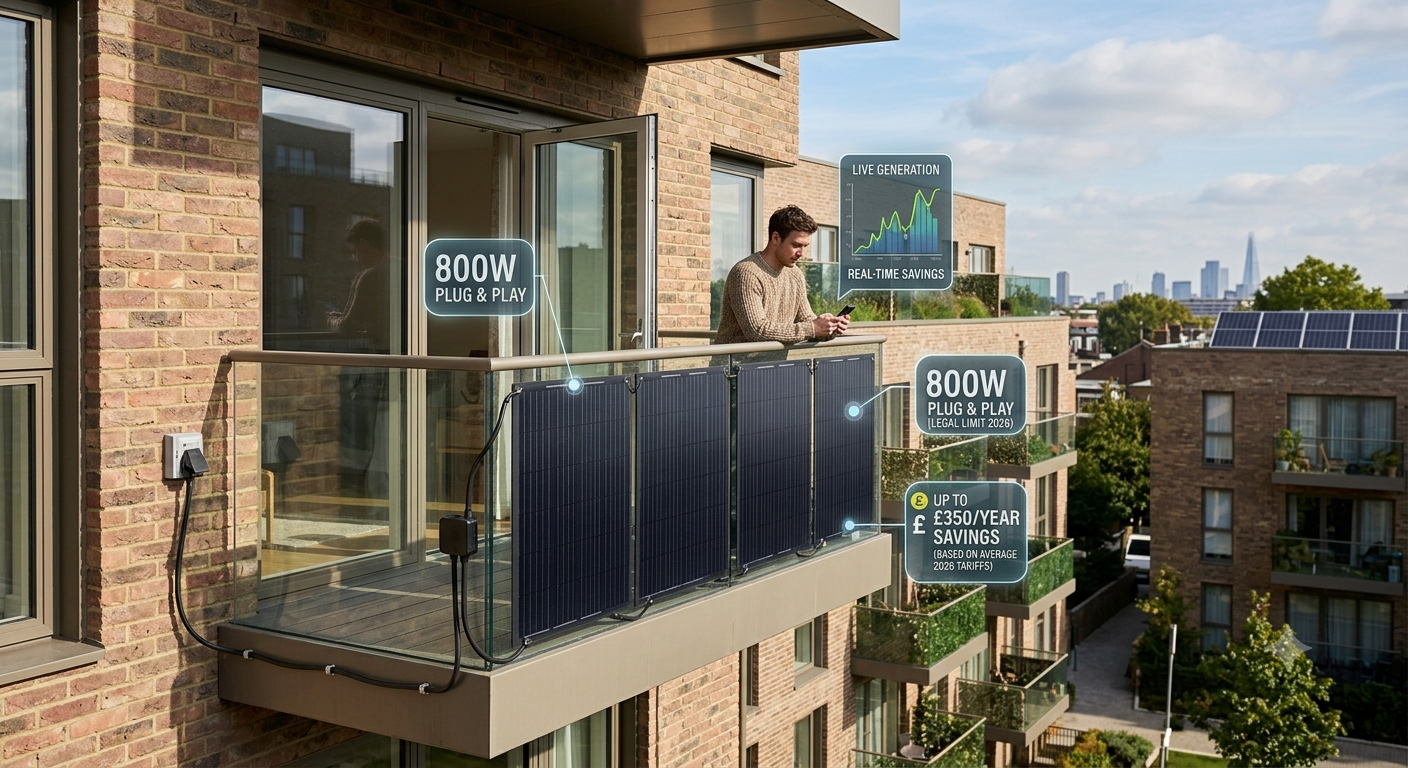
Discover how balcony solar is changing in the UK in 2026. Learn the new plug-in solar rules, 800W limits, costs, benefits and who can install a system.
Balcony Solar UK 2026: Complete Guide to Plug-In Solar Panels, 800W Rules and Real Savings
Why not try our free chat service here for bespoke answers to your solar related questions?
Balcony solar (also called plug-in solar or balcony power stations) uses small solar panels plus a microinverter to feed electricity directly into your home’s circuits, usually via a standard socket. In the UK, this approach has been controversial for years because wiring regulations historically assumed that small generators must be hard‑wired by an electrician rather than plugged in like a kettle.
That is now changing. Under Statutory Instrument 2026 No. 848, a new legal route is being created for compliant plug-in solar microgenerators, allowing approved kits to be plugged into a normal 13A socket from August 27, 2026, as long as they meet strict design and safety requirements. The law caps the AC output at 800W (800VA) but allows up to around 2,000W of panel capacity, provided the complete kit is certified and listed as compliant.
Balcony solar refers to a compact solar power system designed to be mounted on balconies, outside walls, railings, sheds or fences, rather than on a full rooftop array. The typical kit includes one or two solar panels, a microinverter, mounting brackets and a pre‑fitted cable with a UK plug, forming a plug‑and‑play system that can feed solar power into the home when the sun is shining.
In Europe, particularly Germany, balcony solar has become popular under the term Balkonkraftwerk, where millions of households use balcony solar panels to trim energy bills without complex installation work. The UK has lagged behind due to wiring regulations and safety concerns, but the 2026 legal changes bring the UK closer to this European model of small‑scale consumer solar.
Traditional rooftop solar typically requires suitable roof space, scaffolding, an MCS‑certified installer and a several‑thousand‑pound budget, which puts it out of reach for many households. Renters, flat owners, maisonette residents and people with shaded roofs or conservation constraints often cannot install conventional panels at all.
Balcony solar changes the equation by offering a smaller, cheaper and more flexible system that can be mounted on balconies, walls or other outdoor surfaces, then plugged into an existing circuit. For households with modest daytime electricity use, the ability to offset some of that consumption with a simple plug‑in solar kit can make a genuine difference to monthly bills without large up‑front commitments.
The short answer is yes — for certified products — from August 27, 2026. SI 2026/848 defines a new category of “plug‑in microgenerator” and sets out how an electricity‑generating BS 1363 plug can be approved for use with a complete solar kit. When the instrument commences, compliant plug‑in solar devices can legally connect to a standard 13A socket without needing to be hard‑wired by an electrician.
However, the law does not treat every plug‑in system as compliant automatically. To qualify, a balcony solar kit must be supplied as a complete system including panels, microinverter, cables, mounting hardware and a factory‑fitted plug that meets the government’s interim product specification. The kit must also satisfy the 800W/800VA output limit and other technical conditions, and distribution network rules such as G98 still restrict installations to one plug‑in device per household circuit.
A balcony solar kit starts with photovoltaic panels that convert sunlight into DC electricity. This DC power is fed into a microinverter mounted close to the panels, which converts it into AC electricity that matches the voltage and frequency of the home’s electrical system. The microinverter then sends power through a cable to a standard socket, effectively back‑feeding energy into the home’s circuits.
During daylight hours, any appliances already running in the home use this solar electricity first. If the solar output matches part of the load, your meter draws less from the grid, reducing billing for that period. If solar output temporarily exceeds your instantaneous consumption, the excess is exported to the grid, though the plug‑in framework is primarily geared towards self‑consumption rather than export payments.
The UK plug‑in solar framework caps microinverter output at 800W (or 800VA and around 3.5A) to ensure the current and fault conditions remain within the safe range for typical domestic sockets, breakers and protective devices. This limit is intended to balance meaningful energy savings with manageable electrical risk, rather than allowing multi‑kilowatt plug‑in systems that could overload circuits.
Importantly, the panel capacity feeding the inverter can be higher than 800W — up to roughly 2,000W of panels are allowed in some specifications so that the system can still reach its rated 800W output under less‑than‑ideal conditions. Buyers should therefore pay more attention to the inverter rating (the AC output) than the combined panel wattage when comparing balcony solar kits.
Electrical safety bodies and the Institution of Engineering and Technology (IET) have raised concerns about plug‑in solar, particularly around fault protection, socket overloading and the risk of DIY installations in older homes. Wiring regulations historically assumed that generators must be hard‑wired via dedicated breakers and isolators, not plugged into general‑purpose sockets.
To address these risks, the new UK framework requires plug‑in solar products to meet strict design rules, including anti‑islanding protection, compliance with G98 or similar microgeneration standards, and specific limitations on how the kits can be connected. The law also excludes plug‑in batteries from the first wave of rules, keeping the focus on simple generation rather than complex storage systems that would introduce additional fault scenarios.
Balcony solar is primarily targeted at households who cannot easily install rooftop solar. That includes renters who do not control the roof, flat owners with limited roof rights, and homes where shading, orientation or planning restrictions make standard solar installations difficult.
It also suits people who want a lower‑cost, lower‑commitment entry into solar power, particularly those who primarily want to offset daytime baseload such as routers, laptops, fridges and other always‑running appliances. For these users, a plug‑in solar kit can be a pragmatic step into renewables while still leaving the option open for a larger system later.
Exact pricing will depend on brands and retailers, but balcony solar kits are generally cheaper than full rooftop systems because they use fewer panels, no scaffolding and simpler installation. European examples suggest that entry‑level plug‑in kits with around 400–800W of panel capacity sit in the low hundreds of pounds, with more premium kits costing more depending on panel efficiency, microinverter quality and mounting hardware.
UK‑specific prices will be influenced by certification costs, import factors and demand, but the core idea is that balcony solar should provide a relatively low‑cost way to trim bills, rather than a multi‑thousand‑pound investment like a full roof array. Buyers should still weigh costs carefully against realistic savings, especially if they are on cheaper tariffs or have low daytime electricity use.
Typical savings from balcony solar depend heavily on how much electricity your household uses during daylight hours, the orientation of your panels, local weather and your tariff rate. The goal is to offset daytime energy consumption rather than to power the home entirely, so balcony solar works best when you have a consistent baseload that the system can chip away at every day.
Independent guides suggest that plug‑in solar panels can offer payback periods on the order of three to five years in favourable conditions, particularly when daytime tariffs are high and panels are well oriented. However, this is not guaranteed. Households with low daytime use, heavily shaded balconies or very cheap electricity may see longer payback times.
Rooftop solar is still the most powerful and broadly supported form of domestic solar PV in the UK, typically delivering larger generation capacity and more comprehensive long‑term savings. MCS‑certified installations can integrate with export tariffs, batteries and smart systems, offering a more complete decarbonisation solution for homeowners who have the right roof and budget.
Balcony solar, by contrast, is smaller, easier to install and more accessible for people living in flats, rented homes or properties with limited roof options. It is not designed to replace big rooftop arrays, but to complement them by serving households that rooftop solar does not reach. If you can install a full roof system, that will usually deliver greater long‑term savings; if you cannot, balcony solar may be the most realistic way to generate some of your own power.
Portable power stations paired with foldable solar panels offer another route into small‑scale solar, often aimed at camping, van life and backup power rather than continuous household savings. They typically store solar energy in a battery bank and then power devices directly, rather than integrating with household circuits.
Balcony solar kits, on the other hand, are built to plug into the home’s electrical system and offset mains consumption with real‑time solar generation. In the first wave of UK rules, plug‑in battery storage remains excluded from the official framework, so balcony solar is currently more about simple generation than large‑scale storage.
When comparing balcony solar panels and plug‑in solar kits in the UK, focus on compliance, output, mounting and support rather than headline wattage alone. The following checklist can help you narrow down options:
Although plug‑in solar kits are designed to be simpler than rooftop installations, they still require careful planning. First, you’ll need to identify a suitable mounting location with good daylight, ideally facing south or south‑west without heavy shading. You then attach the mounting hardware, fix the panels, connect the microinverter and route the cable safely to the chosen socket.
Manufacturers typically provide step‑by‑step instructions, including guidance on isolation, connection and any recommended protective devices. Some kits may suggest or require a dedicated RCBO‑protected circuit or a specific socket location, even though the law technically allows standard sockets. Once installed, you may need to notify your Distribution Network Operator under G98, particularly if your network or kit documentation requires it.
Early adopters of plug‑in solar in other countries have highlighted a few recurring mistakes. One is buying non‑certified or semi‑DIY kits that do not meet local safety standards, which can create wiring risks and leave customers with products that are technically non‑compliant. Another is underestimating the importance of correct mounting, leading to panels that are shaded, poorly angled or vulnerable to wind.
In the UK context, there is also a risk of misunderstanding the legal framework by assuming that any plug‑in product becomes legal overnight once the law changes. In reality, compliance depends on the complete kit’s design, testing and listing, not just the presence of a plug. Households that ignore documentation, skip G98 notifications or improvise their own cabling could find themselves outside the intended safety envelope.
Balcony solar becomes legal for certified plug‑in solar kits from August 27, 2026, under SI 2026/848. Until then, traditional hard‑wired microgeneration routes remain the only fully compliant options.
The new rules cap microinverter output at 800W/800VA and around 3.5A, though panel capacity feeding the inverter can be higher within the compliant specification.
Plug‑in batteries are excluded from the first wave of UK plug‑in solar rules, so balcony solar kits are primarily about direct generation rather than integrated storage.
The framework allows plug‑in kits to connect via a standard socket without an electrician, but safety bodies still recommend professional advice for older or complex systems.
In principle, yes, provided you have a suitable outdoor mounting location and comply with the landlord’s rules and local regulations. Balcony solar is designed specifically to serve renters and flat dwellers who cannot install rooftop solar.
For the right household, balcony solar is a promising way to cut energy bills and participate in the UK’s transition to cleaner power. It is not intended to compete with large rooftop systems in terms of total output, but to offer a practical, flexible option for renters, flat owners and budget‑conscious households.
If you have good daylight on a balcony or wall, a solid baseload of daytime electricity use, and an interest in DIY‑friendly home energy projects, a well‑chosen balcony solar kit could be worth the investment once the UK’s plug‑in solar framework goes live. As with any major purchase, the key is to focus on safety, compliance and realistic savings — not just marketing promises.
As August 27, 2026 approaches, UK households interested in balcony solar should start by learning the basics of plug‑in solar, reading product documentation carefully and watching how early compliant kits are reviewed by independent testers. Following trusted guides and safety advice will help ensure that balcony solar delivers genuine savings and peace of mind rather than unwanted electrical surprises.
Whether you’re a renter in a city flat, a homeowner with limited roof space or simply someone curious about small‑scale solar, balcony solar panels and plug‑in solar kits are likely to feature heavily in the UK’s energy conversation from 2026 onwards.