Physical Address
304 North Cardinal St.
Dorchester Center, MA 02124
Physical Address
304 North Cardinal St.
Dorchester Center, MA 02124
Your Go-To for Digital Advice
Your Go-To for Digital Advice
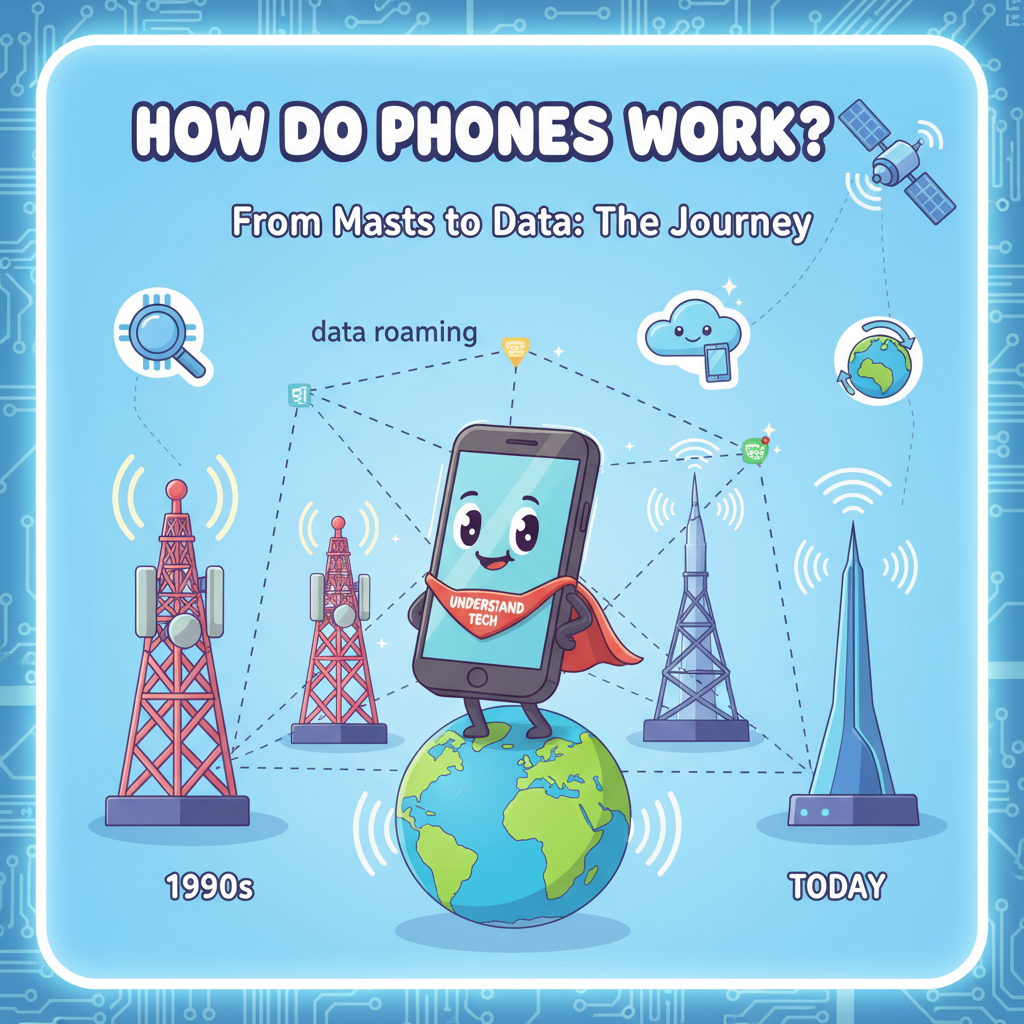
Unlock the secrets behind your mobile phone's seamless connectivity with our comprehensive guide to UK cellular networks. Discover how phones navigate without GPS, the evolution from 2G to 5G, and the intricate web of providers and protocols that keep you connected. Dive deep into the engineering marvels powering your calls and roam confidently abroad.
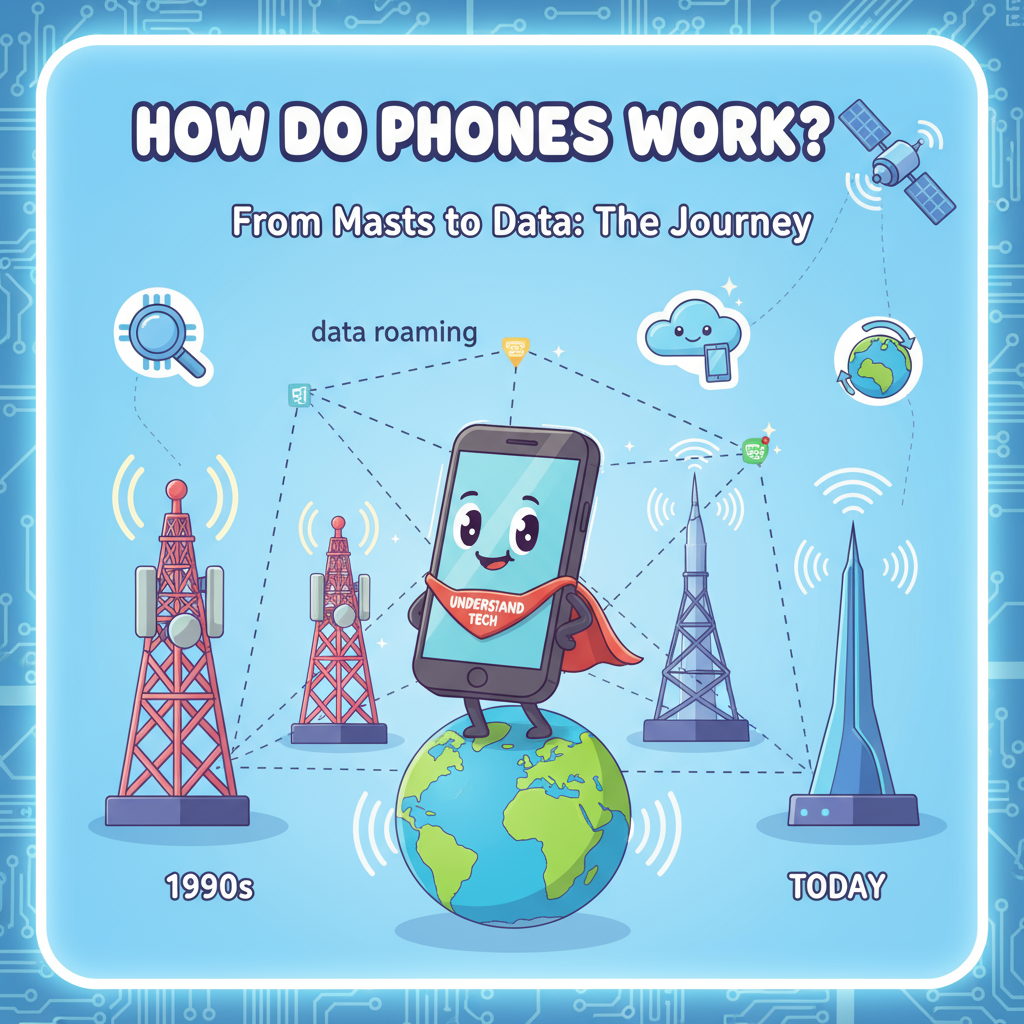
By Richard – Mobile phones are ubiquitous—but behind their seemingly effortless operation lies a complex cellular network ecosystem that most people never think about. In this article, I take you on a deep dive through the technology that makes mobile communication possible, with a particular focus on the UK context. We’ll explore how phones find their location without GPS, the evolution from 2G to 5G, the structure of network providers, how you stay connected when roaming abroad, security protocols, the business of spectrum auctions, and much more. By the end, you will understand not just what is happening when you make a call, but the incredible engineering that makes it all possible.
What this comprehensive guide covers:
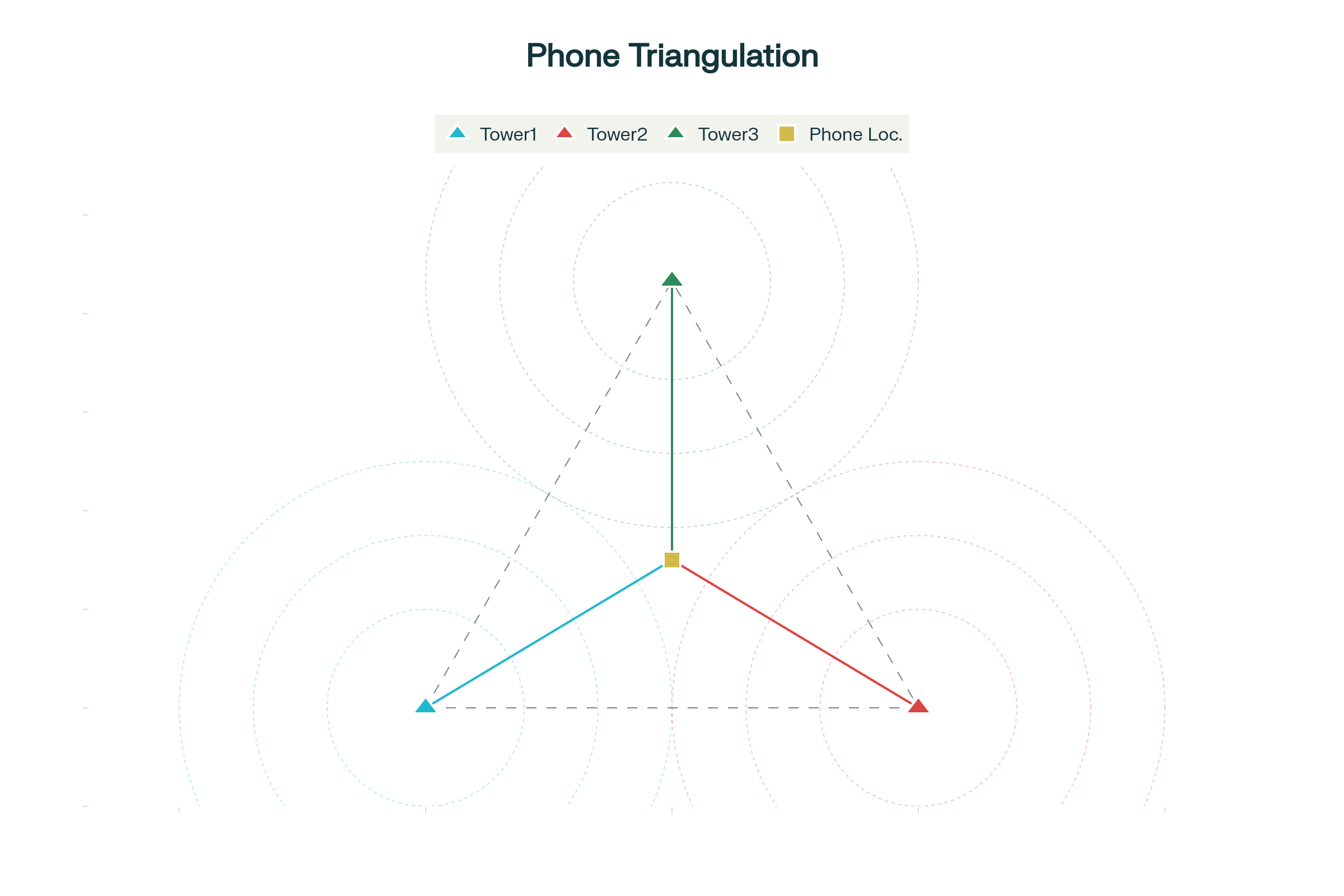
When you think about how your phone knows where it is, you probably think of GPS. But there is another system running silently in the background: cellular triangulation. This is how your phone can pinpoint its location even when GPS fails, and how emergency services can find you when you dial 999.
Your phone communicates with multiple nearby cell towers simultaneously. Each tower measures the signal strength of your phone’s transmission and calculates the distance based on how weak the signal has become. By knowing the exact location of at least three cell towers and the distance from each one to your phone, the network can triangulate your position—essentially solving a geometric problem.
Real-world accuracy:
The accuracy depends on three factors:
✓ Why This Matters: When you dial 999 in the UK, the emergency service does not rely on GPS (your phone might be indoors where GPS does not work). Instead, it uses cellular triangulation combined with your phone’s IMSI number to locate you within minutes. This has saved thousands of lives.
Modern phones combine GPS with cellular data. Your phone’s GPS gets a “heads start” by downloading orbital data from the network, which reduces the time to get a position lock from several minutes to seconds. This is called Assisted GPS or A-GPS. It is why your phone’s location works so quickly when you open Maps.
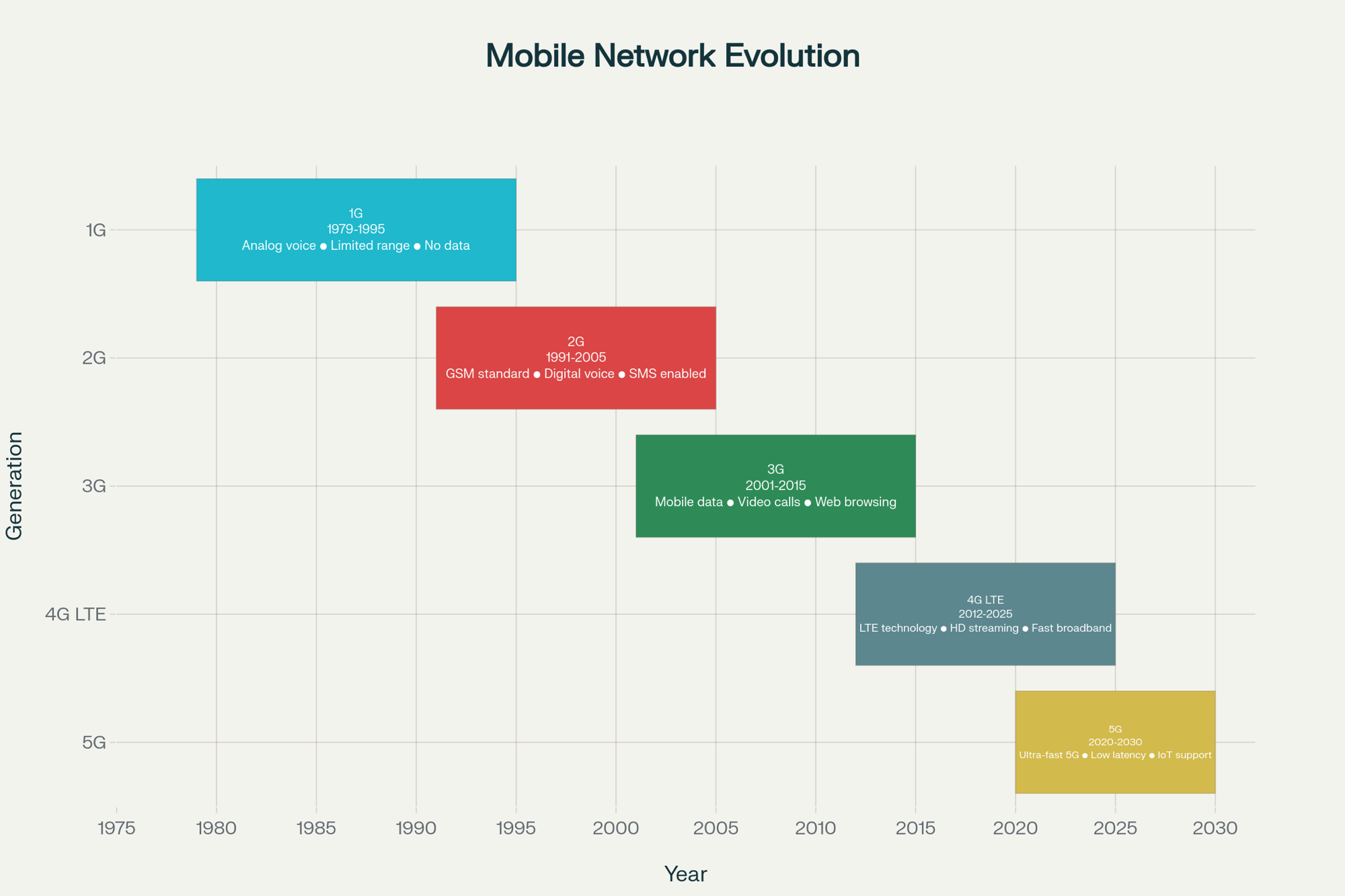
Mobile network technology has evolved through five distinct generations, each offering massive improvements in speed, capacity, and capability. Understanding these generations is key to understanding what your phone can and cannot do.
Why 2G matters today: Many older devices still rely on 2G. When UK networks shut down 2G, millions of devices will stop working—from emergency call buttons in care homes to ATMs in remote areas. This is a massive infrastructure challenge happening in real time.
Interesting UK fact: Three (originally called “3”) never launched a 2G network. They started directly with 3G in 2003, which is why their name is literally the generation they launched with. This was a bold move at the time—it meant they could only target customers with 3G handsets—but it became a key part of their brand identity.
Why 4G was revolutionary: 4G made YouTube, Netflix, and Instagram possible on mobile phones. It transformed mobile from a communication device into an entertainment and productivity device. Every major app you use today was built assuming 4G speeds.
⚠️ Important 5G reality: While 5G is impressive on paper, coverage in the UK is still patchy outside major cities. The high-frequency bands (especially mmWave at 26 GHz and 40 GHz) have very short range and require small cells in every city block. This is expensive to roll out, so most rural areas will not see 5G for years. If you are outside a major city, 4G will likely remain your primary network for the foreseeable future.
| Generation | Primary Frequency | Speed (Real-World) | Coverage Distance | Typical Use |
|---|---|---|---|---|
| 2G (GSM) | 900 MHz, 1800 MHz | 56 kbps | Up to 20 km | Voice, SMS |
| 3G (UMTS) | 2100 MHz | 1–2 Mbps | 1–5 km | Mobile internet, email |
| 4G (LTE) | 800, 1800, 2600 MHz | 20–50 Mbps | 2–5 km | Video streaming, social media |
| 5G (NR) | Sub-6 GHz, 26 GHz, 40 GHz | 100–500 Mbps (sub-6 GHz) | 1–3 km (sub-6 GHz) | AR/VR, autonomous vehicles, IoT |
The UK mobile landscape changed dramatically in June 2025 when Vodafone and Three merged to create VodafoneThree—the largest mobile network operator in the UK by customer numbers. This left a three-player market rather than the previous four.
Beyond the three major operators, there are hundreds of MVNOs that lease network access from the MNOs and resell it under their own brands. The UK MVNO market reached £5.23 billion in 2025 and is growing at 7.3% annually, according to Mordor Intelligence.
Major UK MVNOs include:
✓ Why MVNOs Matter: MVNOs create competition that drives down prices and increases innovation. Because they do not own infrastructure, they can take risks that MNOs cannot. Many of the best pricing innovations (like Smarty’s roll-over data) come from MVNOs first, then get copied by MNOs. The UK MVNO market is one of the most competitive in Europe.
Every time you turn on your phone, it performs a complex authentication ritual with the network. You never see this happening, but it is essential to how mobile communication works.
Your SIM (Subscriber Identity Module) card contains:
When you switch on your phone:
This happens in less than 2 seconds, and your phone does it every time you move to a new cell tower. It is a cryptographic handshake happening thousands of times per day across the UK.
eSIMs (embedded SIMs) are not physical cards—they are rewritable chips built into your phone. You can switch networks by downloading new profile data, without physically swapping SIM cards.
Advantages of eSIM:
Current adoption in the UK: About 25% of new phones sold in 2025 are eSIM-capable. By 2028, this will reach 58%, according to Mordor Intelligence. Vodafone and others are pushing eSIM adoption through faster activation and lower costs.
When you travel abroad and your phone connects to a foreign network, something remarkable happens: you stay connected to your home network’s billing system while using foreign infrastructure.
Before Brexit (2020), roaming within the EU was free or very cheap for UK customers. Post-Brexit, this changed. Most UK operators now charge roaming fees for EU use, though some offer “Roam Like Home” packages where you pay the same price as in the UK.
Example (December 2025): EE charges £2/day for roaming in the EU (automatic daily passes). Vodafone has similar pricing. Three offers higher allowances (500 MB free daily, then paid overage). Compare rates before traveling.
In remote areas where terrestrial networks do not reach, new satellite-based systems are coming. O2 demonstrated this in Northumberland in January 2025 using Starlink links to deliver 4G coverage. By 2027–2028, phones with NTN capability will be able to roam between terrestrial 5G and satellite networks seamlessly.
✓ Pro tip: Before traveling, contact your network provider to understand roaming costs. Many providers offer travel passes (e.g., “30 days in Spain for £30”) that are far cheaper than pay-as-you-go rates. Always check.
Behind every call and data transmission is a vast physical infrastructure. Let’s break down the key components:
Data from cell towers does not magically fly through the air to the internet. Instead, fiber optic cables (backhaul) connect towers to regional network hubs, which connect to national hubs, which connect to the internet. This backhaul is often the bottleneck for network performance.
Real example: A tower in central London is connected via fiber to EE’s London hub. That hub is connected via high-capacity fiber to EE’s national core network in London. All of this is underground, invisible, and heavily engineered for redundancy.
The network core is the “brain” of the system. It handles:
4G networks use the EPC (Evolved Packet Core). 5G networks use a new architecture called the 5G Core (5GC), which is more flexible and supports network slicing (dedicating virtual sub-networks to specific applications).
Mobile networks do not just appear—operators must bid for spectrum (radio frequencies) at government auctions. The UK government runs these auctions, and the amounts of money involved are staggering.
In October 2025, Ofcom (the UK’s communications regulator) conducted an auction for millimeter-wave spectrum (26 GHz and 40 GHz) intended to boost 5G capacity in high-traffic urban areas.
The reason the auction raised relatively modest revenue (compared to earlier 3.5 GHz auctions that raised £1.35 billion in 2022) is that mmWave spectrum is less valuable—it has shorter range and is harder to deploy. But it is valuable for capacity in specific high-traffic areas.
⚠️ Why This Matters to You: Every pound operators spend on spectrum auctions is eventually passed on to consumers through higher tariffs. When Vodafone and Three spent billions on spectrum over the years, that cost gets absorbed into what you pay for your mobile plan. Competition and spectrum availability directly affect your monthly bill.
One of the most confusing aspects of mobile networks is understanding why 2G reaches 20 km but 5G mmWave covers only a few hundred metres. The answer lies in physics and frequency bands.
Frequency: 900 MHz and 1800 MHz
Coverage distance: Up to 20 km in open rural areas (ideal line of sight)
Why so far? Lower frequency signals have longer wavelengths (about 30 cm for 900 MHz). Longer wavelengths diffract around obstacles better, meaning they bend around hills, buildings, and trees. This is why 2G coverage works in rural areas where later generations struggle.
Real example: A 2G mast on top of a Scottish highland can reach across a valley 20 km away. A 5G millimeter-wave site on the same location would only reach 300 metres due to signal attenuation and interference.
Frequency: 2100 MHz (primarily)
Coverage distance: Typically 1–3 km in urban areas; up to 5 km in optimal rural conditions
Why shorter range? Higher frequency (shorter wavelength = about 14 cm) means signals do not diffract around obstacles as well. They get absorbed by buildings and trees more readily.
Frequencies: 800 MHz, 1800 MHz, 2600 MHz (operators use multiple bands)
Coverage distance: 2–5 km depending on which band
Why variable? 4G uses different frequencies strategically:
5G is split into two sub-bands with radically different properties:
Sub-6 GHz (mainly 3.5 GHz in the UK):
Millimeter-Wave (26 GHz and 40 GHz):
⚠️ The 5G mmWave Reality: Operators love to advertise 5G speeds, but in most places, you are getting sub-6 GHz 5G (not mmWave). Real mmWave coverage is still very limited in the UK—mainly central London, Manchester, Birmingham, and a few other major cities. If you see “5G” on your phone but are not in a city centre, you are likely on sub-6 GHz, not the “super-fast” mmWave everyone talks about.
Mobile networks communicate using standardised protocols. Each generation has its own:
These protocols are defined by 3GPP (the 3rd Generation Partnership Project), an international standards body. When a new protocol is defined, equipment manufacturers worldwide build equipment to that standard, ensuring interoperability.
One of 5G’s most powerful features is network slicing. The core network can be divided into virtual sub-networks, each optimized for specific use cases:
This is not yet widely deployed in the UK, but it is the future. By 2027–2028, expect operators to start marketing service tiers based on which network slice you get.
Mobile networks implement security at multiple layers:
Your SIM card proves to the network that you are authorized. This prevents someone else from impersonating you.
Data transmitted between your phone and the tower is encrypted using protocols like AES (Advanced Encryption Standard). This prevents someone from sitting in a van outside intercepting your calls.
Important caveat: 2G encryption (called A5/1) is broken and can be decrypted in real-time by someone with specialized equipment. This is one reason 2G networks are being shut down. 3G and 4G encryption is much stronger.
Even with strong network encryption, your data is only as secure as the apps and websites you use. HTTPS websites encrypt data end-to-end, so even if someone intercepts your network traffic, they cannot read it. HTTP websites (without the S) do not encrypt, so your data can be read by anyone.
✓ Best practices: Use https websites whenever possible. Use encrypted messaging apps (WhatsApp, Signal, Telegram). Do not reuse passwords across sites. Enable two-factor authentication on important accounts using an authenticator app (not SMS, which can be intercepted via SIM jacking).
The UK’s mobile story is a fascinating journey through technology and business.
Vodafone (spun off from Racal Electronics) launches the first cellular network in the UK. It is analog, brick phones, no text messaging, no data. Calls cost about £2–3 per minute (in today’s money, that is about £8 per minute!).
Cellnet (owned by BT) becomes the second network. Competition begins.
Both networks launch digital 2G GSM service. Suddenly, you can get decent coverage, text messaging becomes a thing, and prices fall. This is when mobile phones become ubiquitous.
Two new networks launch: One-2-One (later T-Mobile) and Orange. The UK now has 4 operators. Intense competition drives innovation and prices down.
Vodafone, Cellnet (renamed O2), One-2-One (renamed T-Mobile), and Orange all launch 3G networks. Three (the company) launches directly with 3G—no 2G service. This is bold and risky but becomes their identity.
EE (formed from a merger of Orange and T-Mobile) launches first 4G network in the UK (2012). Over the next decade, consolidation happens: EE acquired by BT, Vodafone and Three discuss mergers, Virgin Media acquires O2.
In June 2025, Vodafone and Three merge (after years of failed attempts). This reduces the UK from 4 major operators to 3: EE, O2 (now Virgin Media O2), and VodafoneThree. This is controversial—consumer groups worry about reduced competition. Ofcom is still investigating.
Early UK mobile users remember these iconic Motorola phones:
These phones shaped the visual identity of 1980s and 1990s business culture.
Myth 1: “5G is not real.”
Reality: 5G is absolutely real. Hundreds of millions of devices worldwide are connected to 5G networks. The UK has 3G coverage in all major cities. However, coverage is still rolling out, and most claims about “super-fast 5G” are misleading because most people are getting sub-6 GHz 5G (100–500 Mbps), not millimeter-wave 5G (which is much faster but has almost no coverage).
Myth 2: “5G causes cancer.”
Reality: There is no scientific evidence that 5G causes cancer. The World Health Organization, the UK’s Health and Safety Executive, and the International Commission on Non-Ionizing Radiation Protection all confirm 5G is safe at approved power levels. 5G uses non-ionizing radiation (radio waves), which do not damage DNA. If 5G frequencies caused cancer, they would have caused cancer when used in radar systems, wireless broadband, satellite communications, and countless other applications for decades.
Myth 3: “More bars = faster speeds.”
Reality: Signal strength (bars) and speed are loosely related but not the same. You can have 4 bars of signal on a congested 4G tower and get slower speeds than 2 bars on a less congested 5G tower. Bars show signal strength; speed depends on signal quality, network congestion, and the technology being used.
Myth 4: “2G is completely dead.”
Reality: 2G is being phased out but is not gone yet. UK operators are shutting it down by 2030. This is creating huge challenges: old alarm systems, car emergency call buttons, payment terminals, and medical devices still rely on 2G. Expect disruptions in 2026–2030.
Myth 5: “You should turn off 5G to save battery.”
Reality: Modern 5G consumes similar power to 4G (or sometimes less). Turning off 5G will not significantly extend battery life. The real battery killers are screen brightness, location services, and background app refresh.
Mobile networks are increasingly carrying non-human traffic. Smart meters, connected cars, industrial sensors, and wearables all rely on cellular connectivity.
Designed for low-power, long-battery-life IoT devices. Typical use cases: smart meters, asset tracking, environmental sensors. Data rates are low (around 250 kbps), but devices can run for years on a single battery.
Similar to NB-IoT but with slightly higher data rates. Used for more demanding IoT applications like remote monitoring.
5G’s network slicing capability allows operators to dedicate virtual networks to IoT traffic, ensuring reliable connectivity for critical applications (autonomous vehicles, remote surgery, industrial control).
How does my phone know which tower to connect to?
Your phone constantly scans for nearby towers and measures signal strength. It automatically connects to the tower with the strongest signal (or by negotiation, the least congested tower). As you move, your phone hands off from one tower to another seamlessly—this is called a “handoff” and typically happens every 1–2 minutes while driving.
Why is my signal weaker indoors?
Radio waves are absorbed and reflected by buildings. Concrete and metal are especially reflective, causing signal loss. Modern buildings with lots of glass, steel, and concrete can lose 10–20 dB of signal compared to outdoors—equivalent to being 5–10x farther from the tower. This is why operators deploy small cells indoors in shopping centres and office buildings.
What happens when I cross borders (e.g., UK to France)?
Your phone automatically searches for networks available in the new country. It prioritizes networks with roaming agreements with your home operator. You will connect automatically (usually) and roaming charges will apply. Some operators’ phone plans include European roaming; others charge per day or per MB.
Why do I lose signal in the same place every day?
Likely causes: (1) Network congestion at a specific time (e.g., during rush hour, everyone connects at once); (2) Weather (rain and storms degrade signal); (3) Interference from nearby devices (microwave ovens, wireless routers); (4) Backhaul congestion (the fiber connection to that tower is overloaded). Contact your operator if this is persistent—they can investigate.
Is eSIM better than a physical SIM?
For most people, not particularly. Both are equally secure and reliable. eSIM’s main advantage is convenience (no need to swap physical cards) and the ability to have multiple numbers on one phone. eSIM is better if you travel frequently or need both a work and personal number. Physical SIM is better if you swap phones often (activation is faster).
What is “network slicing” and why should I care?
Network slicing is a 5G feature that creates virtual sub-networks optimized for different uses. In the future, you might buy different “slices” depending on your needs: a fast slice for streaming, a low-latency slice for gaming, or an IoT slice for smart home devices. This allows operators to offer more granular service tiers and guarantees.
Can my location really be pinpointed within minutes via triangulation?
Yes. Emergency services can locate you using triangulation in urban areas (50–200 metres accuracy). In rural areas with sparse towers, accuracy drops to 500–2,000 metres. This is why 999 calls include location even if you cannot provide an address. The network automatically shares your location with the emergency service.
Will 2G really be completely shut down?
Yes, UK operators are scheduled to shut down 2G by 2030. This will affect millions of devices: older phones, alarm systems, car emergency call buttons, ATMs, and medical devices. Operators are preparing migration strategies, but disruptions are expected during the transition.