
iPhone Fold: Price, Specs, Release Date & UK Pricing Guide 2025
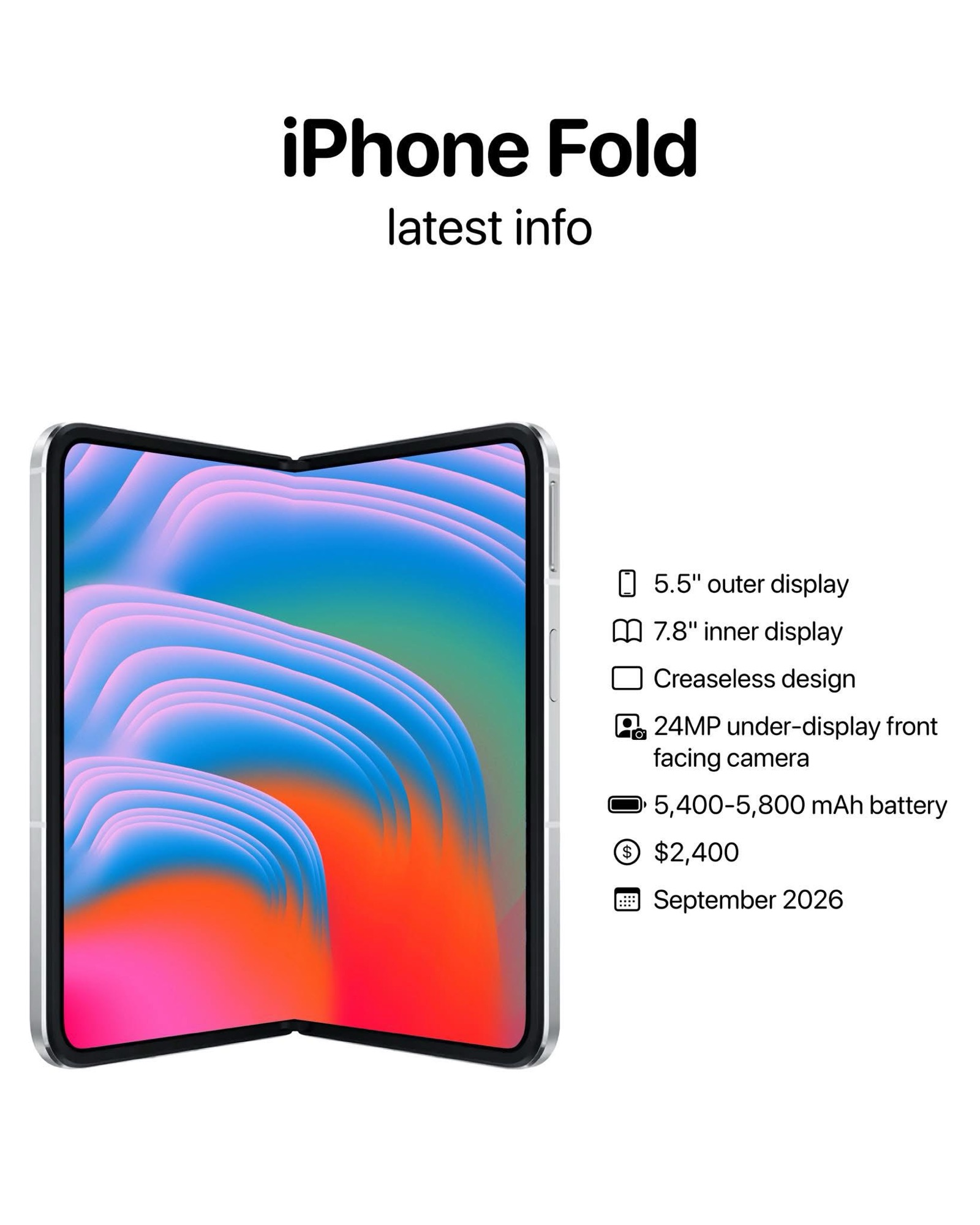
After years of speculation, the iPhone Fold is closer to reality than ever. Multiple supply-chain reports, analyst notes, and industry sources now point to a September 2026 launch with a revolutionary crease-free display, tablet-like inner screen, and a price tag that could reach £2,000+ in the UK.
This is Apple’s boldest move into foldable phones yet—and it’s designed to be unlike anything Samsung or other Android manufacturers have shipped. But should you wait? And what will it actually cost you in Britain? Let’s separate fact from rumour and give you the complete picture.
📖 Quick Navigation
iPhone Fold at a Glance: What We Know
📱 Design
Book-style foldable with outer and inner displays. Similar to Galaxy Z Fold, not clamshell style.
🖥️ Outer Display
5.5 inches OLED. Compact phone-like experience. Approx. 6.1mm thickness unfolded.
📖 Inner Display
7.8 inches OLED. Tablet-like inner screen when unfolded. Crease-free technology.
💾 Processor
A20 or newer custom chip. Same generation as 2026 flagship iPhones.
🔋 Battery
5,400–5,800 mAh. Significantly larger than current iPhones. All-day usage expected.
📷 Camera
Pro-level system (not Ultra). Under-display selfie camera on inner screen.
💷 UK Price
£2,000–£2,500 estimated. Most expensive iPhone ever.
📅 Release
September 2026 expected. Some sources warn it could slip to 2027.
Design & Display: What the iPhone Fold Will Look Like
Outer Display: Compact Phone Experience
The iPhone Fold’s outer screen is rumoured to be approximately 5.5 inches, making it slightly smaller than today’s iPhone Pro models. This gives you a traditional phone experience when folded—compact, easy to hold in one hand, and familiar to every iPhone user.
Leaks suggest the outer display will use a standard OLED panel with thin bezels and a notch or Dynamic Island for the front-facing camera. The body will be notably thinner than current iPhones when folded (around 6.1mm), which is impressive for a foldable device.
Inner Display: Tablet-Like Unfolded Experience
When you unfold the iPhone Fold, the inner screen expands to approximately 7.8 inches—putting it in the same ballpark as an iPad mini. This is the real magic: a tablet-sized display that fits in your pocket.
The inner panel will feature slim bezels and an under-display camera (more on this below), giving you an almost uninterrupted screen for media, productivity, and gaming.
Weight and Thickness
Estimates suggest the iPhone Fold will weigh between 240–260 grams (heavier than current iPhones, but reasonable for a foldable with a larger battery). When folded, it’ll be roughly 12–13mm thick—thicker than a regular iPhone but thinner than first-gen Android folds.
When unfolded, it’ll be significantly thinner (closer to 6mm), showing the engineering effort Apple has invested.
Build Materials
The iPhone Fold is expected to feature Apple’s signature design language:
- Surgical-grade stainless steel frame (or titanium, like the Pro Max)
- Ceramic Shield on the front and back
- Aerospace-grade aluminum hinge (heavily engineered to minimize the crease)
- IP68 water resistance (likely rated for full submersion like current iPhones)
The Crease-Free Display: Apple’s Secret Engineering
Why the Crease Matters
Every foldable phone on the market today—Galaxy Z Fold, OnePlus Open, Honor Magic V—has a visible crease down the middle of the inner display. You can feel it when you run your finger across it, and you can often see it when the screen is on, especially at certain angles.
This crease has been a persistent complaint from reviewers and users. It’s not a deal-breaker, but it’s the most obvious sign you’re using a foldable phone rather than a traditional device. Apple has reportedly spent years delaying the iPhone Fold specifically to solve this problem.
How Apple Claims to Eliminate the Crease
Recent supply-chain reports suggest Apple’s engineers have developed a new hinge mechanism and display substrate that work together to:
- Flatten the fold area: The display lies flatter across the hinge, reducing the visible crease
- Reduce tactile crease: New materials make the fold less pronounced when you touch it
- Optimize viewing angle: Even if a subtle crease remains, it’s far less visible at normal viewing angles
The exact technology remains secret, but industry analysts point to new hinge designs and specialized glass layers that distribute stress more evenly across the fold point.
Why This Took So Long
Apple’s perfectionism is legendary. The company reportedly rejected multiple prototype versions because the crease still wasn’t “good enough.” Rather than launch a mediocre product, Apple delayed the entire project multiple times (originally expected in 2024, then 2025, now 2026).
This approach has a downside: it means the iPhone Fold will be a late entrant to the foldable market. But the upside is that it might be the most refined foldable phone ever made.
Complete Specifications: What to Expect
| Specification | Expected Details |
|---|---|
| Outer Display | 5.5-inch OLED, 1440 x 3240 (approx.), 120Hz, ProMotion, HDR |
| Inner Display | 7.8-inch OLED, 1920 x 2688 (approx.), 120Hz, ProMotion, HDR, Crease-free technology |
| Processor | Apple A20 or A20X (custom chip for 2026), 8GB RAM |
| Storage | 256GB / 512GB / 1TB (no microSD) |
| Battery | 5,400–5,800 mAh; supports wireless charging and MagSafe |
| Charging | USB-C; 65W+ fast charging expected; MagSafe accessories |
| Rear Cameras | Pro-level: Main + Telephoto + Ultra-wide (no periscope zoom) |
| Front Camera | Under-display on inner screen (~12MP); standard notch/Dynamic Island on outer |
| Software | iOS 27 (or later); foldable-optimized multitasking and split-screen |
| Weight | ~240–260 grams |
| Thickness (Folded) | ~12–13mm |
| Thickness (Unfolded) | ~6–7mm |
| Water Resistance | IP68 (submersible up to 6m for 30 minutes, expected) |
| Colors | Midnight, Silver, Gold, Deep Purple (predicted) |
Why These Specs Matter
Larger battery: The 5,400–5,800 mAh capacity is roughly 40% larger than current iPhones. This is essential because the larger inner display will consume significantly more power.
Pro-level cameras (not Ultra): This suggests Apple is keeping the camera system powerful but not ultra-premium, likely to manage thickness and weight.
Under-display selfie: This is crucial for the crease-free promise—no notch or Dynamic Island cutting into that tablet-like inner display.
iOS 27 optimization: Software is critical. Apple will likely build the entire OS around the foldable form factor, with split-screen multitasking, foldable-aware apps, and adaptive UI layouts.
Pricing: Global and UK Estimates
United States Pricing
Multiple analyst reports converge on a starting price of US$2,399 for the iPhone Fold in the US market. This makes it:
- ~£380 more expensive than the iPhone 16 Pro Max (£2,019)
- Roughly equivalent to a high-end iPad Pro + MacBook Air combined
- More expensive than the Galaxy Z Fold 6 (typically $1,999)
Storage tiers are expected to follow Apple’s usual structure:
- 256GB: $2,399
- 512GB: $2,599
- 1TB: $2,799+
UK Pricing (Estimated)
Based on Apple’s typical US-to-UK conversion (roughly 1:1.25–1.3 ratio), expect:
| Storage | Estimated UK Price |
|---|---|
| 256GB | £2,000–£2,200 |
| 512GB | £2,200–£2,400 |
| 1TB | £2,400–£2,700 |
Note: These are estimates based on current Apple pricing patterns. The actual UK price will depend on currency conversion, VAT, and any special UK pricing Apple decides to use.
Carrier Deals and Trade-In Value
Expect UK carriers (EE, Vodafone, O2, Three) to offer:
- Upfront costs: £500–£800+ on contracts
- Monthly contracts: £60–£100+ per month for 24–36 months
- Trade-in deals: Up to £600–£800 off if you trade in an older iPhone
These are rough estimates; actual offers will become clear closer to launch.
Release Date Timeline & Availability
Expected Announcement: September 2026
Most credible sources point to September 2026 as the likely announcement date, following Apple’s traditional iPhone launch cycle. This would mean:
- September 2026: Announcement event
- Late September 2026: Pre-orders begin
- Early October 2026: General availability
Risk of Delays
Some supply-chain sources still warn that the iPhone Fold could slip into 2027 if:
- The crease-free technology isn’t ready
- Manufacturing yields are too low
- Durability testing reveals unforeseen issues
- Component shortages occur
Apple has already delayed the iPhone Fold multiple times (originally 2024, then 2025). A final slip to 2027 is not impossible, though 2026 is now considered most likely by most analysts.
Initial Availability
The iPhone Fold will likely launch in:
- 🇺🇸 United States
- 🇬🇧 United Kingdom
- 🇦🇺 Australia
- 🇯🇵 Japan
- 🇪🇺 Europe (select countries)
As with all flagship iPhones, the iPhone Fold will be available through Apple Stores, online, and major UK retailers (John Lewis, Currys, Selfridges) from day one.
iPhone Fold vs. Galaxy Z Fold 6: How They Stack Up
| Feature | iPhone Fold (2026, Expected) | Galaxy Z Fold 6 (Current) |
|---|---|---|
| Outer Display | 5.5″, crease-free | 6.3″, visible crease |
| Inner Display | 7.8″, crease-free | 7.6″, visible crease |
| Processor | Apple A20 | Snapdragon 8 Gen 3 |
| Software | iOS 27 (foldable-optimized) | Android 14 (One UI) |
| Battery | 5,400–5,800 mAh | 4,400 mAh |
| Price (US) | $2,399 | $1,999 |
| Price (UK) | £2,000–£2,200 (est.) | £1,749 |
| Launch | September 2026 | July 2024 (available now) |
| Crease | Reportedly eliminated | Visible and tactile |
Key Differences
Crease-free display: This is the headline difference. If Apple succeeds, the iPhone Fold will be a major leap forward for foldable technology.
iOS vs. Android: This is about ecosystem lock-in. If you’re invested in Apple’s products, iPhone Fold keeps you in the family. Android users are already comfortable with the Galaxy Z Fold.
Price: The iPhone Fold is £200–250 more expensive than Galaxy Z Fold 6 in the UK. You’re paying a premium for Apple’s brand, build quality, and (hopefully) superior crease-free display.
Durability & First-Generation Risks
Why First-Generation Foldables Are Risky
The Galaxy Z Fold launched in 2020 with significant durability issues: the inner display was plastic and easily scratched, the hinge was prone to creasing prematurely, and water resistance was limited. By the Z Fold 6 (2024), Samsung fixed most issues, but users had to suffer through four generations of refinements.
The iPhone Fold will be Apple’s first foldable. It’s likely to be more refined than the Z Fold 1, but you should still expect:
- Potential hinge wear: Hinges degrade with repeated folding. Apple claims their hinge is more durable, but real-world testing will tell
- Display scratching: Even with a protective layer, the inner display may be more vulnerable than a rigid screen
- Battery degradation: The larger battery may degrade faster than expected in the first year or two
- Thermal management: More powerful chips + larger screen = more heat. Apple will need proven thermal design
AppleCare+ and Extended Warranty
For a £2,000+ device, AppleCare+ will be essential. Expect:
- Coverage for accidental damage: Drops, water damage, cracked screens
- Monthly cost: Probably £25–35/month for two years of protection
- Repair costs: Screen replacement could be £300–500
This could add £600–800 to the total cost of ownership over two years.
Should You Wait for the iPhone Fold? A Practical Guide
Wait If You:
- Are genuinely interested in a tablet-sized portable screen
- Can afford £2,000+ without financial strain
- Are willing to wait until 2027 or 2028 for a second-generation (more refined) version
- Want to use a single device to replace both iPhone and iPad mini
- Are an early adopter and want to experience cutting-edge technology
Don’t Wait If You:
- Need a new phone now (the iPhone 16 Pro is excellent and affordable by comparison)
- Are on a budget or concerned about cost
- Want proven durability before switching to a foldable
- Prefer a simpler device without complex moving parts
- Are happy with a regular iPhone or Galaxy Z Fold available today
Realistic Expectations
If you do decide to wait for the iPhone Fold, manage expectations:
- Limited initial availability: Apple will likely prioritize the US market. UK supply will be limited for the first few weeks
- Price won’t drop quickly: Apple’s flagships stay expensive for at least a year. Don’t expect significant discounts in late 2026
- Early reviews will be mixed: Expect some durability concerns to emerge in real-world usage
- Second-generation will be better: By 2027–2028, the iPhone Fold 2 will be significantly more refined and potentially cheaper
Frequently Asked Questions
Q: Is the iPhone Fold confirmed?
A: Not officially. Apple has never announced an iPhone Fold. All information comes from supply-chain reports, analyst notes, and industry leaks. These are reliable sources, but nothing is confirmed until Apple speaks.
Q: When will it actually release?
A: September 2026 is the current consensus, but there’s a real possibility it could slip to 2027. Apple has delayed the project multiple times already. Don’t book holidays around an announcement date.
Q: Will it work with my Apple Watch?
A: Yes. The iPhone Fold will work with all existing Apple Watches and likely introduce new watch faces optimized for the larger display.
Q: Can I use it with one hand?
A: When folded, the 5.5-inch outer display is similar to current iPhones—one-handed use is possible but not always comfortable. When unfolded, it’s a two-handed device.
Q: Will apps work on both displays?
A: iOS 27 is expected to bring native foldable support. Developers will need to update apps to take advantage of the larger inner display, but existing apps should work on both screens.
Q: How much will it weigh?
A: Estimates suggest 240–260 grams—noticeably heavier than current iPhones but reasonable for a foldable with a larger battery and display.
Q: Will the screen be glass or plastic?
A: Likely a hybrid material—not pure glass (which would be too rigid for a foldable), but not plastic either. Probably a specialized layer designed to be scratch-resistant while flexible.
Q: How long will the battery last?
A: With a 5,400–5,800 mAh battery and efficient A20 chip, Apple claims all-day battery life should be achievable. Real-world usage will depend on screen usage.
Q: Will it be water-resistant?
A: IP68 rating is expected—same as current iPhones. However, the folding hinge may be the weak point. Avoid prolonged submersion until real-world reviews confirm durability.
Q: Will it support iPhone upgrade programs?
A: Likely yes, through Apple’s own program and carrier programs. Expect higher monthly costs due to the premium price tag.
Final Thoughts: Is the iPhone Fold the Future?
The iPhone Fold represents a massive shift in how Apple thinks about portable computing. For years, the company insisted that the iPad and iPhone filled different needs. The iPhone Fold challenges that logic—what if one device could be both?
If Apple delivers on the crease-free promise, the iPhone Fold could be the device that finally makes foldables mainstream rather than a niche curiosity. But it’s also a risk: a £2,000+ first-generation device with unproven durability in the real world.
Our recommendation: Wait for launch reviews. If durability tests are positive and early adopters report few issues by Q1 2027, consider joining the fold revolution. If problems emerge, stick with a regular iPhone and wait for the second-generation iPhone Fold in 2027–2028.
The future of phones might be foldable. But the future doesn’t have to start with the first version.