
Next-Gen Connectivity: 6G & Ultra-Fast Networks Explained
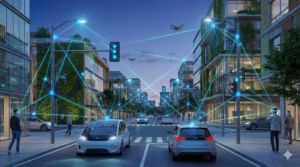
What comes after 5G, what’s real in 2026, and when it will actually matter for your family and devices.
What 6G Means for You in 2026
6G is the name for the next big upgrade to mobile networks after 5G, promising speeds up to
hundreds of times faster than today’s best connections and almost instant response times
(latency).
Want a clear, jargon‑free answer right now? Ask our free AI tech chatbot for UK parents about Roblox, TikTok, screen time and more in seconds – try it here.
In 2026, this is still early-stage technology: it lives in labs, standards meetings, and small research
trials rather than in your phone’s signal bar. But the decisions and experiments happening now
will shape how our children experience the internet in the 2030s – from holographic calls to safer
autonomous cars.
6G vs 5G: The Simple Version
If 4G was “mobile internet” and 5G is “fast, everywhere internet”, 6G aims to be “instant, intelligent
and immersive internet” – where networks feel invisible because everything just connects and responds
immediately.
Headline differences you can understand
- Speed: 5G can reach around 10–20 Gbps in ideal conditions; 6G research targets up to 1 Tbps (1,000 Gbps) in the lab.
- Latency: 5G aims for about 1–10 ms; 6G aims for sub‑1 ms, even down to microseconds for some applications.
- Devices: 5G supports about 1 million devices per km²; 6G is being designed for tens of millions of devices per km².
- Spectrum: 5G uses sub‑6 GHz and millimetre-wave bands; 6G is expected to add “terahertz” bands (roughly 100 GHz–3 THz) for ultra‑high capacity.
- Built‑in AI: 5G uses AI mainly for optimisation; 6G is being designed as “AI-native”, where AI is central to how the network runs and adapts.
6G vs 5G at a glance
| Feature | 5G Today | 6G (Expected) |
|---|---|---|
| Peak speed | Up to ~10–20 Gbps in ideal lab/field tests | Up to ~1 Tbps in research demos (100× higher) |
| Typical user speed | 100–1,000 Mbps in good coverage areas | Several Gbps expected for everyday users in mature deployments |
| Latency (response time) | 1–10 ms in best cases | Below 1 ms for critical applications |
| Supported devices | ~1 million per km² | 10+ million per km² (dense IoT, sensors) |
| Frequency bands | Sub‑6 GHz, 24–40 GHz mm | Mid‑bands plus 7–24 GHz and early terahertz bands |
| Key focus | Fast mobile broadband, low-latency apps, industrial IoT [web:19] | Immersive XR, holography, sensing, massive autonomy, digital twins [web:22][web:46][web:54] |
Is 6G Real in 2026?

6G is real as a research and standards effort, but not as something you can buy from your mobile operator
in 2026. There are no 6G phones, no 6G SIM‑only plans, and no 6G logo in your status bar yet.
Instead, what exists today are:
- Lab experiments showing terahertz data links, advanced antennas, and AI‑optimised beams.
- Early trials using 7–24 GHz and other new mid‑bands to understand coverage and performance.
- Standards work in bodies like 3GPP and ITU, mapping out what a 6G specification might look like around 2028.
- National projects in Europe, the UK, US, South Korea, Japan and China exploring new use cases and technologies.
In other words, 6G in 2026 is like 5G was around 2012–2014: a lot of white papers, testbeds and demos, but
no consumer rollout yet.
How 6G Actually Works (In Plain English)
Under the hood, 6G builds on what 5G already does well but pushes it much further using new spectrum,
smarter antennas, and tighter integration of sensing and AI.

New spectrum: into the terahertz era
Today’s networks mostly use the same basic idea: send radio waves between your device and the nearest mast.
6G experiments move into higher frequencies – especially the so‑called terahertz range – where you can carry
huge amounts of data in each signal.
The trade‑off is that these higher‑frequency signals don’t travel as far and are blocked more easily by
walls, trees, and even rain. To make this work in the real world, 6G needs:
- Smarter beamforming to “steer” signals precisely at your device.
- Many more small cells and repeaters to fill gaps.
- Hybrid use of lower bands (for coverage) and terahertz (for peak speed).
Integrated sensing: the network as a sensor
6G research is also focusing on “joint communication and sensing” (often called ISAC or JCAS). That means
your network wouldn’t just carry data; it could also sense motion, position and environment – a bit like
turning parts of the network into a giant radar.
This could enable:
- Precise location and movement tracking for vehicles and drones.
- Monitoring crowds or traffic patterns without relying only on cameras.
- Fine‑grained environment mapping that helps robots and autonomous machines move safely.
AI-native design
6G networks are being designed from the start to rely on AI and machine learning to handle complexity.
Instead of engineers manually tuning thousands of parameters, algorithms will constantly:
- Optimise which frequency, beam, and route your data should use.
- Predict congestion and reroute traffic before you notice slowdowns.
- Adapt coverage and power to save energy while keeping performance high.
What 6G Could Enable: New Experiences

The real reason 6G matters is not just speed; it is the new kinds of experiences ultra‑fast, ultra‑reliable
connectivity makes possible.
1. Holographic and ultra-immersive communication
6G white papers often show futuristic scenes where you chat to a life‑size 3D hologram of a family member
in your living room. While that’s marketing, the underlying idea is serious: if networks can shift terabits
of data with almost no delay, they can handle full‑body 3D video, spatial audio, and even haptic feedback.
In practical terms, that could mean:
- Remote work meetings where participants appear as 3D avatars or volumetric video.
- Family calls where grandparents “sit” at the table virtually at Christmas.
- Education where students explore accurate 3D simulations – from the human body to historical events.
2. XR, AR and VR that feel natural
Today’s VR and AR often feel bulky, laggy, and isolating. For children or teens, motion sickness and
eye‑strain can be a concern. 6G aims to shift more processing to the network, so headsets can be lighter
while still providing high‑resolution, responsive worlds.
With lower latency and more bandwidth, XR headsets could:
- Stream photorealistic environments instead of running them on the headset.
- Blend real and virtual objects more smoothly so AR overlays feel “locked” in place.
- Support multi‑user shared spaces, like virtual classrooms or sports training.
3. “Autonomous everything” – from cars to cities
6G research also focuses heavily on vehicles, drones, and robots which rely on connectivity to make
smarter, safer decisions. With sub‑millisecond latency and precise sensing, vehicles can
share information in real time about their position, speed, and road conditions.
- Connected cars could coordinate braking and lane changes to reduce accidents.
- Drones could navigate crowded environments more safely for deliveries or inspections.
- Cities could use networks of sensors to manage traffic, energy, and emergency response.
4. Massive IoT and “digital twins”
6G is expected to bring a huge jump in the number of sensors and devices we can attach to the network,
from home appliances to industrial machines and city infrastructure. When you combine that
data with powerful AI, you can create “digital twins” – live digital models of a factory, a building, or
even a whole city.
This opens up possibilities such as:
- Predicting maintenance needs before a machine fails.
- Testing energy or traffic changes in the digital twin before applying them in real life.
- Helping emergency services simulate evacuations or disaster response.
When Will You Actually Get 6G?
Different organisations predict slightly different timelines, but most agree on a rough pattern:
standards work this decade, early deployments around 2030, and wider consumer availability after that.
Global timeline
- 2024–2026: Research projects, lab trials, initial spectrum discussions and “6G vision” documents.
- 2026–2028: Formal standards work intensifies (e.g. 3GPP Release 20/21 for 6G), larger‑scale testbeds.
- Around 2030: First commercial 6G launches in a few leading markets (for example, parts of East Asia or North America).
- Early‑mid 2030s: Broader consumer access and integration into mainstream smartphones and devices.
What about the UK?
The UK is investing in 6G research and advanced wireless testbeds, but the current focus is still on
expanding 5G and 5G‑Advanced. That means:
- You should expect better, more consistent 5G coverage in the later 2020s.
- UK 6G trials will likely appear around the decade’s end in cities and specific test locations.
- For everyday UK consumers, 6G is likely a 2030s story, not a 2020s one.
6G vs 5G: What’s Real Now vs Hype
It’s easy to see headlines like “6G in 2026” or “10× faster than 5G” and assume your current phone is
about to be outdated overnight. The reality is slower and more practical.
What’s real right now (2026)
- 5G networks continue to roll out, with better speeds and coverage each year.
- 5G‑Advanced upgrades bring improvements like better battery efficiency and more reliable connections.
- 6G is in research, demos, conferences, and early standards meetings.
- Some “6G‑ready” marketing claims really mean strong 5G or preparation for future standards, not true 6G.
What’s still hype (for now)
- Consumer 6G phones or home routers in the next few years.
- Guaranteed speeds like 1 Tbps for every user; that’s a research figure, not a promise for your home.
- Instant worldwide holographic calls as a standard feature in the 2020s.
Practical Angle: What Should Families and Everyday Users Do?
For most families and everyday users in 2026, the best strategy is to focus on getting the most out of
4G/5G today while keeping an eye on 6G developments without feeling pressured to upgrade early.
- Choose devices with good 5G support (and Wi‑Fi 6/6E/7) so they remain fast for years.
- Think about digital wellbeing: faster networks make it easier to stream and game anywhere, so clear screen‑time rules matter more than ever.
- Plan for data‑hungry applications like cloud gaming or VR – home broadband and Wi‑Fi will still shoulder much of that load.
- Watch how regulators respond to privacy, safety, and online harms as more devices become connected.
SEO Corner: How to Turn This Topic into Multiple Articles
If you run a tech or parenting site, 6G is not just one article – it is a whole cluster of helpful content.
Here are some ideas and keyword angles.
Suggested article titles
- “What 6G Means for You in 2026 (And What’s Just Hype)”
- “6G vs 5G: The Future of Mobile Speeds Explained in Plain English”
- “Is 6G Real Yet? Your 2026 Guide for UK Families”
- “How 6G Could Change Gaming, VR and Holograms for Teens”
- “6G and Autonomous Cars: How Next‑Gen Networks Aim to Keep Roads Safer”
Long‑tail keyword ideas
- “is 6g real 2026”
- “when will 6g be available in uk”
- “6g vs 5g speed real world”
- “what will 6g mean for online gaming”
- “6g hologram calls explained for beginners”
- “parents guide to 6g and xr”
Internal linking ideas for your site
- From this 6G explainer to any article about screen time rules or digital wellbeing (faster networks = more temptation to binge).
- From sections on autonomous cars and drones to any content on F1 2026 tech or vehicle technology.
- From the AI‑native network parts to your Quantum Computing 2026 or general AI explainer articles.
- From XR/holography to any screen technology or VR headset reviews and guides.
6G FAQs (Great for Featured Snippets)
Is 6G real in 2026?
6G is real as a research and standards topic, but there are no commercial 6G networks or phones available
in 2026. You cannot buy a 6G plan yet.
How much faster will 6G be than 5G?
Research targets show potential peak speeds up to 1 Tbps, compared with around 10–20 Gbps for 5G in ideal
conditions, but everyday user speeds will be lower in practice.
When will 6G come out?
Most roadmaps point to early commercial 6G deployments around 2030 in some countries, with mainstream
consumer availability likely in the early‑mid 2030s.
Will I need a new phone for 6G?
Yes. Just as 4G phones cannot use 5G, today’s 5G phones will not support future 6G networks. New chips
and antennas will be required.
Is 6G safe?
6G will still have to comply with strict international safety limits for radio exposure, just like 4G and 5G.
Regulators and health bodies will review new bands before mass rollout.
Will 6G replace Wi‑Fi?
Probably not. 6G will complement home and office Wi‑Fi rather than replace it, especially for local
traffic and indoor coverage.
Does 6G mean my broadband will be obsolete?
No. Fixed broadband and fibre will still play a major role – in fact, 6G masts will likely rely on very
fast fibre connections in the background.
Want a clear, jargon‑free answer right now? Ask our free AI tech chatbot for UK parents about Roblox, TikTok, screen time and more in seconds – try it here.