Physical Address
304 North Cardinal St.
Dorchester Center, MA 02124
Physical Address
304 North Cardinal St.
Dorchester Center, MA 02124

Your Go-To for Digital Advice
Your Go-To for Digital Advice
On April 1, 2026, NASA successfully launched the Artemis II mission, marking the first crewed lunar mission in over 50 years and the most ambitious human spaceflight endeavor since the Apollo program. Four astronauts—NASA commanders Reid Wiseman, Victor Glover, and Christina Koch, alongside Canadian Space Agency astronaut Jeremy Hansen—embarked on a 10-day journey aboard the Orion spacecraft, traveling approximately 685,000 miles around the Moon and back to Earth. The mission represents a technological leap forward, employing cutting-edge propulsion systems across multiple spacecraft stages, consuming vast quantities of cryogenic fuels, and demonstrating NASA’s commitment to establishing sustainable lunar exploration infrastructure. This comprehensive examination explores the intricate engineering, unprecedented fuel capacities, advanced engine technologies, and mission architecture that make Artemis II one of the most technically sophisticated space missions ever attempted.
The Artemis II launch represents a watershed moment in human space exploration, occurring at 6:35 p.m. Eastern Time on April 1, 2026, from Launch Complex 39B at NASA’s Kennedy Space Center in Florida. This mission carries profound historical significance: it is the first crewed journey beyond Earth’s orbit since Apollo 17 in December 1972, representing a gap of more than 50 years in human lunar exploration. The crew composition itself breaks new ground for space exploration, featuring the first woman to venture beyond Earth orbit, the first person of color on a lunar mission, and the first Canadian to travel to the Moon.
Commander Reid Wiseman leads the mission as the spacecraft commander. A United States Navy test pilot who transitioned into the astronaut corps in 2009, Wiseman brings extensive spaceflight experience to the role. He previously spent six months aboard the International Space Station during Expedition 40 in 2014 as a flight engineer. Wiseman’s military aviation background and technical expertise make him an ideal leader for this high-stakes mission pushing the boundaries of human space travel. Despite his passion for flying, Wiseman has acknowledged a fear of heights when on solid ground—a paradox that underscores the psychological complexity of astronauts preparing for deep-space missions.
Pilot Victor Glover, a United States Navy captain and test pilot, serves as Artemis II’s pilot. Glover was selected as an astronaut in 2013 after serving as a fellow in the U.S. Senate, bringing a unique background combining military, diplomatic, and technical expertise. Notably, Glover was part of the first operational crew of SpaceX’s Crew Dragon spacecraft to the International Space Station in 2020, making him an experienced veteran of both NASA and commercial spaceflight systems. His role as pilot involves manual control of the Orion spacecraft during critical proximity operations demonstrations and docking procedures in Earth orbit before the translunar injection burn.
Mission Specialist Christina Koch represents a historic milestone as the first woman to travel beyond Earth orbit. Koch has already distinguished herself in space history by conducting the first all-female spacewalk with astronaut Jessica Meir in 2019 while aboard the International Space Station. Her 328-day mission aboard the ISS set the record for the longest single spaceflight by a woman, demonstrating her exceptional ability to adapt to the rigors of extended space missions. Koch’s early inspiration for space exploration traces back to a childhood visit to Kennedy Space Center when she was approximately 10 or 11 years old, a formative experience that ignited her lifelong passion for space exploration.
Mission Specialist Jeremy Hansen from the Canadian Space Agency creates history as the first Canadian to venture beyond low Earth orbit and the first Canadian to travel to the Moon. Born January 27, 1976, in London, Ontario, Hansen has demonstrated a lifelong commitment to aviation and space exploration. He began his aviation journey at age 12 by joining the Royal Canadian Air Cadets, earning his glider pilot wings at age 16 and receiving his private pilot license at age 17. Hansen holds a bachelor’s degree in honours space science from the Royal Military College of Canada and a master’s degree in physics. Selected as an astronaut by the Canadian Space Agency in 2009, Hansen has become the first Canadian to lead a NASA astronaut class, demonstrating his exceptional standing within the international space community. He participated in rigorous analog training, including the European Space Agency’s CAVES program in Sardinia, Italy, where he lived underground for six days, and NEEMO 19, an undersea exploration mission in the Aquarius habitat off Key Largo, Florida, where he simulated deep-space conditions for seven days.
The Space Launch System (SLS) serves as the launch vehicle propelling Artemis II toward the Moon, representing the most powerful rocket currently operational and the most powerful rocket humanity has developed since the Saturn V that carried Apollo missions to the lunar surface. Standing 322 feet (approximately 98 meters) tall and weighing 5.75 million pounds (2.6 million kilograms) at liftoff, the SLS generates staggering amounts of thrust to overcome Earth’s gravity and accelerate the Orion spacecraft toward cislunar space. The sheer scale of this launch vehicle is difficult to comprehend; its weight at liftoff is comparable to approximately eight fully-loaded Boeing 747 jets, while its height exceeds the Statue of Liberty by approximately 100 feet.
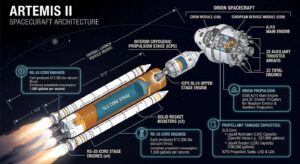
The SLS architecture for Artemis II consists of a tripartite thrust system: the core stage with four RS-25 main engines at the base, two advanced solid rocket boosters on either side, and the Interim Cryogenic Propulsion Stage (ICPS) positioned above the core stage but below the Orion spacecraft. This three-component system produces over two million pounds of vacuum thrust, generating approximately 10 times the equivalent thrust-to-weight power density of the largest commercial jet engine. Understanding the propulsion requirements and fuel consumption of this massive vehicle provides insight into the engineering complexity of modern deep-space exploration.
The four RS-25 engines mounted on the SLS core stage represent a remarkable example of aerospace engineering heritage and continuous improvement. Three of the four RS-25 engines were originally Space Shuttle Main Engines (SSMEs) that flew on the Space Shuttle orbiter, dating back to the Space Shuttle program’s early operational flights in the 1980s. The fourth engine, designated Engine 2062, represents the only unflown RS-25 engine on Artemis II, constructed from NASA’s heritage flight spares. This remarkable recycling of proven flight hardware represents both a practical and symbolic bridge between NASA’s Space Shuttle era and its next generation of deep-space exploration vehicles.
The RS-25 engine represents the pinnacle of cryogenic rocket engine technology, employing a staged-combustion cycle powered by the combination of liquid hydrogen and liquid oxygen. Each RS-25 engine operating on Artemis II produces 512,300 pounds (2,279 kilonewtons) of vacuum thrust at its operational power level of 109 percent of the rated power level. This power level exceeds the typical operational level of Space Shuttle engines, which typically operated at 104.5 percent of rated power, demonstrating that the SLS program has optimized these proven engines for enhanced performance in a new mission context.
The fuel consumption rate of the RS-25 engines is extraordinarily high, reflecting the immense energy required to accelerate the SLS and Orion spacecraft toward orbital velocity. Operating collectively, the four RS-25 engines consume liquid propellant at the rate of 1,500 gallons per second. This consumption rate is so dramatic that during the core stage burn of approximately 8.5 minutes, the four engines collectively drain more than an Olympic-sized swimming pool’s worth of propellant. To put this in perspective, the consumption rate would deplete a full bathtub of propellant in approximately one second, underscoring the prodigious energy release and thrust generation required for launch.
The propellant for the RS-25 engines consists of liquid hydrogen (cooled to minus 423 degrees Fahrenheit or minus 252 degrees Celsius) and liquid oxygen (cooled to minus 297 degrees Fahrenheit or minus 183 degrees Celsius). The core stage maintains separate tankage for these cryogenic propellants due to their incompatibility and distinct handling requirements. The liquid hydrogen tank carries 537,000 gallons (2 million liters) of hydrogen fuel, totaling approximately 317,000 pounds (144 kilograms) of mass. The liquid oxygen tank stores 196,000 gallons (741,941 liters) of oxidizer, providing approximately 1.86 million pounds (843 kilograms) of oxidizer mass. These massive quantities of propellant represent the chemical energy source that will propel the SLS through the lower atmosphere and into space.
The RS-25 engine operates at chamber pressures of 2,994 psia (pounds per square inch absolute), creating combustion conditions of extraordinary temperature and pressure within the engine’s combustion chamber. The exhaust gases exit the engine nozzle at 9,600 miles per hour, which is 13 times the speed of sound and equivalent to traveling from New York City to Los Angeles in approximately 15 minutes. The remarkable aspect of this exhaust is its composition: unlike earlier kerosene-based rocket engines that produced black, sooty exhausts, the RS-25 produces clean superheated water vapor, as the hydrogen-oxygen combination yields only water as a combustion byproduct.
[Insert your propulsion diagram image here in WordPress ‘Add Media’]
The RS-25’s specific impulse (a measure of propulsive efficiency) reaches 452 seconds in vacuum and 366 seconds at sea level. This specific impulse rating places the RS-25 among the most efficient chemical rocket engines ever developed, reflecting the fundamental thermodynamic advantages of hydrogen-oxygen propulsion. The engine achieves this efficiency through its staged-combustion cycle, which routes a small fraction of propellant through a preburner before injection into the main combustion chamber, thereby optimizing the combustion process and extracting maximum energy from the propellants.
While the RS-25 core stage engines generate impressive thrust, the two Solid Rocket Boosters (SRBs) mounted on either side of the core stage actually provide more than 75 percent of the total thrust during the initial seconds of flight. Each booster stands 177 feet tall, measures 12 feet in diameter, and weighs 1.6 million pounds, producing a maximum of 3.6 million pounds of thrust during launch. These enhanced versions of the Space Shuttle Solid Rocket Boosters incorporate new avionics, refined propellant grain designs, and improved case insulation.
The solid rocket boosters employ a composite solid propellant consisting of ammonium perchlorate as the oxidizer, aluminum powder and polybutadiene acrylonitrile (PBAN) as fuel components, all bound together into a mixture with the consistency of a rubber eraser. The total propellant load for each booster weighs approximately 1,100,000 pounds (500 metric tons), representing an enormous quantity of solid propellant packed into a segmented motor case. Unlike the liquid-fueled core stage, the solid rocket boosters produce continuous thrust throughout their entire burn duration until exhaustion, with no throttle control capability. This characteristic requires precise preflight calculations and testing to ensure that the booster thrust profile meets mission requirements throughout the powered flight phase.
The SRBs fire immediately at T-0 and continue burning for approximately 2 minutes and 6 seconds, providing the massive initial thrust required to lift the 5.75-million-pound SLS vehicle clear of the launch pad and accelerate it through the densest portions of the lower atmosphere. At approximately T+2:06, the SRBs are jettisoned, having consumed their entire propellant load, and the four RS-25 core stage engines continue firing for approximately 6.5 additional minutes, carrying the stack through the upper atmosphere and into the near-vacuum of space. The timing between booster burnout and core stage engine cutoff is precisely choreographed to ensure that Orion achieves the correct orbital parameters for the translunar injection sequence that follows.
Above the SLS core stage and below the Orion spacecraft sits the Interim Cryogenic Propulsion Stage (ICPS), a modified version of the Delta IV Cryogenic Second Stage, which serves as the final “kick” stage propelling Orion from Earth parking orbit toward the Moon. The ICPS measures 43 feet (13 meters) tall and 17 feet (5 meters) in diameter, providing the in-space propulsion capability necessary after the solid rocket boosters and core stage have been jettisoned and left behind in Earth orbit.
The ICPS is powered by a single Aerojet Rocketdyne RL10 engine, specifically the RL10B-2 variant for Artemis missions. This engine generates 24,750 pounds of force (110.1 kilonewtons) of maximum thrust and operates on the same hydrogen-oxygen propellants as the RS-25 core stage engines, requiring liquid hydrogen and liquid oxygen tankage. The ICPS contains modified liquid hydrogen and liquid oxygen tanks, with specific modifications for SLS including lengthening of the liquid hydrogen tank to provide additional propellant capacity and adding hydrazine bottles for attitude control.
The RL10 engine represents a unique design compared to the staged-combustion RS-25: it employs an expander cycle in which waste heat absorbed by the engine combustion chamber, throat, and nozzle drives the turbopump system. This elegant thermodynamic cycle allows the RL10 to achieve extraordinarily high specific impulse values ranging from 373 to 470 seconds in vacuum (depending on the specific RL10 variant and operational conditions), with the RL10B-2 variant used on Artemis achieving 465.5 seconds of specific impulse in vacuum. This remarkable efficiency makes the RL10 one of the most efficient chemical rocket engines in operation.
For Artemis II, the mission profile calls for the ICPS to execute multiple burns: first raising Orion’s perigee to approximately 185 kilometers, then performing a subsequent burn to place Orion into a high, elliptical orbit with an apogee of approximately 46,000 miles above Earth, the point at which the Orion Main Engine will perform the critical trans-lunar injection burn. Unlike Artemis I, which used the ICPS for the full trans-lunar injection, Artemis II’s profile divides this responsibility between the ICPS and Orion’s own Service Module Main Engine, providing additional operational flexibility and demonstrating Orion’s independent propulsion capability for future lunar missions.
While the Space Launch System rocket serves as the powerful launch vehicle, the Orion spacecraft represents the actual vehicle that will carry the four astronauts to the Moon and back. Orion consists of three primary components: the launch abort system (a solid-fueled escape system sitting atop the spacecraft), the crew module (the pressurized cabin where astronauts live and work), and the European Service Module (the unpressurized powerhouse providing propulsion, power, and life support consumables).
The European Service Module (ESM), built by Airbus under contract from the European Space Agency and representing NASA’s first use of a European-built system as a critical element for American human spaceflight, provides the primary in-space propulsion capability for Orion. The ESM uses a one main engine—actually a variant of the AJ10 hypergolic rocket engine—supplemented by an extensive array of smaller thrusters for attitude control and orbital maneuvering.
The primary Orion Main Engine (OME) is an AJ10 variant that burns hypergolic propellants (monomethyl hydrazine fuel and nitrogen tetroxide/mixed oxides of nitrogen oxidizer) rather than cryogenic propellants like the RS-25 and RL10 engines. The specific AJ10 variant used on Orion represents the lineage of the venerable AJ10 family, which traces its heritage back to the Vanguard rocket’s second stage in the late 1950s and has served as the Apollo Service Propulsion System, the Space Shuttle Orbital Maneuvering System engine, and now serves as Orion’s primary engine. The hypergolic propellants used by the AJ10 on Orion do not require ignition systems, being spontaneously ignitable when the fuel and oxidizer make contact. This characteristic makes the design inherently reliable and ideal for critical applications where there is no backup system, such as lunar orbit operations where engine failure could strand the crew.
The ESM’s propulsion system comprises three categories of engines and thrusters working in concert: one main engine providing 25.7 kilonewtons (approximately 5,780 pounds-force) of thrust, eight auxiliary thrusters producing 490 newtons (approximately 110 pounds-force) each, and 24 reaction control system thrusters producing 220 newtons (approximately 49 pounds-force) each. These 33 engines provide comprehensive propulsion and attitude control capability across all axes of spacecraft orientation.
The ESM carries its propellant in four separate titanium tanks, each with a capacity of approximately 2,000 liters, for a total capacity of approximately 8,000-9,000 liters of combined fuel and oxidizer, totaling approximately nine tonnes of propellant mass. The propellant tanks are pressurized to 25 bar (approximately 362 psia), with helium from two separate helium pressurant tanks providing the pressure to force propellants into the various engines on demand. The titanium construction of the tanks reflects the need for durability and reliability in the deep-space environment, while the internal components of the tanks are designed to reduce fuel sloshing and ensure repeated engine ignitions function properly under the microgravity conditions of space.
The hypergolic propellant system, while less efficient than hydrogen-oxygen systems in terms of specific impulse, offers significant operational advantages for the ESM. Hypergolic propellants require no external ignition system, function across a wide range of temperatures, can be stored for extended periods at room temperature without cryogenic cooling, and provide reliable engine restarts—all critical capabilities for a deep-space spacecraft that must operate autonomously for 10 days away from Earth support.
Beyond propulsion, the ESM provides the consumables essential for astronaut survival during the 10-day mission. The European Service Module supplies four oxygen tanks containing a total of 90 kilograms of oxygen, a single nitrogen tank holding 30 kilograms of nitrogen, and four water tanks providing 240 kilograms (approximately 240 liters) of potable water for crew consumption and use in the environmental control and life support systems. These consumables are carefully sized to allow for the extended duration of the Artemis II mission, accounting for the fact that astronauts require up to three liters of water per day and almost one kilogram of oxygen per day.
The pressurized crew module interfaces with the service module’s life support systems to create a habitable environment for the astronauts. The environmental control and life support systems maintain cabin temperature, pressure, humidity, and atmospheric composition within narrow ranges necessary for human comfort and safety during the mission. The oxygen and nitrogen are mixed into the crew module’s atmosphere at controlled rates, generating breathable air for the astronauts, while water is pumped from the service module’s tanks to the crew module on demand for drinking and hygiene purposes.
The innovative design of these consumable systems reflects lessons learned from previous spaceflight programs and incorporates improvements in reliability and efficiency. For example, the water tanks employ metallic bellows to ensure reliable water delivery in microgravity conditions, while gas tanks employ composite overwrap construction to minimize weight while maintaining structural integrity. The four solar arrays of the ESM, spanning 19 meters across when fully deployed, generate sufficient electrical power to operate all of Orion’s systems and provide approximately as much electrical power as necessary to power two households, demonstrating the comprehensive power requirements of the deep-space exploration system.
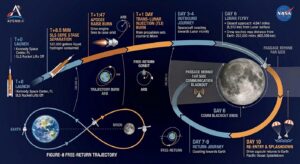
[Insert your mission timeline / trajectory image here in WordPress ‘Add Media’]
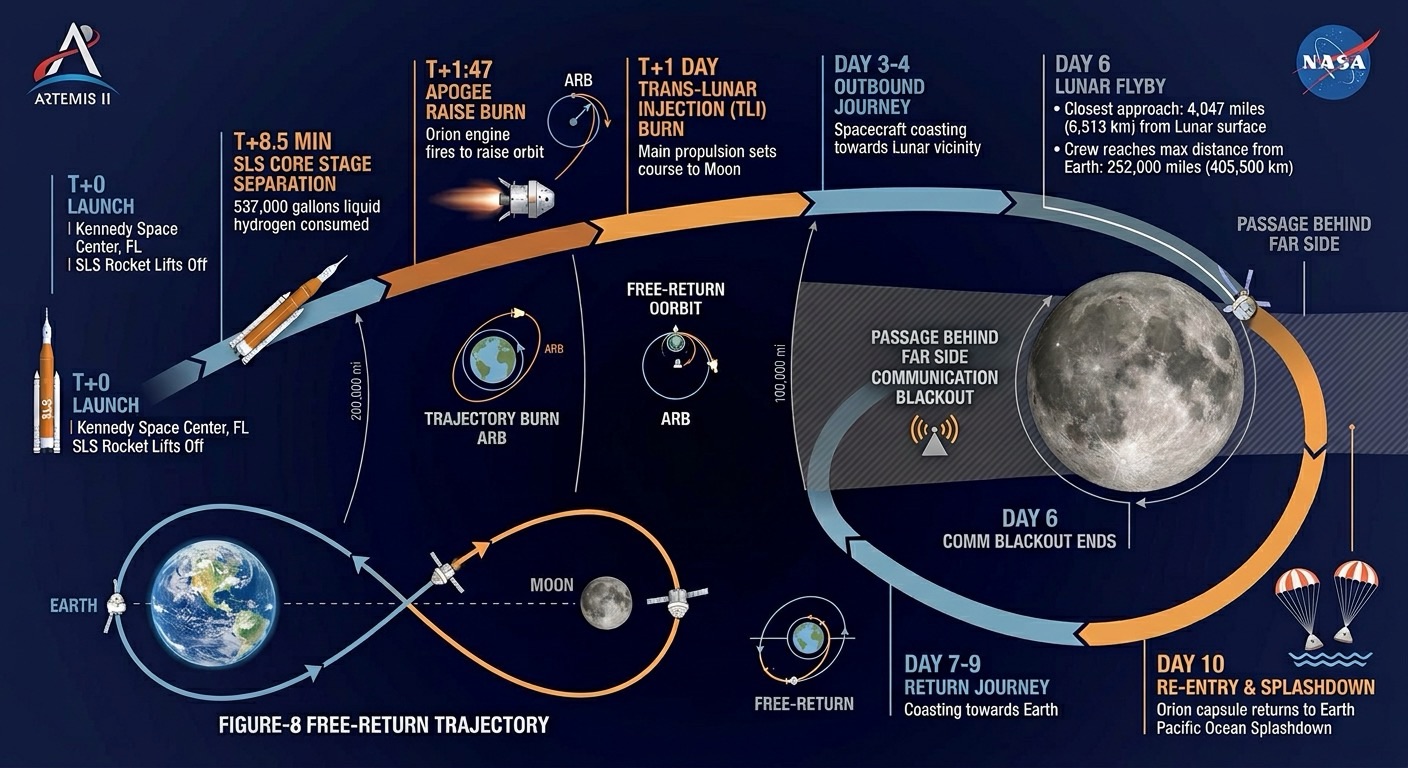
The Artemis II mission profile represents a carefully choreographed sequence of engine burns, orbital maneuvers, and propulsive events that will carry the four astronauts from Earth’s surface to the Moon and back over approximately 10 days. Understanding this mission profile provides insight into how the various propulsion systems discussed above work in concert to achieve the mission objectives.
Day 1: Launch and Earth Orbit Insertion
The mission begins at T-0 with the ignition of the two solid rocket boosters and the four RS-25 core stage engines. The combined thrust of over 8.8 million pounds (the two SRBs providing approximately 7.2 million pounds and the four RS-25 engines providing approximately 2.1 million pounds) immediately lifts the 5.75-million-pound launch vehicle from the pad. The SLS accelerates through the lower atmosphere for approximately 2 minutes and 6 seconds until solid rocket booster burnout and separation at an altitude of approximately 28 miles.
The four RS-25 core stage engines continue firing for an additional 6.5 minutes, progressively accelerating Orion toward orbital velocity while consuming the 537,000 gallons of liquid hydrogen and 196,000 gallons of liquid oxygen at the rate of 1,500 gallons per second. The four RS-25 engines achieve Mach 23 velocity (approximately 17,000 miles per hour) in approximately 8.5 minutes, reaching near-Earth space with Orion positioned in a parking orbit approximately 185 kilometers above Earth’s surface.
Day 1-2: Earth Orbit Operations and Proximity Operations Demonstration
After approximately eight-and-a-half hours in space, the astronauts sleep for a short period before being awakened after approximately four hours to perform additional engine firings that position Orion into the correct orbital geometry for the trans-lunar injection. The ICPS performs an apogee raise burn at approximately T+1 hour and 47 minutes, increasing Orion’s orbital apogee to approximately 46,000 miles, creating a highly elliptical orbit similar to a geostationary transfer orbit. This orbit places Orion at the optimal position for the trans-lunar injection burn that will occur on flight day 2.
During this period in Earth orbit, the crew performs a critical proximity operations demonstration in which Pilot Victor Glover takes manual control of the Orion spacecraft and maneuvers it around the depleted ICPS (Interim Cryogenic Propulsion Stage) that just pushed Orion into its high elliptical orbit. This demonstration, lasting just over one hour, proves Orion’s capability for manual spacecraft maneuvering and rendezvous operations—skills that will be essential for future missions involving docking with lunar gateways or other spacecraft. Glover uses a joystick to control the spacecraft’s motion around the ICPS, demonstrating precise attitude control and translational maneuvers in deep space.
Day 2: Trans-Lunar Injection Burn
On flight day 2, at approximately T+1 day and 1 hour and 37 minutes (approximately 25 hours and 37 minutes after launch), Orion performs its critical trans-lunar injection (TLI) burn. Unlike Artemis I, where the ICPS performed the entire TLI, Artemis II divides this responsibility: the ICPS positioned Orion into the high elliptical orbit, and now Orion’s own Service Module Main Engine (the AJ10 variant) will provide the final push needed to escape Earth’s gravity and begin the journey to the Moon.
This TLI burn represents the last major engine firing of the mission and sets Orion on the trajectory that will carry it to the Moon. The Service Module’s AJ10 Main Engine, burning its hypergolic propellants, provides the delta-velocity (change in velocity) necessary to transition Orion from Earth orbit to a lunar trajectory. Because Artemis II uses a free-return trajectory (described below), the TLI burn simultaneously sets Orion on the path to return to Earth on flight day 10, creating an elegant closed-loop trajectory that uses lunar gravity as a natural slingshot to redirect Orion back toward Earth.
Days 3-5: Translunar Coast
After the TLI burn, Orion begins a three-day coast toward the Moon, with the crew monitoring spacecraft systems, gathering data on the effects of deep-space travel on human physiology, and performing trajectory correction burns as needed using the smaller auxiliary thrusters of the Service Module. The astronauts experience an environment far different from Earth orbit: at distances exceeding 50,000 miles from Earth, the gravitational influence of our planet becomes increasingly negligible, while the Moon’s gravitational attraction grows stronger with each passing hour.
Day 6: Lunar Flyby and Maximum Distance from Earth
On the sixth day of the mission, approximately four days after the trans-lunar injection burn, Orion reaches the Moon. The spacecraft approaches to within approximately 4,047 miles (6,513 kilometers) of the lunar far-side surface—significantly farther than the Apollo missions, which orbited at altitudes as close as 100 miles from the lunar surface or even landed on the surface itself. However, the higher flyby altitude for Artemis II was selected for the mission profile to test the free-return trajectory concept and to ensure that Orion can perform the required rendezvous with the Lunar Gateway in future missions.
During the lunar flyby, the four astronauts will reach a maximum distance of approximately 252,000 miles from Earth—surpassing the Apollo 13 record of 248,655 miles (400,171 kilometers) established in 1970 and becoming the farthest humans have ever ventured from their home planet. For 30 to 50 minutes during this flyby, the astronauts will go radio silent as Orion passes behind the far side of the Moon, temporarily losing communication with Earth due to radio signal blockage from the lunar mass. During this communication blackout period, the astronauts will have an unprecedented view of the lunar far side—regions that have never been seen directly by humans from the surface.
The most remarkable aspect of this lunar approach is the elegance of the free-return trajectory. The spacecraft need not perform a lunar orbit insertion burn or any propulsive maneuver to enter lunar orbit. Instead, the Moon’s gravity naturally curves Orion’s trajectory, creating a smooth arc around the lunar surface. If the Service Module’s engines were to fail entirely at any point up to the lunar encounter, the Moon’s gravity would naturally redirect Orion back toward Earth without any additional propulsive input, creating an inherent safety margin for the mission. This ingenious use of orbital mechanics transforms lunar gravity into a passive safety system—a fail-safe that relies on the laws of physics rather than on engine firing.
Days 6-10: Return Journey and Splashdown
After the lunar encounter, the Moon’s gravity gently redirects Orion back toward Earth. The return journey takes approximately four days, during which the astronauts continue monitoring spacecraft systems and performing any necessary trajectory correction burns using the Service Module’s auxiliary thrusters. These correction burns ensure that Orion’s trajectory intersects with Earth’s atmosphere at precisely the correct angle—shallow enough to avoid burning up the spacecraft but steep enough to slow it sufficiently for parachute deployment.
On flight day 10, Orion approaches Earth’s atmosphere at an extremely high velocity—approximately 25,000 miles per hour (approximately 11 kilometers per second). The Service Module separates from the crew module at an altitude of approximately 100 kilometers, leaving the crew module to face Earth’s atmosphere alone. The atmospheric entry of the crew module is extraordinarily violent: atmospheric friction creates temperatures exceeding those on the surface of the Sun, but the crew module’s advanced heat shield dissipates this energy and slows the spacecraft sufficiently for parachute deployment.
The spacecraft then deploys a series of parachutes—first a small drogue parachute for stability, then three enormous main parachutes—that further slow the descent. Finally, Orion’s heat shield-first orientation flips to a blunt-end-forward position (with the crew module’s forward end facing upward), and the spacecraft splashes down in the ocean. Recovery operations retrieve the spacecraft and astronauts within hours, completing the 10-day, 685,000-mile journey around the Moon and back to Earth.
The Artemis II mission represents an unprecedented level of international cooperation in human spaceflight, extending beyond the International Space Station partnership that has characterized space exploration since the 1990s. The European Service Module (ESM), built by Airbus Space under contract from the European Space Agency, represents the first time that NASA has relied on a European-built system as a critical element for an American crewed spacecraft bound for deep space.
The assembly of the ESM takes place in Bremen, Germany, while suppliers from 11 countries across Europe and the United States contribute components that form the spacecraft’s chassis and supply life-support and propulsion systems. This international effort underscores the recognition that deep-space exploration requires collaboration among the world’s leading spacefaring nations. The ESM provides not only the primary propulsion system but also the consumables (oxygen, nitrogen, and water), electrical power, and thermal control essential for the astronauts’ survival and the spacecraft’s operation throughout the mission.
The inclusion of Canadian astronaut Jeremy Hansen on the Artemis II crew further demonstrates international cooperation at the human level. Hansen’s presence represents Canada’s contribution to lunar exploration and signals that future Moon missions will draw on the skills and expertise of international partners. The Canadian Space Agency’s selection of Hansen for this mission and his preparation over many years underscore the significant investment that spacefaring nations make in developing the next generation of space explorers.
From a financial perspective, Artemis II is extraordinarily expensive. While NASA does not publish a standalone price tag specifically for the Artemis II mission, credible estimates from government audits suggest that each Artemis launch—including both the Space Launch System rocket and the Orion spacecraft—costs over $4 billion. The broader Artemis program has accumulated costs exceeding $93 billion through 2025, with some estimates placing the total program cost potentially exceeding $100 billion. These costs reflect the development of new heavy-lift rockets, deep-space crew systems, advanced engines, and long-term lunar infrastructure. While these expenditures represent significant financial investment, they must be contextualized: the total Artemis program costs are comparable to, or actually lower than, the inflation-adjusted costs of the Apollo program, which placed humans on the Moon for the first time.
To comprehend the engineering achievement represented by Artemis II, it is valuable to summarize the propulsion system across all three stages:
Space Launch System Core Stage (RS-25 Engines): The four RS-25 engines produce a combined 2.048 million pounds of vacuum thrust. Operating at 109 percent power level for 8.5 minutes, the engines consume cryogenic propellants at 1,500 gallons per second—537,000 gallons of liquid hydrogen and 196,000 gallons of liquid oxygen. Specific impulse: 452 seconds in vacuum. Exhaust velocity: 9,600 miles per hour.
Solid Rocket Boosters: Two SRBs produce combined 7.2 million pounds of thrust for 2 minutes 6 seconds. Propellant: ammonium perchlorate composite, approximately 1,100,000 pounds per booster. Combined SRBs provide over 75 percent of initial launch thrust.
Interim Cryogenic Propulsion Stage (RL10 Engine): Single RL10B-2 engine produces 24,750 pounds of thrust. Propellant: liquid hydrogen and liquid oxygen. Specific impulse: 465.5 seconds in vacuum. Mission duration: multiple burns totaling approximately 25 minutes.
Orion European Service Module (AJ10 Main Engine and Thrusters): Main engine produces 25.7 kilonewtons (5,780 pounds-force). Eight auxiliary thrusters at 490 newtons each. Twenty-four RCS thrusters at 220 newtons each. Total propellant capacity: 8,000-9,000 liters of hypergolic propellants (monomethyl hydrazine and mixed nitrogen oxides), approximately nine tonnes. Specific impulse: 285-320 seconds depending on thruster type.
The Artemis II mission represents far more than simply returning humans to lunar space after a 50-year hiatus. It demonstrates the culmination of decades of engineering, propulsion system development, and technical innovation that has advanced human spaceflight to a level of sophistication and capability never before achieved. The four astronauts—Reid Wiseman, Victor Glover, Christina Koch, and Jeremy Hansen—will rely on intricate systems involving multiple stages of propulsion, consuming enormous quantities of cryogenic and hypergolic propellants, coordinated through precise orbital mechanics and trajectory design.
The Space Launch System rocket, with its 8.8 million pounds of initial thrust from SRBs and RS-25 engines consuming 1,500 gallons of propellant per second, represents the most powerful launch vehicle currently operational. The Interim Cryogenic Propulsion Stage and Orion’s European Service Module provide the sophisticated maneuvering and life-support capabilities necessary for the 10-day, 685,000-mile journey to lunar orbit and back. The free-return trajectory, utilizing lunar gravity as a passive safety system, showcases how orbital mechanics can transform fundamental physics into mission-critical engineering.
The international cooperation evident in the European Service Module and the inclusion of a Canadian astronaut on the crew signals a new paradigm for space exploration—one in which the world’s spacefaring nations work together to push the boundaries of human capability and advance our understanding of deep space. As Artemis II completes its historic mission, it will pave the way for Artemis III and subsequent missions aimed at establishing a sustainable human presence at the lunar south pole, eventually facilitating human missions to Mars and deeper into the cosmos.
The Artemis II mission, launching on April 1, 2026, stands as testament to human ingenuity, international cooperation, and the remarkable achievements possible when thousands of engineers, scientists, and astronauts work toward a shared vision of exploring the Moon and returning humans safely home. With its advanced propulsion systems, life-support capabilities, and precisely choreographed maneuvers, Artemis II will write a new chapter in the history of human spaceflight—one that future generations will recognize as the moment when humanity once again reached beyond Earth to touch the Moon.