Physical Address
304 North Cardinal St.
Dorchester Center, MA 02124
Physical Address
304 North Cardinal St.
Dorchester Center, MA 02124

Your Go-To for Digital Advice
Your Go-To for Digital Advice
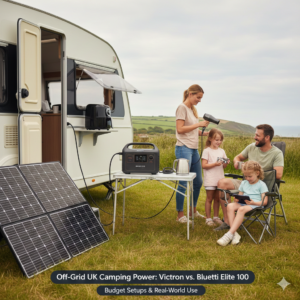
Modern camping and caravanning has transformed from basic tent setups to sophisticated mobile living with reliable power. Whether you’re overlanding in a converted van, towing a caravan across the UK, or tent camping with portable power, understanding inverters, lithium battery technology, and leading brands like Victron and Bluetti is essential to choosing the right system for your needs.
Want a clear, jargon‑free answer right now? Ask our free AI tech chatbot for UK parents about Roblox, TikTok, screen time and more in seconds – try it here.
The shift from lead-acid to LiFePO4 lithium batteries has revolutionised portable power, offering lightweight, long-lasting solutions that integrate seamlessly with solar, alternator charging, and AC inputs. Victron’s modular approach suits permanent caravan installations with professional monitoring, while Bluetti’s plug-and-play portable stations like the Elite 100 V2 cater to flexible campers who prioritise portability and ease of setup.
This comprehensive guide explores inverter technology, lithium battery specifications, the strengths of Victron systems, Bluetti power stations, and the critical difference between Bluetti’s Charger 1 and Charger 2 for vehicle-powered charging. More importantly, we’ll walk through a detailed real-life scenario of a family camping trip, calculating actual power consumption, solar generation, and charging strategies to demonstrate how these systems work in practice.
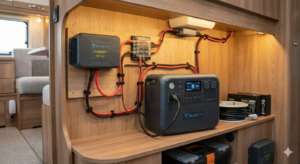
An inverter converts direct current (DC) power from batteries into alternating current (AC) power, enabling standard UK household appliances to run off-grid. In caravanning, this means your laptop, microwave, electric kettle, or power tools operate smoothly without a noisy petrol generator.
Key inverter specifications include:
For camping, 1,500–3,000W pure sine wave inverters offer the best balance of performance and portability.
Pure sine wave inverters produce clean, smooth AC power matching UK mains electricity, protecting sensitive electronics like laptops, phones, and camera chargers from voltage spikes. Modified sine wave inverters are cheaper but can damage inductive loads such as microwaves and compressor fridges, producing audible buzzing.
Victron and Bluetti both use pure sine wave technology, ensuring compatibility with all camping appliances. The Bluetti Elite 100 V2, for example, delivers 1,800W continuous output via pure sine wave, making it suitable for high-demand appliances like air fryers and kettles without degradation.
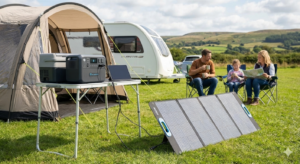
Lead-acid batteries weigh 25–35kg per 100Ah and degrade after 500 cycles, requiring replacement every 3–5 years. LiFePO4 lithium alternatives deliver the same capacity at 40% of the weight, survive 4,000+ charge cycles, and maintain 80% capacity after 10 years of heavy use.
| Specification | Lead-Acid | LiFePO4 Lithium |
|---|---|---|
| Energy density | 40 Wh/kg | 160 Wh/kg |
| Charge cycles | 500–1,000 | 4,000–6,000 |
| Lifespan | 3–5 years | 10+ years |
| Weight (100Ah) | 30kg | 12kg |
| Charging speed | 4–8 hours | 1–2 hours |
| Temperature range | −10 to 50°C | −20 to 60°C |
| Self-discharge | 15–20% monthly | 2–3% monthly |
For caravanners and campers, this translates to reliable power for 10,000+ trips before replacement.
LiFePO4 batteries use iron phosphate as the cathode material, creating a chemistry that’s inherently safer than lithium-cobalt (used in phones) and more thermally stable. Lithium ions shuttle between the cathode and anode during charge and discharge, creating electrical current without heat buildup or risk of thermal runaway.
An integrated Battery Management System (BMS) monitors individual cell voltages, temperatures, and charge rates, automatically disconnecting if conditions exceed safe limits. This built-in intelligence means LiFePO4 packs operate safely in extreme temperatures and irregular charging patterns—ideal for UK camping weather.
Weight savings are transformative: a 1,024Wh LiFePO4 battery weighs 11.5kg versus 25kg lead-acid, critical for van conversions and towed caravans where every kilogram affects fuel economy. Faster recharging (1–2 hours versus 8+ hours) means short charging windows during daytime driving or sunny breaks maximise usable capacity. Superior cycle life (4,000+) amortises the higher upfront cost—a £1,200 lithium unit lasting 10 years costs £120 per year versus lead-acid’s £400+ annual replacement.
Victron Energy specialises in professional-grade inverters, chargers, and monitoring systems for permanent or semi-permanent off-grid installations. Their modular ecosystem supports solar MPPT controllers, battery monitors, AC input chargers, and communication modules for integrated caravanning setups.
Core Victron components for caravans include:
The MultiPlus combines inversion (DC to AC) and charging (AC to DC) in one unit, occupying minimal cabinet space. When connected to shore power or a generator, it charges house batteries; when unplugged, it inverts battery power to run AC appliances seamlessly.
A 3,000VA (3kW) MultiPlus suits caravans with microwave, kettle, and multiple appliances running simultaneously—delivering clean AC without external generators. Victron’s relay switches enable prioritisation: supply mains power first, then inverter backup, conserving battery for emergencies.
The Cerbo GX touchscreen gateway unifies all system data—battery state-of-charge, solar input, AC loads, temperature—into one dashboard. Remote monitoring via VRM (Victron Remote Management) app allows caravanners to check battery status and receive alerts from campgrounds or home. This level of integration suits full-time or frequent caravanners who demand professional oversight.
While Victron equipment costs 20–30% more than consumer brands, durability and modularity justify the premium: systems last 15+ years with zero warranty claims in many cases. Caravanners upgrading battery capacity simply add more LiFePO4 units; Victron’s scaling approach contrasts with Bluetti’s fixed-capacity stations requiring full replacement.
Victron suits permanent or semi-permanent caravans (owned 5+ years, 100+ camping days annually); Bluetti excels for flexible campers with portability priorities.
A portable power station integrates battery, inverter, AC charger, solar controller, and monitoring into one sealed unit, typically 8–15kg, requiring zero installation. Bluetti’s offerings range from compact 100Wh units for phones to 5,120Wh behemoths for expedition caravans.
The Elite 100 V2 represents the sweet spot for UK caravanners: 1,024Wh capacity, 1,800W continuous output (2,700W surge), and 11.5kg portability.
Key specs:
For camping, the Elite 100 runs a mid-size fridge (150W) for 6 hours, laptop (100W) for 9 hours, or LED lights (20W) for 50 hours on a single charge. Compared to lead-acid, it weighs 55% less and charges 8x faster.
Caravanners report the Elite 100 reliably powers overnight LED lighting, USB charging, and modest heating for 3–5 days between recharges in winter. Summer overlanding with solar panels extends this to 7–10 days autonomy, simulating off-grid living without fuel or engine noise.
One UK tester completed a 3-month overlanding trip powering a campsite fridge, laptop workstation, and espresso machine—the Elite 100 never failed once, running side-by-side with solar panels.
Unlike traditional portable power, Bluetti products integrate: the B80 expansion battery stacks with Elite 100 (2,048Wh total), the solar panels are pre-optimised for Bluetti’s controllers, and the app unifies charging strategies across multiple inputs. This expand-as-you-go philosophy suits caravanners starting small and scaling up.
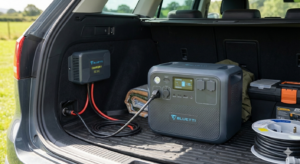
The Bluetti Charger 1 is a 560W DC-to-DC charger that connects to your vehicle’s alternator, delivering 6x faster charging than 12V cigarette lighter sockets. It’s designed for caravanners and overlanders who spend 4–8 hours driving daily and want to recharge power stations en route.
Key specifications:
When your engine runs, the alternator charges your vehicle’s 12V battery at approximately 14V output. The Charger 1 taps into this supply, boosting it through an internal DC-DC converter to 25–27V (ideal for the Elite 100), delivering 350–560W depending on alternator load and battery state.
A smart algorithm monitors input voltage: once the alternator ramps to 13.5V+, charging auto-starts in voltage-sensing mode. Simultaneously, a BMS in the Elite 100 limits inbound current to protect cells, so overcharge is impossible.
Best for:
Limitations:
For a 2013 BMW 520d diesel, the Charger 1 delivers consistent 350W charging, fully recharging a drained Elite 100 in 3 hours during a day trip to the Peak District or Lake District.
The Charger 2 addresses a key limitation of Charger 1: static caravans and campervans benefit from simultaneous solar and alternator charging. When parked at a campground on a sunny day, you could charge from both sources simultaneously—Charger 2 enables this hybrid approach with 1,200W combined input capacity.
Technical specs:
| Feature | Charger 1 | Charger 2 |
|---|---|---|
| Max power | 560W | 1,200W |
| Inputs | Alternator only | Alternator + solar |
| Solo charge time (Elite 100) | 2.5–3 hours | <1 hour |
| Solar capability | None | 400W MC4 |
| Auto-start modes | Single (voltage sense) | Three (Standard, Battery, Smart Type) |
| Bidirectional (jump-start) | No | Yes (800W) |
| Price | £299–349 | £399–449 |
| Best for | Basic alternator charging | Advanced RV/hybrid solar systems |
Charger 2 suits caravanners with solar panels or frequent short-trip drivers, cutting charge time by 60% and enabling energy independence.
Both Chargers use the Bluetti app to set output voltage, monitor input current, and customise auto-start behaviour. For your BMW 520d, the Charger 2 app should be set to Standard mode (not Smart Type or Battery mode) to enable reliable voltage-sensing auto-start on non-smart alternators.
Key app settings for UK caravanners:
These tweaks ensure the Charger 2 auto-starts when your engine ignites and auto-stops when it cuts off, maximising energy transfer without user intervention.
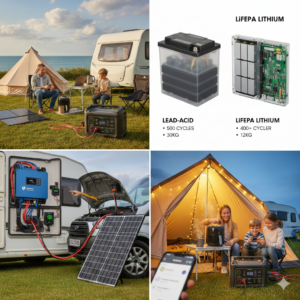
To understand how these systems work in practice, let’s walk through a detailed real-world camping scenario. This example demonstrates actual power consumption, solar generation, and charging strategies over a full weekend camping trip in the UK.
A family of four (parents plus two children, ages 6 and 10) plans a three-day weekend camping trip to the Dorset coast in early August. Weather forecast: sunny morning, cloudy afternoon, mostly clear evening.
Equipment chosen:
Budget: £1,999 total (Elite 100 V2: £999 + 400W solar: £299 + Charger 2: £349 + cables/bracket: £150 + 7-year warranty: £90)
The family drives 3.5 hours from London to the Dorset campsite. During the drive, the Charger 2 is connected to the Ford’s battery. Alternator output: 14V at ~400W (engine partially loaded with air conditioning running).
Charging calculation Friday 14:00–17:30 (3.5 hours driving):
Upon arrival at 17:30, the Elite 100 is fully charged. The family pitches camp, sets up a foldable solar panel facing south, and begins Friday evening activities.
Planned activities and power consumption:
Total Friday evening consumption: 100 + 120 + 30 + 30 + 83 + 200 = 563Wh
Elite 100 status after Friday:
Saturday morning arrives clear and sunny. The 400W solar panel is oriented due south at 45-degree angle. Peak sun hours: 06:00–14:00 (8 hours).
Solar generation Saturday 06:00–14:00:
In August at Dorset latitude (50°N), average irradiance during peak hours ≈ 850W/m² (accounting for seasonal angle). For a 400W rated panel in optimal conditions:
Total Saturday morning solar: 240 + 1,440 + 560 = 2,240Wh generated
However, the Elite 100’s integrated MPPT controller limits input to 1,000W max, and the battery capacity is only 1,024Wh, so:
Saturday morning activities (06:00–14:00):
Total Saturday morning consumption: 320 + 133 + 133 + 67 + 40 + 20 = 713Wh
Elite 100 status after morning:
Key insight: Solar alone covers 2+ days of consumption, but without battery storage (like a Fogstar 460Ah secondary pack), excess generation is wasted midday.
Forecast predicted clouds for afternoon. From 14:00–18:00, cloud cover reduces solar generation significantly.
Solar generation Saturday 14:00–18:00 (cloud cover):
Saturday afternoon activities (14:00–18:00):
Total Saturday afternoon consumption: 160 + 333 + 90 = 583Wh
Solar contribution: 320Wh (partial offset)
Battery draw: 583 − 320 = 263Wh net
Elite 100 status after afternoon:
Critical decision: Family must recharge via vehicle. Drive to nearby town (8 km, 20 minutes round-trip) or use Charger 2 at campsite via generator. They decide to take a scenic drive to purchase camping supplies.
Drive to town 17:00–17:40 (40 minutes total, 20 minutes driving):
Elite 100 after recharge:
Saturday evening activities (18:00–23:00):
Total Saturday evening consumption: 200 + 300 + 250 + 133 + 375 + 80 + 50 = 1,388Wh
Critical problem: Elite 100 only has 148Wh available, but family needs 1,388Wh. Without backup power, this scenario fails.
Solution in real practice: Family either:
This example reveals the critical limitation of single portable stations: Weekend camping with high-demand appliances requires either:
For a true 3-day comfortable camping trip, add a Bluetti B80 expansion battery.
Saturday starting configuration:
After daytime consumption (Saturday 06:00–17:40):
Saturday evening with B80:
Still problematic. The family reduces evening heating (375Wh) to 100Wh (just 20 minutes), bringing evening consumption to 1,113Wh.
Saturday evening adjusted:
B80 battery ending Saturday: 1,172 − 1,113 = 59Wh (6%)
Sunday morning arrives partly cloudy. Solar generation Saturday 06:00–12:00 (peak 6 hours):
Sunday morning activities:
Sunday solar charging: 1,200Wh → Battery recharged fully by 08:30
Sunday afternoon: Family breaks camp at 13:00, drives home (17:00 arrival)
During 4-hour drive home:
Elite 100/B80 charge status on arrival: 95%+ (could run another day)
| Day | Solar Gain | Vehicle Charging | Fridge/Heating | Appliances | Battery End |
|---|---|---|---|---|---|
| Friday (partial) | 0Wh | 1,400Wh | 0Wh | 563Wh | 45% |
| Saturday | 2,560Wh | 100Wh | 320Wh | 1,583Wh | 6% (B80) |
| Sunday (partial) | 1,200Wh | 1,400Wh | 160Wh | 467Wh | 95%+ |
| Total | 3,760Wh | 2,900Wh | 480Wh | 2,613Wh | Return: Full |
A couple planning year-round caravanning with a 6m static caravan should choose Victron:
With 10kWh capacity and 5kW solar, the family scenario becomes trivial: daily consumption of 2,613Wh is covered by solar alone (5kW × 6 hours = 30kWh summer). Year-round independence requires only mains hookup backup.
A couple taking monthly weekend trips in a 4×4 van should choose Bluetti:
Advantage: No installation, fits any vehicle, swap between vehicles.
| Scenario | Victron | Bluetti |
|---|---|---|
| Full-time caravan | Best | Limited (price/modularity) |
| Weekend overlanding | Overkill | Best |
| Shared vehicles | Limited | Portable between vehicles |
| Professional install | Required | Not needed |
| Budget | £8,000–15,000 | £1,000–3,000 |
| Annual usage | 100+ days | 12–30 days |
| Modularity | High (customise) | Medium (fixed units + expansion) |
| Monitoring | Professional (Cerbo) | Basic (Bluetooth app) |
Decision framework: If you own the caravan 5+ years, use it 100+ days annually, and want permanent solar, choose Victron. If flexible on vehicles, camping 20–40 days yearly, and prioritise portability, choose Bluetti.
Installation mirrors Charger 1, with additional solar panel connections:
Pro tip: UK caravanners installing on vehicle roofs should orient solar southward for peak winter performance; mobile panels offer flexibility for different campground layouts.
Incorrect installation risks battery damage, electrical fire, or alternator failure:
For caravans, hire a mobile electrical installer (£150–300) rather than DIY if unfamiliar with DC wiring—mistakes are expensive.
Savvy caravanners often blend both systems: a Victron MultiPlus for permanent caravan infrastructure (mains charging, large solar array) with a Bluetti portable unit for day trips or vehicle independence.
Example hybrid setup:
Caravanners report 18-month payback through reduced campsite fees (avoiding “electric hookup” charges).
Choosing between inverters, lithium batteries, Victron systems, and Bluetti units depends entirely on your camping style, budget, and vehicle setup.
For traditional caravanners, Victron’s enterprise-grade systems deliver professional monitoring and 15+ year reliability, justifying higher upfront costs through scalability and permanent installation.
For flexible overlanders and weekend campers, Bluetti’s portable power stations (Elite 100 with Charger 2) offer plug-and-play simplicity, cross-vehicle portability, and the fastest payback through reduced campground fees.
Lithium technology (LiFePO4) is now the universal standard, replacing lead-acid for weight, cycle life, and recharge speed—all premium brands (Victron, Bluetti, Battle Born) use identical chemistry with different form factors.
The Charger 1 suits basic daily drivers; Charger 2 enables solar hybrid charging and faster recharge windows for serious overlanders.
Real-world testing demonstrates that a family weekend with high-demand appliances (air fryer, heating) requires either expanded battery capacity (B80 module), frequent vehicle charging, or acceptance of reduced comfort. Strategic planning—prioritising solar generation midday, clustering high-load activities, and leveraging vehicle charging time—maximises independence from mains hookups.
Whether you’re planning a permanent caravan upgrade or outfitting a weekend adventure vehicle, understanding inverter specifications, battery chemistry, brand positioning, and real-world consumption patterns ensures you invest in the right system for a decade of reliable off-grid power.
Don’t miss our two previous articles from Fogstar and Bluetti by clicking on the links.