Physical Address
304 North Cardinal St.
Dorchester Center, MA 02124
Physical Address
304 North Cardinal St.
Dorchester Center, MA 02124
Your Go-To for Digital Advice
Your Go-To for Digital Advice
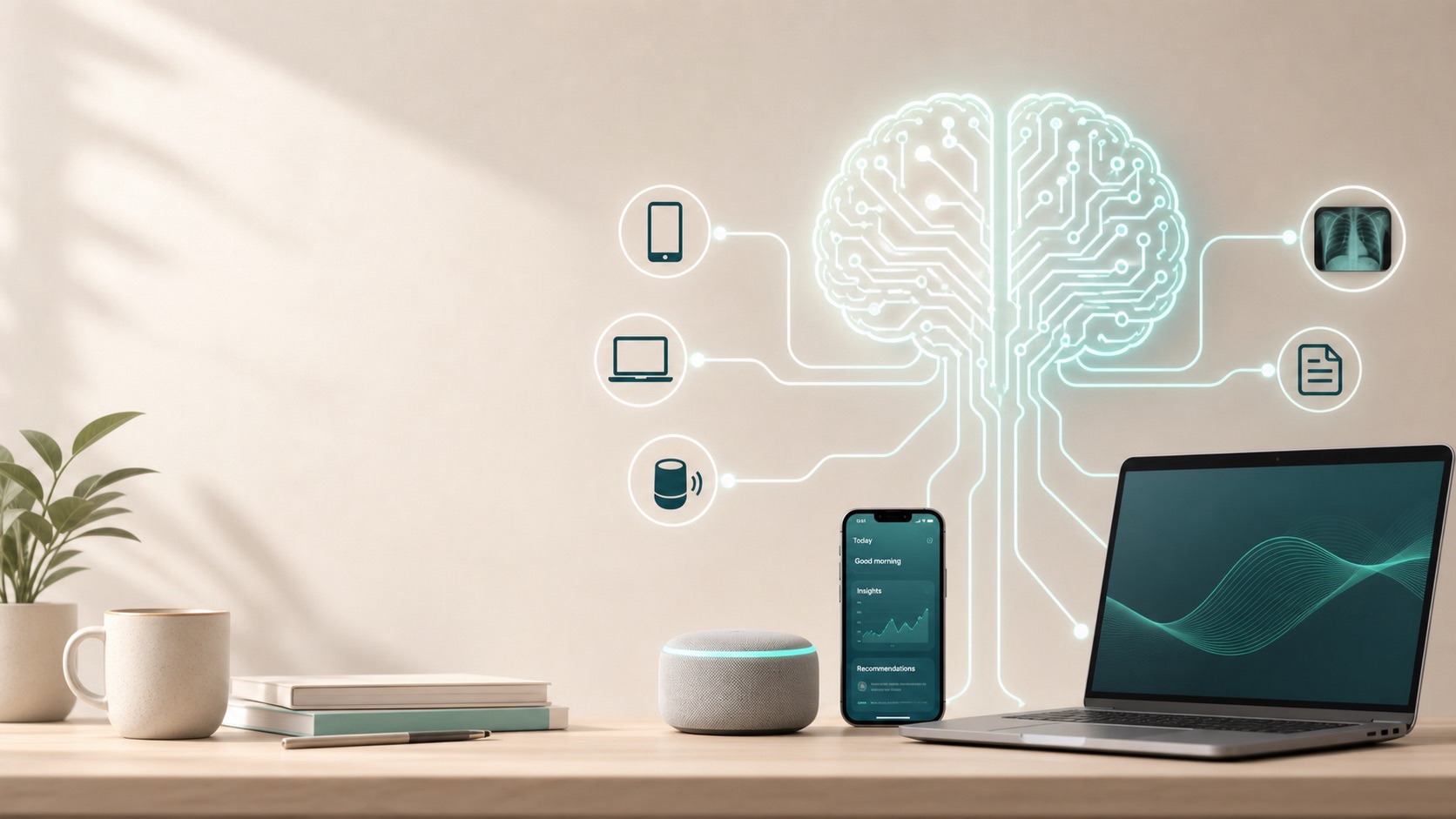

Artificial intelligence is software that can spot patterns in data, make predictions, generate content, answer questions, recognise images and speech, and help people complete tasks that once needed human judgement or effort. In simple terms, AI is not magic and it is not a robot uprising; it is a set of computer systems designed to perform jobs such as understanding language, identifying objects, recommending content, detecting fraud, and automating repetitive work.
If you have used a voice assistant, seen Netflix or YouTube recommendations, asked ChatGPT a question, unlocked your phone with your face, relied on spam filtering, or used sat-nav traffic predictions, you have already used AI. Businesses now use artificial intelligence to reduce errors, speed up analysis, personalise services, improve customer support, detect suspicious behaviour, and uncover patterns in huge sets of data that humans would struggle to review quickly.
This guide explains what AI is in plain English, how it works, the different types of AI people talk about, the benefits and risks, and the huge range of real-world uses for artificial intelligence across daily life, work, healthcare, education, finance, transport, cybersecurity, retail, creative tools, and the home. It is written for readers who want a clear answer, not technical waffle.
Artificial intelligence, usually shortened to AI, is a broad term for computer systems that can carry out tasks that normally need human intelligence. That can include understanding language, recognising speech, spotting patterns, making choices, solving problems, identifying objects in images, or generating text, code, music, and pictures.
A useful way to think about AI is this: normal software follows fixed instructions written by a programmer, while AI systems are often trained on large amounts of data so they can learn patterns and respond to new inputs. For example, instead of programming every possible spam email rule by hand, an AI system can learn what suspicious email tends to look like and then flag new messages that match those patterns.
That is why AI feels clever. It is not “thinking” like a human in the full sense, but it can process huge amounts of information very quickly and produce outputs that seem intelligent. Modern AI can draft emails, summarise documents, translate languages, recommend products, identify signs of disease in medical scans, and help detect cyber threats. In many cases, it works best as a helper rather than a replacement for human judgement.
At a basic level, AI works by taking in data, finding patterns, and then using those patterns to make a prediction, recommendation, decision, or generated response. The exact method depends on the type of AI being used, but the core idea is consistent: the system learns from examples and applies what it has learned to new situations.
For example, if an AI model is trained to recognise cats in photos, it is shown many examples labelled as cats and not cats. Over time, it learns the visual features that often appear in cat images. Later, when you upload a new photo, it estimates the likelihood that a cat is present. Language models work in a similar pattern-driven way, except they are trained on enormous amounts of text and learn which words, phrases, and ideas tend to appear together.
Most modern AI systems rely on machine learning, which means they improve by learning from data rather than following only fixed rules. Some use deep learning, a method built around layered neural networks that are especially effective for tasks like image recognition, speech processing, and language generation. You do not need to understand the maths to understand the outcome: AI is powerful because it can detect relationships in data at a scale and speed that humans cannot match unaided.
People often use the term AI to mean many different things, so it helps to break it down into clearer categories.
This is the kind of AI we actually use today. Narrow AI is designed for specific tasks such as voice recognition, route planning, image detection, recommendation systems, fraud detection, or chatbot responses. It can be extremely capable in one area without understanding the world in the broad way humans do.
Generative AI creates new content such as text, images, audio, video, or code based on patterns in the material it was trained on. Tools such as chatbots, image generators, coding assistants, and meeting-note generators fall into this category. This is the branch of AI that most people have become aware of in the last few years.
Machine learning is a major branch of AI in which systems learn from data to make predictions or decisions. It powers product recommendations, fraud detection, search ranking, predictive maintenance, and many business analytics tools.
Deep learning is a more advanced form of machine learning that uses layered neural networks. It is especially useful for handling complex data such as photos, speech, video, and natural language.
This allows AI to interpret images and video. It is used in facial recognition, medical imaging, manufacturing quality checks, smart cameras, self-driving research, and visual search tools.
Often shortened to NLP, this area helps computers understand and generate human language. It powers chatbots, translation services, summarisation tools, search engines, voice assistants, sentiment analysis, and transcription software.
Some AI is used to control physical systems such as warehouse robots, robotic surgery tools, drones, and industrial automation equipment. In these cases, AI may combine sensors, vision, planning, and decision-making.
AI is not new, but it matters more now because computing power, data availability, and model design have improved dramatically. That means tools once limited to research labs are now appearing in phones, workplaces, schools, hospitals, cars, online services, and smart home devices.
Businesses are interested because AI can reduce manual work, lower costs, improve consistency, support faster decisions, and uncover insights hidden in large datasets. Consumers notice AI because it is increasingly built into products they already use, from search engines and email apps to cameras, shopping sites, banking systems, and streaming platforms.
The current wave of interest is also being driven by generative AI, which makes AI visible in a way earlier systems often were not. People can now directly ask an AI to explain a topic, rewrite a message, create an image, analyse a spreadsheet, or brainstorm ideas, so the technology feels more personal and immediate than background systems like spam filters or route prediction ever did.
Many readers assume AI is something futuristic, but it already shapes a surprising amount of daily life. Here are some of the most common ways artificial intelligence is used right now.
Search engines use AI to understand intent, rank results, correct spelling, detect spammy pages, summarise topics, and improve relevance. AI helps decide which pages seem most useful for the words you type and the likely meaning behind your query.
Netflix, YouTube, Spotify, and similar platforms use AI to recommend what to watch, listen to, or play next. These systems learn from viewing habits, similar users, engagement patterns, and content categories to keep suggestions relevant and addictive.
AI powers spam filtering, smart replies, grammar suggestions, predictive text, translation, inbox categorisation, and phishing detection. When your email service warns you that a message looks suspicious, that often involves AI pattern recognition.
Route prediction, traffic forecasting, estimated arrival times, and suggested alternative routes all rely heavily on AI and related data analysis. These systems process live and historical travel data to predict the quickest route.
Smartphones use AI for facial recognition, voice dictation, image enhancement, portrait mode, spam call detection, battery optimisation, photo search, and on-device assistants. Much of the “smart” part of a modern phone is AI-driven.
Retailers use AI to recommend products, personalise offers, predict demand, manage stock, optimise pricing, and detect suspicious transactions. It also powers visual search and customer support bots.
Platforms use AI to rank posts, recommend accounts, detect harmful content, target adverts, and estimate what is most likely to keep users engaged. The order in which people see content is usually not random; it is algorithmically shaped.
Alexa, Siri, Google Assistant, and similar tools use AI to interpret speech, understand commands, and generate responses. They combine speech recognition, language processing, and task execution.
One of the best ways to understand AI is to look at the jobs it does. The list below covers the biggest and most important uses of artificial intelligence across sectors.
AI can draft blog posts, product descriptions, outlines, emails, social captions, ad copy, summaries, scripts, subtitles, and presentations. It can also generate images, edit photos, produce voiceovers, and help create video from text prompts. Used well, it speeds up creative work; used badly, it produces bland or inaccurate content that still needs human review.
Chatbots and virtual agents answer common questions, route support tickets, suggest help articles, and provide 24/7 first-line assistance. AI can reduce waiting times and handle repetitive questions, while human staff focus on more complex or sensitive issues.
AI can sift through vast volumes of data far faster than a human analyst, finding trends, anomalies, and correlations that would otherwise be missed. This is valuable in business reporting, scientific research, security monitoring, market analysis, and operational planning.
Businesses use AI to forecast sales, demand, maintenance needs, weather impact, customer churn, traffic, and risk. The system learns from past patterns and uses them to estimate what is likely to happen next.
AI tailors content, product recommendations, prices, notifications, and user experiences based on behaviour, preferences, and context. This can be genuinely useful, but it also raises concerns about manipulation, tracking, and filter bubbles.
One of the biggest uses of AI is automating repetitive or time-consuming work. That includes data entry, sorting, tagging, transcription, document classification, scheduling, image processing, and workflow routing.
AI is very good at recognition tasks: recognising faces, voices, handwriting, products, licence plates, tumours in scans, defects on factory lines, or suspicious activity in network traffic.
In many settings, AI does not make the final decision but helps a human make a better one. Doctors, teachers, analysts, security teams, and business leaders may all use AI-generated suggestions, risk scores, or summaries to support judgement.
AI is used to detect anomalies, identify malware patterns, monitor behaviour, flag suspicious login attempts, recognise phishing, and automate parts of incident response. Because attacks move quickly and generate huge volumes of signals, AI is increasingly important in security operations.
AI helps machines perceive their surroundings and act more effectively, from warehouse robots and industrial arms to autonomous vehicle research and drone navigation.
Healthcare is one of the most promising and sensitive areas for AI. AI is used to analyse medical images, support diagnosis, identify patterns in patient records, speed up administrative tasks, improve scheduling, assist drug discovery, and help clinicians prioritise care.
For example, AI can help review radiology images, flag possible abnormalities, and identify subtle patterns that may deserve further human attention. It can also help hospitals process huge numbers of records and operational signals more efficiently, which matters in stretched systems where staff time is limited.
That said, healthcare AI must be handled carefully. Accuracy, fairness, explainability, privacy, and clinical oversight all matter hugely. AI can support professionals, but it should not be treated as an infallible replacement for medical expertise.
AI is increasingly used in education for personalised learning, tutoring support, automated marking, lesson planning assistance, revision help, translation, accessibility tools, and content adaptation for different learning needs. It can help explain concepts in different ways and give students faster feedback.
Teachers can use AI to generate worksheets, simplify text, create quizzes, adapt reading levels, and save time on repetitive admin. Students may use AI to brainstorm, practise languages, summarise notes, or get help understanding a difficult idea.
But there are real concerns too. AI can produce wrong answers confidently, encourage over-reliance, weaken critical thinking if used lazily, and complicate assessment and originality. In education, the goal should be to use AI as a support tool while still building genuine understanding.
Almost every business function now has some potential AI use case. Marketing teams use AI for copy drafts, audience analysis, campaign optimisation, and content ideas. Sales teams use it for lead scoring, email drafting, CRM summaries, and forecasting. HR teams use it for screening support, onboarding materials, internal knowledge search, and training content.
Operations teams use AI to monitor workflows, predict delays, improve stock planning, and automate routine paperwork. Finance teams use it for anomaly detection, fraud prevention, forecasting, reconciliation support, and reporting. Legal teams use AI to summarise documents, extract clauses, and review large volumes of text more quickly.
The practical appeal is simple: AI can save time on repetitive tasks and help people focus on higher-value work. The risk is that organisations may rush in without proper governance, staff training, data protection, or quality control.
Banks, insurers, and fintech firms use AI for fraud detection, risk scoring, customer service, document processing, claims review, market analysis, and compliance support. AI is especially useful in finance because the sector produces huge amounts of structured data and needs rapid anomaly detection.
For consumers, AI might show up as transaction alerts, credit decisions, chat support, budgeting insights, or scam detection. For institutions, it can help identify suspicious behaviour faster than manual review alone.
However, finance is also one of the clearest examples of why fairness and transparency matter. If an AI system influences lending, pricing, or risk decisions, people need safeguards against bias, poor data, and opaque outcomes.
Cybersecurity teams use AI to analyse large streams of logs, network activity, device events, and user behaviour to detect possible threats. AI can help identify unusual patterns, suspicious lateral movement, phishing attempts, fraud, and other behaviours that may indicate a breach or attack.
This matters because security teams face a scale problem. Modern networks generate too many signals for humans to review manually in real time. AI helps by prioritising what looks risky and automating some responses.
But AI is not only a defensive tool. Criminals also use AI to improve scams, generate more convincing phishing messages, clone voices, and create fake media. So AI raises the level of both defence and attack.
Retailers use AI to recommend products, predict what shoppers may want next, optimise pricing, manage inventory, forecast demand, improve search, and automate service queries. It can also help with warehouse management and logistics.
For shoppers, this can mean a smoother experience: better search results, more relevant recommendations, quicker customer support, and fewer out-of-stock frustrations. For retailers, it can mean lower waste and better stock control.
The trade-off is that personalisation often depends on data collection. Shoppers may appreciate relevance while also feeling uneasy about how much companies know about their habits, preferences, or spending patterns.
AI is used in traffic prediction, route planning, demand forecasting, fleet management, aviation systems, predictive maintenance, and research into autonomous vehicles. Travel firms also use AI for dynamic pricing, customer service, translation, and journey recommendations.
In transport, one of the biggest practical uses is prediction. AI can spot maintenance risks before breakdowns happen, helping reduce delays and improve safety. It can also help make logistics networks more efficient by adjusting routes or schedules based on live data.
Factories and industrial sites use AI for quality control, predictive maintenance, robotics, energy optimisation, supply chain planning, and defect detection. Computer vision systems can inspect products at speed, often spotting tiny irregularities humans might miss on fast-moving lines.
Predictive maintenance is especially valuable because it helps companies repair machinery before a breakdown causes major disruption. That saves money, reduces downtime, and can improve safety.
In homes, AI appears in smart speakers, thermostats, security cameras, robot vacuums, energy management tools, translation features, smart appliances, and accessibility aids. It can automate routines, recognise voices, detect motion, and adjust settings based on behaviour.
For many families, the convenience is obvious. Lights can switch on automatically, heating can adapt to habits, cameras can distinguish between people and pets, and voice assistants can control devices hands-free. But smart home AI also raises questions about privacy, data collection, and overdependence on connected systems.
AI is increasingly used in writing, image generation, music tools, design support, video editing, photo cleanup, subtitle creation, and coding assistance. For creators, it can speed up rough drafts, reduce repetitive editing, generate options quickly, and make certain tools accessible to beginners.
That does not mean AI replaces human creativity. The strongest creative work still depends on taste, judgement, originality, context, and emotional intelligence. AI is best thought of as an amplifier, not a substitute for vision.
One of the most positive uses of AI is accessibility. AI can generate captions, transcribe speech, describe images, improve voice control, translate text, enhance reading support, and help people interact with technology in ways that suit their needs.
For people with hearing, sight, mobility, or language barriers, these tools can remove friction and increase independence. This is an area where practical value is often immediate and easy to see.
AI brings real advantages when it is used thoughtfully. The biggest benefits include:
These strengths are why AI is spreading so quickly. In the right settings, it can improve productivity, reduce costs, surface insight, and save time.
AI also comes with serious risks, and any honest article needs to say that clearly.
This is why the most sensible approach is neither blind enthusiasm nor blanket fear. AI is useful, but it needs guardrails, human oversight, and critical thinking.
AI can replace some tasks, especially repetitive, rules-based, or pattern-heavy ones. It can draft, sort, classify, predict, detect, and summarise at remarkable speed. But most jobs are not just one task. They involve judgement, trust, accountability, emotional intelligence, context, negotiation, and responsibility.
In practice, AI is more likely to change jobs than erase all work. People who learn how to use AI well may gain an advantage, especially if they combine it with strong communication, expertise, and critical thinking. The real divide may be less “humans versus AI” and more “people who can work with AI versus people who ignore it.”
If you want to use AI wisely, a few simple habits matter a lot.
AI will almost certainly become more common, more embedded, and less visible as it fades into everyday tools. Instead of people visiting separate “AI products”, many will simply use email, search, office software, banking apps, cars, cameras, and home devices that quietly contain more AI than they did before.
We are likely to see more AI copilots at work, more automated content handling, more personalised services, more powerful accessibility tools, and more debate about regulation, energy use, data rights, and digital trust. The important thing is not to treat AI as either salvation or doom. It is infrastructure, and society will have to decide how that infrastructure should be built and governed.
So, what is AI? The clearest answer is this: artificial intelligence is software that learns patterns from data and uses them to make predictions, generate content, recognise inputs, support decisions, or automate tasks. That makes it powerful, useful, and sometimes risky.
The best way to think about AI is not as a magical brain, but as a set of tools. Some are brilliant, some are overhyped, and nearly all of them work best when a human understands their strengths and limitations. The more clearly people understand artificial intelligence, the better prepared they are to use it well.