
Loot Boxes & Gaming Spending: The Parent’s Guide to Hidden Gambling in Games Your Kids Play
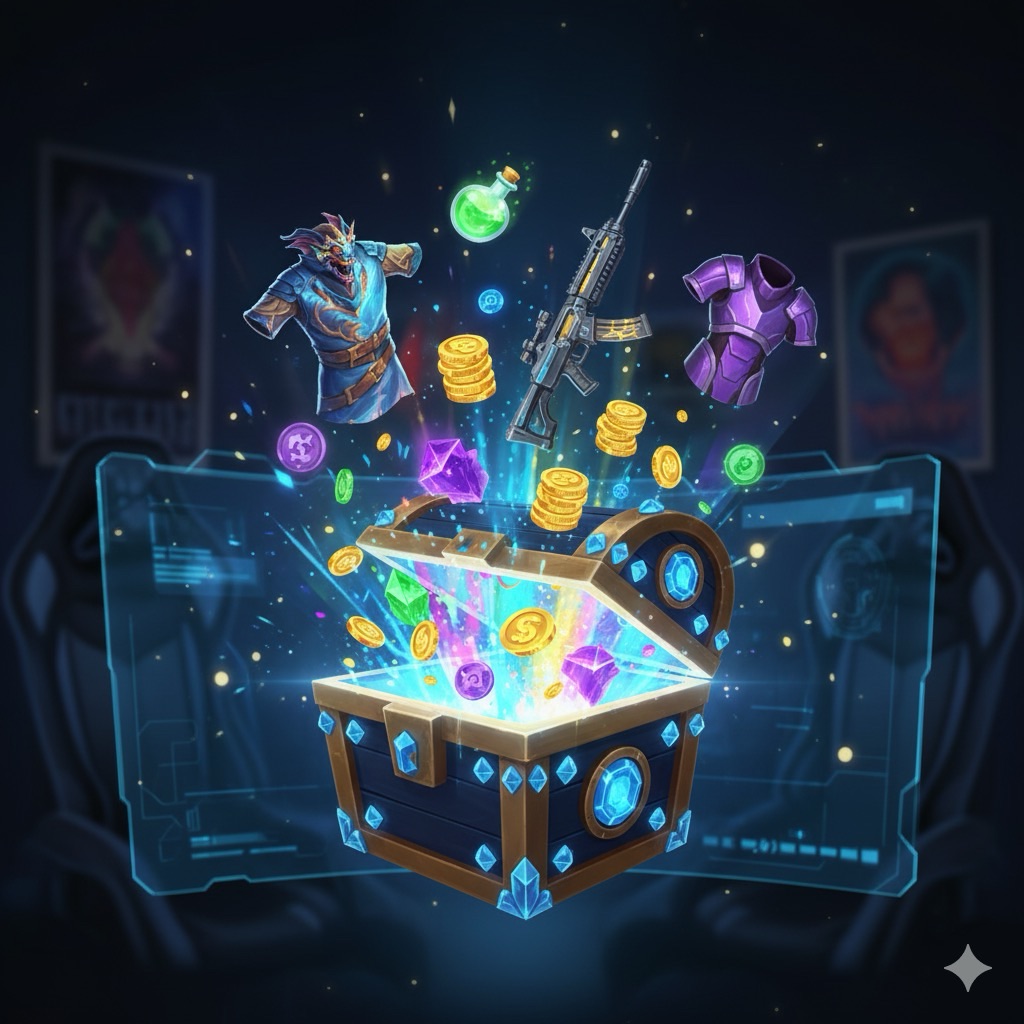
By Richard / December 2025. In today’s digital gaming world, seemingly harmless features like “loot boxes” and “skins” are raising growing concerns among parents, educators, researchers, and regulators. While these elements might look like just part of the fun in video games, evidence increasingly shows they mimic gambling behaviours—and children may be taking part without fully realising it. At Understand Tech, we want to break down exactly how loot boxes work, why they are so dangerous for young people, what the law says, and most importantly, how you can protect your children from spending hundreds of pounds (sometimes without your knowledge) on randomised, addictive digital items.
What this comprehensive guide covers:
- What loot boxes and skins actually are (and why they matter).
- The psychology of loot boxes and why they are gambling-adjacent.
- Why children are particularly vulnerable to loot box spending.
- Real research linking loot boxes to problem gambling and mental health issues.
- The three most problematic games (EA Sports FC, Roblox, Fortnite) and their specific risks.
- How much money children are actually spending (the real numbers).
- Complete platform-by-platform parental control setup guides (PlayStation, Xbox, Nintendo, PC).
- UK legal position and regulatory developments in 2025.
- Red flags to watch for and what constitutes problem gaming spending.
- Real parent case studies (successes and failures).
- Detailed FAQ addressing parent concerns.
1. What Are Loot Boxes and Skins? (And Why Parents Should Care)
Loot boxes are virtual treasure chests that players can buy or earn in games, containing randomised rewards such as character skins, weapons, cosmetics, or other in-game items. The key word is randomised—when you open a loot box, you do not know what you will get. This is identical to how a slot machine works.
Skins are cosmetic customisations that change the appearance of characters or gear but do not affect gameplay. In most games, skins hold no physical ownership value outside the game. However, in some games and markets, skins can be traded, sold, or even cashed out for real money on third-party websites—which is where the gambling problem becomes severe.
How Loot Boxes Work in Practice:
Imagine your child sees a YouTuber using an incredibly rare or exclusive skin. That skin looks cool, and they want it. In the game’s store, they see this skin is only available in a “Premium Loot Box” that costs £7.99. When they buy and open the box, there is a 3% chance they get the skin they want, and a 97% chance they get something else. They do not get the skin. They try again. And again. By the time they finally get the skin they want, they may have spent £40, £50, or even £100 without your knowledge.
⚠️ The Reality: According to research from 5 Rights Foundation (2025), approximately one-third (32%) of UK children report regretting money they spent while playing games online. Another study found that 43% of young people regretted purchases made on games. These are not marginal numbers—this is affecting millions of UK children.
2. The Psychology: How Loot Boxes Are Designed Like Slot Machines
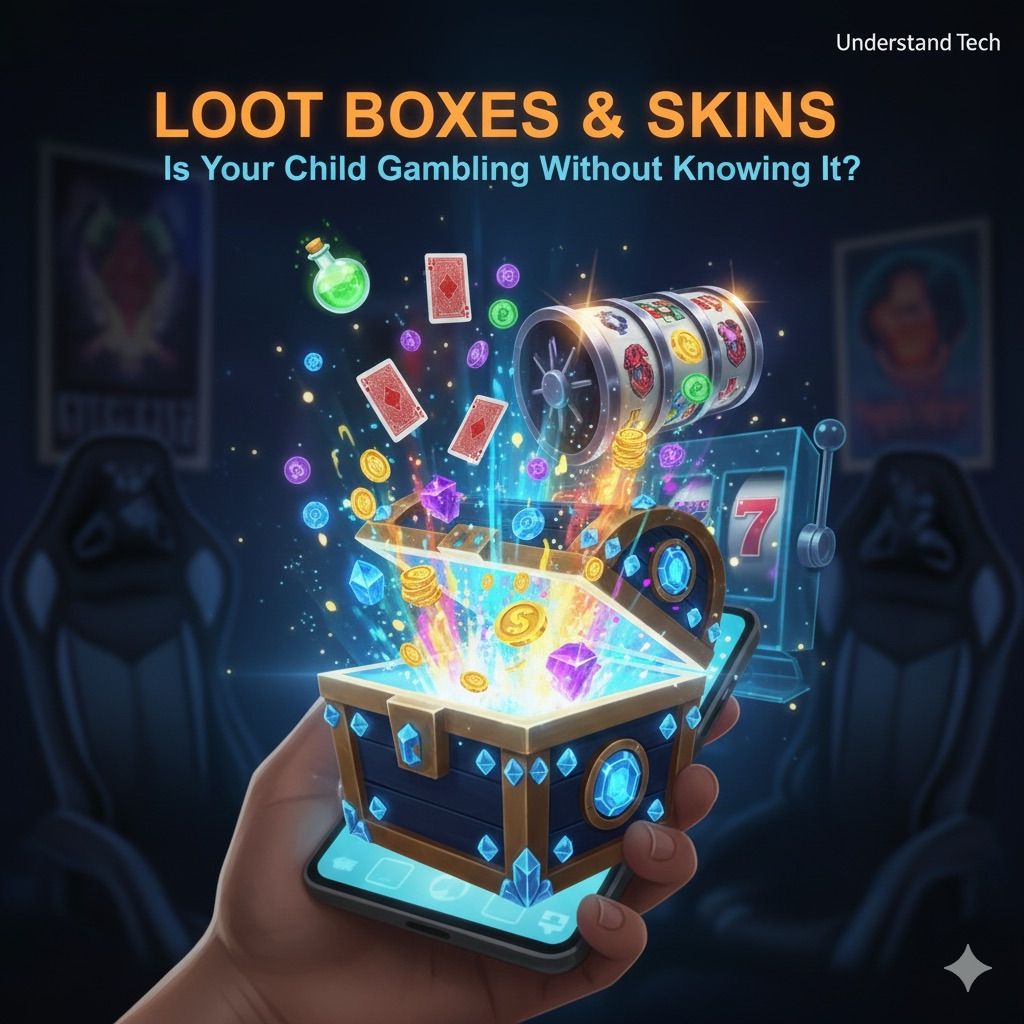
Loot boxes are not accidentally similar to gambling—they are deliberately designed with gambling principles at their core. Understanding this design is crucial because it shows you what your children are actually dealing with.
The Six Pillars of Gambling Psychology in Loot Boxes:
- Randomness (Variable Reward Schedule): You cannot predict what you will get. This unpredictability is what makes slot machines addictive, and it is exactly what loot boxes replicate. Your brain releases a dopamine hit with every unopened box, and the uncertainty keeps you coming back.
- Near Misses: Some loot box systems show you what you “almost” won. This psychological trick is borrowed directly from slot machines. Seeing that you were close to winning (but did not) makes people want to try again immediately.
- Loss Chasing: When you do not get what you wanted, you buy another box to try again. This is called “loss chasing”—a core feature of gambling addiction. A 2025 study from GambleAware found that 50% of people who use loot boxes experience “at any level of risk” from their spending.
- Artificial Scarcity (FOMO): Loot boxes are often only available for a limited time (“This skin expires in 24 hours!”). This creates Fear of Missing Out (FOMO), pressuring children to buy immediately without thinking.
- Psychological Rewards (Excitement): Opening a loot box mimics the arousal of pulling a slot machine lever. The ritual, the anticipation, the reveal—it is all engineered to feel exciting.
- Hidden Currency: Most games use abstract “coins” or “points” that you buy with real money. This layers of abstraction makes it psychologically easier to spend. Your child is not thinking “I am spending £7.99,” they are thinking “I am spending 800 of these colourful points.”
✓ Important distinction: While loot boxes share many similarities with gambling, not all loot boxes are legally classified as gambling in the UK—yet. This is a major loophole that the gaming industry exploits. However, the research is irrefutable: the psychological mechanics are nearly identical, and the harms are measurable.
How This Affects the Adolescent Brain Specifically:
Adolescents (aged 12–18) are particularly vulnerable to loot box spending because:
- Impulse control is still developing: The prefrontal cortex (responsible for impulse control and long-term planning) is not fully developed until age 25. Teens struggle to resist immediate gratification, even when they know it is a bad decision.
- Reward sensitivity is heightened: Teen brains are more sensitive to rewards than adult brains. The dopamine hit from opening a loot box is more intense for a 14-year-old than a 40-year-old.
- Social pressure is powerful: If all their friends have a particular skin, the social pressure to buy it is intense. FOMO is not just a saying for teens—it is a genuine emotional experience.
- They struggle with value assessment: Teens have not yet developed a strong sense of money’s real value. Spending £50 on a digital item feels abstract and consequence-free to them.
3. The Research: What Studies Show About Loot Boxes and Problem Gambling
If loot boxes were just harmless cosmetics, this would be a non-issue. But the research linking loot boxes to problem gambling is robust and growing.
Key Findings from 2024–2025 Research:
- GambleAware (2025): Found that 50% of people who use loot boxes experience “at any level of risk” from their engagement. This is shockingly high—equivalent to saying half of loot box users are at risk of harm.
- Plymouth University (2025): NHS England raised official concerns about loot boxes exposing children to gambling-like experiences. The health service explicitly called for restrictions.
- 5 Rights Foundation (2025): 32% of UK children regret money spent on games. 43% regret purchases made on games. This suggests widespread financial harm among young people.
- NIH Study (2019, replicated 2024–2025): Found that adolescents who spent more on loot boxes showed stronger links to problem gambling than adults. The relationship was of “moderate to large magnitude.” Adolescents are MORE vulnerable, not less.
- Computers in Human Behavior (2025): A study of 1,400+ adults found that loot box purchases are linked to real-world gambling behaviours, gaming addiction, anxiety, depression, and stress. The researchers concluded that loot boxes share “similar health risk factors with other behavioural addictions.”
Direct quote from NHS England (2020): “No company should be setting up kids for addiction by teaching them to gamble.” This is not hyperbole from a charity—this is the official position of the UK’s health service.
What Does “At Risk” Actually Mean?
When researchers say someone is “at risk” from loot box spending, they mean:
- Spending more than intended or losing track of spending.
- Continuing to spend despite negative consequences (grades dropping, sleep loss, financial stress).
- Chasing losses (buying more boxes to try to recover from a bad purchase).
- Prioritising loot box spending over other needs.
- Experiencing withdrawal symptoms (anxiety, irritability) when unable to spend.
4. Real Spending: How Much Are Children Actually Spending?
The numbers are staggering. Research and anecdotal evidence from parents and gaming communities reveal the scale of the problem:
- Average annual spending (Problem Gamblers): Teens identified as “problem loot box spenders” report spending £300–£1,200 per year on loot boxes alone.
- Extreme cases: The gaming subreddit r/gaming regularly features posts from parents discovering their children have spent £500–£2,000+ on a single game’s loot boxes in a matter of weeks.
- One recent case: A 14-year-old secretly used their parents’ credit card to spend £3,400 on FIFA (now EA Sports FC) Ultimate Team packs in four months before the parents noticed the credit card charges.
- Normalisation: Among heavy gaming communities, spending £20–£50 per week on loot boxes is considered normal. This is normalised addiction.
⚠️ Critical reality: If your child has access to a credit card, PayPal, or a saved payment method on their gaming console, they can rack up hundreds of pounds in charges before you notice. Gaming companies are deliberately designed to make spending easy and hiding obvious (no confirmation emails, purchases hidden in obscure menus, etc.).
5. The “Big Three” Problem Games (And How to Control Them)
Why These Three?
These games were chosen because they (1) are extremely popular with UK children, (2) have aggressive loot box or spending mechanics, and (3) have proven track records of children spending hundreds of pounds on them.
⚽ EA Sports FC 26 (Formerly FIFA)
The Risk Level: EXTREME. This is the game most associated with childhood gambling-adjacent spending in the UK.
How the Spending Works: “Ultimate Team” mode is the problematic feature. Players buy packs of randomised football player cards to build a team. The odds of getting a top-tier player (like Mbappé, Haaland, or Rodri) are incredibly low—often less than 1%. This means your child may buy 50, 100, or even 200 packs before getting the card they want. Each pack costs £3.99 to £17.99.
Real spending example: A child wants Erling Haaland (rated 92). The pull rate for a 92-rated card is approximately 0.11%. To have a statistical 50% chance of pulling him, they would need to open roughly 630 packs, costing approximately £2,500–£10,700 depending on pack type.
Parental Controls (PlayStation 5):
- Go to Settings → Family and Parental Controls → Family Management.
- Select your child’s account.
- Go to Spending Limits → Monthly Spending Limit.
- Set it to £0.00.
- This blocks all in-game purchases entirely.
In-game controls (for users who want to allow some spending):
- In EA Sports FC, go to Settings → Account Settings → FC Playtime.
- Enable spending warnings and set daily/weekly pack limits.
- This does not block spending but makes it more visible.
Best practice: Set platform spending to £0. Do not rely on in-game warnings alone—they are designed to be easy to dismiss.
🧱 Roblox
The Risk Level: VERY HIGH. Roblox is insidious because it is a platform with hundreds of games, not a single game. Your child can spend across multiple experiences.
How the Spending Works: “Robux” is Roblox’s virtual currency. Players buy Robux with real money (£4.99 for 400 Robux, £9.99 for 800 Robux, etc.). Robux can be spent on cosmetics, game passes, or limited-time items. Because the currency is abstract and multiple games are involved, spending can spiral quickly. Your child might spend £10 in one game, £15 in another, and £20 in a third—all within an hour.
The FOMO trap: Limited-edition items in Roblox create intense FOMO. Items that are only available for 24–72 hours pressure children into impulse purchases.
Parental Controls (Roblox Accounts):
- Go to the Roblox website → Account Settings.
- Select Parental Controls.
- Link your parent account to your child’s account.
- Go to Spending Controls.
- Set a Monthly Spending Limit (e.g., £0 or £5).
- Enable PIN requirement for transactions. This means every single purchase requires a PIN you set. This is the most effective control.
Critical step: Enable the PIN requirement. Without it, spending limits are ineffective—determined children can keep trying until they get through.
🔫 Fortnite
The Risk Level: HIGH (but different from the above). Fortnite does not use randomised loot boxes—you buy exactly what you see. The problem is FOMO and peer pressure.
How the Spending Works: “V-Bucks” are Fortnite’s currency. Cosmetic skins are sold in the shop but only available for 24 hours at a time. This creates intense FOMO: “If I do not buy this skin now, I will never have it again.” Combined with social pressure (all their friends have a particular skin), children feel compelled to spend repeatedly.
Real example: A new collaboration skin is released (e.g., Harry Potter, Marvel character). It is only available for 48 hours. Your child’s entire friend group is buying it. The pressure is intense. A skin costs 1,500 V-Bucks (approximately £11.99). If your child sees three skins they want in a week, that is £36.
Parental Controls (Epic Games):
- Go to www.epicgames.com → Account → Parental Controls.
- Create a “Cabined Account” for children under 13.
- Set spending limits (you can set it to £0).
- Restrict in-game chat and social features.
For children 13+: Fortnite does not have native spending controls as restrictive as PlayStation or Roblox. You will need to:
- Link a payment method you control (not their card).
- Require them to ask before any purchase.
- Use console-level controls (PlayStation Family Settings, Xbox Family Settings) to block all purchases on the device.
6. Platform-by-Platform Parental Control Setup Guide
PlayStation 5 (Complete Setup)
Step 1: Create a Child Account
- Go to Settings → Users and Accounts → Other Users → Create User.
- Select Create a Child Account.
- Follow the prompts and link it to your Parent Account.
Step 2: Set Spending Limits
- From your Parent Account, go to Settings → Family and Parental Controls → Family Management.
- Select the child’s account.
- Go to Spending Limits → Monthly Spending Limit.
- Set to £0.00 to block all purchases, or set a limit (e.g., £5/month).
Step 3: Restrict Content
- In the same menu, select Playtime Settings.
- Set Playtime Duration Limits (e.g., 2 hours on school days, 4 hours on weekends).
- Set Bedtime (e.g., 10 PM) and Wake Time (e.g., 6 AM). Console cannot be used between these times.
Xbox (Series X/S)
Using Xbox Family Settings App:
- Download the Xbox Family Settings App on your phone.
- Create a child account and link it to your account.
- In the app, go to Spending → Spending Limit.
- Set “Ask to Buy” for every purchase (most restrictive option).
- Alternatively, set a spending limit of £0.
Playtime settings:
- In the app, go to Playtime.
- Set daily playtime allowance (e.g., 2 hours on school days).
- Set bedtime (console locks after specified time).
Nintendo Switch
Using Nintendo Switch Parental Controls App:
- Download the official Nintendo Switch Parental Controls App on your phone.
- Create a child account on the console and link it to the app.
- In the app, go to Restrictions → eShop.
- Set to Cannot use eShop (blocks all digital purchases).
Playtime settings:
- Set daily playtime limits.
- Set quiet hours when the console cannot be used.
PC/Steam
Steam has less restrictive parental controls than consoles:
- Go to Steam → Account Details → Family Library Sharing.
- Do NOT enable library sharing if you want to restrict spending (sharing enables purchases).
- Instead, use a separate child account.
- Do NOT link a payment method to the child account.
- Require them to ask you to add funds via Steam cards (physical cards you purchase, not automatic).
Better alternative: Use third-party parental control software like Bark or Qustodio on PC, which give you finer control over spending and purchases.
✓ Golden rule: Never save your credit card, PayPal, or debit card details on any gaming device or account your child uses. Instead, use gift cards (physical or digital) that you purchase in advance. When the gift card runs out, spending stops. This is the most effective control.
7. UK Law & The Regulatory Landscape (2025)
As of December 2025, the UK legal position on loot boxes is complex and evolving.
Current Legal Status:
- Loot boxes are NOT classified as gambling (yet): The UK Gambling Commission does not regulate loot boxes in games as gambling, provided the rewards cannot be “cashed out” for real money outside the game. This is a critical loophole.
- However, there are exceptions: If skins or loot box contents can be traded or sold for real money on third-party sites (e.g., CS:GO skins being sold on betting sites), that DOES constitute gambling and is subject to Gambling Commission enforcement.
- The government called for self-regulation: In July 2022, the UK government responded to evidence on loot boxes by calling on the gaming industry to self-regulate rather than introducing legislation. However, industry self-regulation has been inadequate.
What Experts Are Calling For:
- Ban for minors: The NHS, 5 Rights Foundation, and various MPs have called for loot boxes to be unavailable to anyone under 18 without parental permission.
- Display odds: Calls for all loot box pull rates to be displayed prominently (like phone app stores are required to show).
- Age verification: Requiring ID verification for accounts on games with heavy monetisation.
- Spending caps: Mandatory spending limits for accounts linked to minors.
What Might Change in 2026:
Several factors suggest stricter regulation is coming:
- Increasing evidence of harm (especially 2025 research showing links to problem gambling).
- Multiple calls from health bodies (NHS, Mental Health Foundation) for action.
- Possible future Gambling White Paper that might expand definitions of gambling.
- European regulation (if EU classifies loot boxes as gambling, UK may follow).
Bottom line: Do not wait for regulation. The current legal grey area is intentionally exploited by gaming companies. Protect your children yourself through parental controls and education.
8. Real Parent Case Studies: What Actually Happens
Case Study 1: James (Age 12, Discovered Too Late)
The Situation: James’ parents gave him an iPhone with access to Apple ID for “emergencies.” Apple ID was linked to their credit card. James discovered he could buy V-Bucks in Fortnite without needing permission.
What Happened: Over eight weeks, James spent £847 on V-Bucks and cosmetics. His parents discovered it only when reviewing their credit card statement. James claimed he “did not know it was real money.”
What They Did Wrong:
- Did not link their credit card to the child’s device.
- Did not explain the difference between virtual and real money.
- Did not monitor spending or set up parental controls.
- Did not have conversations about monetisation in games.
What They Fixed: They removed all payment methods from James’ devices, set up Family Link on his Nintendo Switch (blocking the eShop entirely), and had explicit conversations about how real money works. James is now allowed £5/month on gift cards, which he spends deliberately rather than impulsively.
The Lesson: Young children (under 13) do not fully understand the connection between digital spending and real money. Never link credit cards to child accounts.
Case Study 2: Emma (Age 15, The “Good” Outcome)
The Situation: Emma’s parents discovered she was spending £200/month on Ultimate Team packs in EA Sports FC. They were shocked but approached it calmly.
What They Did: Instead of banning gaming entirely, they:
- Set platform spending to £0 (blocking all in-game purchases).
- Gave her a £20/month gaming budget in the form of a gift card.
- Explained the psychology of loot boxes and loss chasing.
- Made a deal: “If you can stick to £20/month for three months, we will review this.”
The Result: Emma’s spending normalised. She still plays EA Sports FC but is more intentional about purchases. She says understanding the psychology behind loot boxes made her resistant to them. She now spends an average of £12/month.
The Lesson: Older teens respond better to education + reasonable limits than to total prohibition. Give them autonomy within guardrails.
Case Study 3: Marcus (Age 14, Addiction Spiral)
The Situation: Marcus’ parents discovered he had spent £3,400 on Ultimate Team packs in three months using their credit card. His grades were dropping and he was anxious about school.
What They Discovered: Marcus admitted he was experiencing “loss chasing”—he would spend, not get the card he wanted, and immediately spend again to “try to make up for it.” He described it as feeling like a “need” rather than a want.
What They Did:
- Removed EA Sports FC entirely from the house for two weeks.
- Contacted EA and disputed the charges (successfully recovered £1,500).
- Set up hard blocks: console spending set to £0, credit cards removed from all devices.
- Sought support from a counsellor who specialises in gaming.
- Slowly reintroduced gaming with gift cards (£10/month) and monitored behaviour carefully.
The Result: Three months later, Marcus was able to use gaming moderately. He still had urges to spend but recognised them and could resist. His grades improved and his anxiety dropped.
The Lesson: Severe loot box spending can be addictive and may require professional support. Cold turkey (temporary removal) combined with hard parental controls is sometimes necessary.
Case Study 4: Sophia (Age 13, The Prevention Story)
The Situation: Sophia’s parents set up parental controls BEFORE she started gaming, not after.
What They Did From Day One:
- Created a child account with spending set to £0.
- Educated Sophia about loot boxes before she encountered them.
- Showed her a video about “loss chasing” and how it works psychologically.
- Made a deal: “If you want to buy cosmetics, you save pocket money and ask me first. We will discuss together if it is worth £10.”
The Result: After two years of gaming, Sophia has spent approximately £30 total. She actively makes fun of friends who spend excessively. She has developed healthy scepticism about loot boxes.
The Lesson: Prevention through education + proactive parental controls from the start is the most effective strategy.
9. Red Flags: When Loot Box Spending Becomes Addiction
Immediate Red Flags (Intervene Within Days):
- Unexpected charges: You find charges on your credit card or bank statement you did not authorise. Do not ignore this.
- Obsessive checking of account balance: Your child constantly checks how many coins/Robux/V-Bucks they have left.
- Asking for money specifically for “skins” or “packs”: They are explicitly asking to buy cosmetics or loot boxes.
- Emotional distress when unable to buy: They become anxious, angry, or disproportionately upset when they cannot spend.
- Attempts to hide spending: You find evidence they are trying to hide purchases (deleting emails, using different devices).
Medium-Term Red Flags (Intervene Within 1–2 Weeks):
- Repeated spending “to get one specific item”: They keep buying packs, repeatedly saying “just one more.”
- Academic impact: Homework neglected, grades dropping because they are focused on games/spending.
- Sleep disruption: Staying up late gaming/spending, being exhausted at school.
- Social withdrawal: Less interest in real-world friends or activities; spending money instead of time with friends.
- Borrowing money: Asking friends or family members for money to spend on games.
✓ If you spot red flags: Have a calm conversation first, not an accusation. “I have noticed you seem really focused on getting [specific item]. Tell me what is going on.” Listen. Then implement controls.
10. Frequently Asked Questions
Are loot boxes actually gambling?
Legally in the UK, not yet. But psychologically and functionally, yes. Loot boxes use identical reward mechanisms to slot machines (randomness, loss chasing, near misses). The NHS and health experts argue they should be regulated as gambling. The gaming industry argues the items have no real-world cash value (unless they can be sold externally). This distinction is a legal loophole. Regardless of legal classification, the harm is real.
Can I get my money back if my child spent money on loot boxes?
Sometimes. If the spending is on a credit card (not gift cards), you can dispute the charges with your bank as unauthorised. Apple, Google, and PlayStation sometimes refund one-time purchases if you argue your child made them without permission. Contact support for each platform. However, do not rely on refunds—prevention through controls is more effective. Note: Multiple refund requests may result in your account being flagged or restricted.
Is it okay to let my child spend £20/month on games?
If it is their own money from pocket money or earnings, yes—it teaches financial responsibility. If it is your money, it depends on your values and financial situation. The research suggests up to £5–10/month is reasonable for teens 14+; under 13, spending should be avoided entirely. The key is intentional, transparent spending, not impulse spending on randomised items.
My child says “all their friends have the skin”—what should I say?
This is FOMO (Fear of Missing Out), and it is a powerful psychological trigger. You can say: “I understand everyone wants the same thing. But that skin will come back around. And even if it does not, having it does not make you a better person or a better friend. Let’s find something else that makes you happy that costs less.” Help them resist social pressure by pointing out how the algorithm/marketing is deliberately designed to create FOMO. Understanding the psychology helps them resist it.
What if my child disables parental controls I set up?
This is a serious breach of trust and an opportunity for conversation. Determine if they know the password (they should not) or if they found a workaround. If they deliberately circumvented controls, that is grounds for losing gaming privileges temporarily. However, the better approach is understanding why: “Why did you feel you needed to turn this off? Let us talk about what you wanted to buy and why.” Sometimes the controls need adjustment based on their input. Other times, it means losing the device temporarily.
Is Fortnite more dangerous than FIFA/EA Sports FC?
Different but equally dangerous. FIFA/Ultimate Team is more random (loot box addiction); Fortnite is more FOMO-driven (limited cosmetics). Both exploit psychological vulnerabilities. FIFA is more likely to cause “loss chasing”; Fortnite is more likely to cause social anxiety (“I do not have the cool skin everyone else has”). Choose your battles based on your child’s vulnerabilities.
Should I ban gaming entirely?
No. Gaming is a normal part of modern childhood and can be educational and social. Total prohibition backfires—it creates resentment and secret gaming. Instead, set boundaries: spending limits, time limits, parental controls, and education. The goal is healthy gaming, not no gaming.
How do I know if my child has a problem?
Ask yourself: (1) Is spending affecting their academic performance? (2) Are they losing sleep? (3) Are they hiding spending or lying about it? (4) Is spending causing family conflict? (5) Do they seem anxious or distressed when unable to spend? If you answered yes to any of these, it is time to intervene and possibly seek professional support.
11. The Parent’s Complete Action Plan
Your Step-by-Step Strategy (Start Today)
- Educate yourself: Spend 30 minutes playing one of the “Big Three” games yourself. Experience the spending mechanics firsthand. You cannot protect what you do not understand.
- Check for current spending: Log into your child’s accounts (or ask them to) and review their spending history. Look at bank statements for recurring charges. You may find spending you were not aware of.
- Remove all payment methods: Delete credit cards, PayPal, and saved payment methods from EVERY gaming device and account. Do this today. Do not wait.
- Set up platform controls: Use the setup guides above to lock down spending on PlayStation, Xbox, Nintendo, PC, and mobile. Set spending to £0 initially. You can adjust once you are confident.
- Have the conversation: Explain loot boxes, randomness, loss chasing, and FOMO to your child. Show them how the psychology works. Do not shame them—this is a learning opportunity.
- Establish clear boundaries: Explain that spending on cosmetics is allowed but requires discussion and agreement. Create a budget together (e.g., £10/month maximum for ages 14+).
- Use gift cards only: Provide spending money as gift cards (iTunes, PlayStation Store, Google Play), never credit cards or PayPal. When it runs out, it is gone.
- Monitor regularly: Check in monthly on spending habits. Ask what they bought, why, and if they regret it. This teaches financial reflection.
- Watch for red flags: If you see signs of addiction (loss chasing, hiding spending, academic impact), tighten controls and consider professional support.
- Stay updated: Games and spending mechanics change. Stay informed about what your children are playing and how they monetise.
Final Takeaway: Loot Boxes Are Gambling, And Your Children Are The Targets
The gaming industry has built a multi-billion-pound business on loot boxes, and they are deliberately targeting children with psychological manipulation. They argue it is just cosmetics, but the research is irrefutable: loot boxes cause real harm.
Your job as a parent is not to ban gaming—gaming is here to stay. Your job is to protect your children from exploitation by setting hard boundaries, using parental controls, and educating them about how these systems work.
The good news? When parents are informed and take action, children adapt quickly. They develop healthy scepticism about loot boxes. They make intentional purchasing decisions. They learn that real fulfillment does not come from cosmetic items.
Start today. Remove your payment methods from their devices. Set spending to zero. Have the conversation. This is one of the most important digital literacy conversations you will have with your child.